Learning
Control codes to steer your language models into a right direction.
✅ CTRL: A Conditional Transformer Language Model for Controllable Generation from Salesforce: https://arxiv.org/abs/1909.05858
✅ PPLM from Uber: https://eng.uber.com/pplm/
✅ My new Artificial Intelligence Book is out: https://amzn.to/37kBr99
🔥 Contentyze, a content generation platform: https://contentyze.com/
#salesforce #machinelearning #transformer

This video explains the Transformer architecture in a very detailed way, including most math formulas in the paper, and the neural network operations behind it. The Transformer is the foundation of many powerful language models like BERT, GPT3, RoBERTa, XLNET, ELECTRA, T5. Understanding how it works in detail might help you modify, optimize, or improve it in the way you want.
Connect
Linkedin https://www.linkedin.com/in/xue-yong-fu-955723a6/
Twitter https://twitter.com/home
Email [email protected]
0:00 - Intro
1:10 - Architecture overview
1:56 - Encoder
3:58 - Residual connection & layer normalization
6:59 - Decoder
11:14 - Attention mechanism
14:30 - Scaled dot-product attention
20:22 - Learned projection layers
26:32 - Multi-head attention
28-39 - Encoder-decoder attention
31:18 - Encoder self-attention
31:34 - Decoder self-attention
33:58 - Position-wise feedforward network
36:41 - Word embedding
39:34 - Positional encoding
47:37 - Why self-attention
What Is GPT-3 Series
https://www.youtube.com/playli....st?list=PLoS8jSwcU-c
Paper: Attention Is All You Need
https://arxiv.org/abs/1706.03762
Abstract
The dominant sequence transduction models are based on complex recurrent or convolutional neural networks that include an encoder and a decoder. The best
performing models also connect the encoder and decoder through an attention mechanism. We propose a new simple network architecture, the Transformer, based solely on attention mechanisms, dispensing with recurrence and convolutions entirely. Experiments on two machine translation tasks show these models to be superior in quality while being more parallelizable and requiring significantly less time to train. Our model achieves 28.4 BLEU on the WMT 2014 English- to-German translation task, improving over the existing best results, including ensembles, by over 2 BLEU. On the WMT 2014 English-to-French translation task, our model establishes a new single-model state-of-the-art BLEU score of 41.0 after training for 3.5 days on eight GPUs, a small fraction of the training costs of the best models from the literature. We show that the Transformer generalizes well to other tasks by applying it successfully to English constituency parsing both with large and limited training data.

GPT-J-6B - Just like GPT-3 but you can actually download the weights and run it at home. No API sign-up required, unlike some other models we could mention, right? Any just like GPT-3, this has 3 super easy example ways you can run this -v ia the EleutherAI website, Google Colab TPU or single GPU on a local system.
Buy art & support a nerd!
https://t.co/kAUP0Vfq48?amp=1
Github: https://github.com/kingoflolz/mesh-transformer-jax
Requirements for this guide to running locally:
* Ubuntu 20.04
* 32 GB RAM and an Nvidia GPU with at least 24 GB VRAM
* Anaconda - https://www.anaconda.com/products/individual
== Python virtual environment (Anaconda) ==
conda create --name mesh-transformer-jax python=3.8
conda activate mesh-transformer-jax
== Download & install ==
git clone https://github.com/kingoflolz/mesh-transformer-jax.git
cd mesh-transformer-jax
sudo apt install zstd
wget https://the-eye.eu/public/AI/G....PT-J-6B/step_383500_
tar -I zstd -xf step_383500_slim.tar.zstd
pip install torch==1.8.1+cu111 torchvision==0.9.1+cu111 torchaudio==0.8.1 -f https://download.pytorch.org/whl/torch_stable.html
pip install jaxlib==0.1.67+cuda111 -f https://storage.googleapis.com..../jax-releases/jax_re
pip install -r requirements.txt # (Edited to use tensorflow-gpu 2.5.0 for no reason)
pip install jax==0.2.12
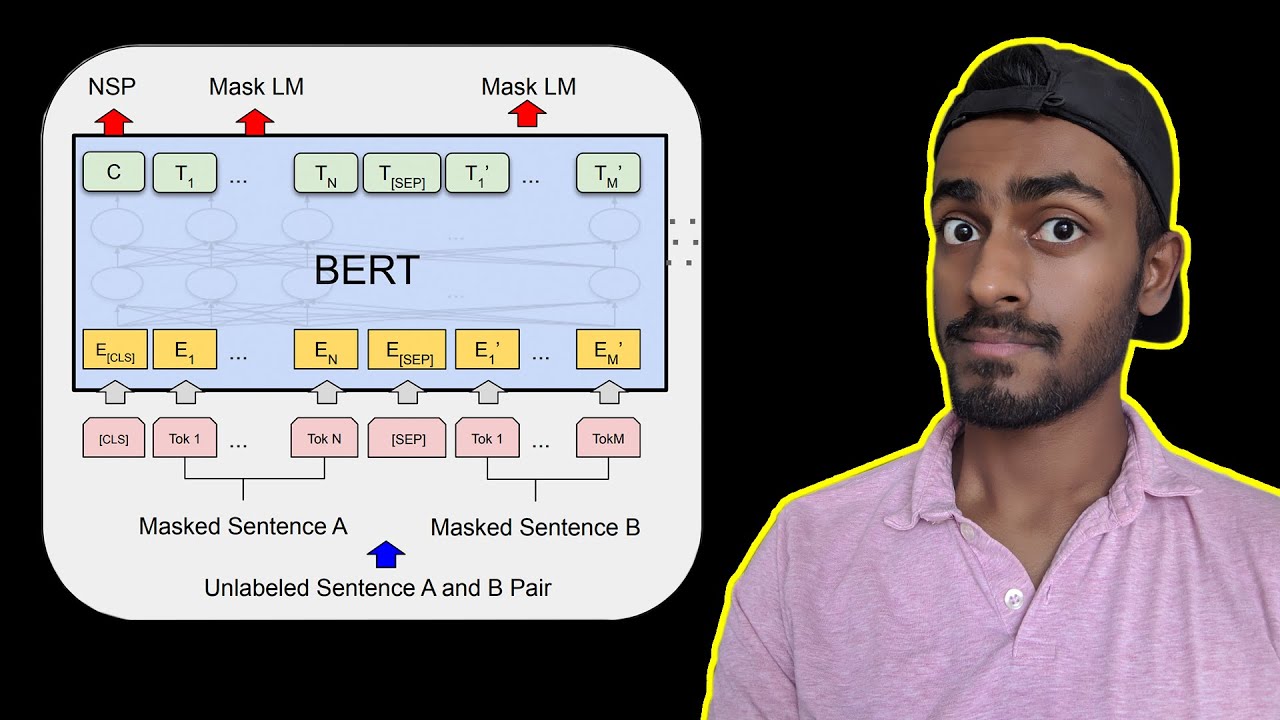
Understand the BERT Transformer in and out.
Follow me on M E D I U M: https://towardsdatascience.com..../likelihood-probabil
Please subscribe to keep me alive: https://www.youtube.com/c/Code....Emporium?sub_confirm
INVESTING: (You can get 3 free stocks setting up a webull account today): https://a.webull.com/8XVa1znjYxio6ESdff
⭐ Coursera Plus: $100 off until September 29th, 2022 for access to 7000+ courses: https://imp.i384100.net/Coursera-Plus
MATH COURSES (7 day free trial)
📕 Mathematics for Machine Learning: https://imp.i384100.net/MathML
📕 Calculus: https://imp.i384100.net/Calculus
📕 Statistics for Data Science: https://imp.i384100.net/AdvancedStatistics
📕 Bayesian Statistics: https://imp.i384100.net/BayesianStatistics
📕 Linear Algebra: https://imp.i384100.net/LinearAlgebra
📕 Probability: https://imp.i384100.net/Probability
OTHER RELATED COURSES (7 day free trial)
📕 ⭐ Deep Learning Specialization: https://imp.i384100.net/Deep-Learning
📕 Python for Everybody: https://imp.i384100.net/python
📕 MLOps Course: https://imp.i384100.net/MLOps
📕 Natural Language Processing (NLP): https://imp.i384100.net/NLP
📕 Machine Learning in Production: https://imp.i384100.net/MLProduction
📕 Data Science Specialization: https://imp.i384100.net/DataScience
📕 Tensorflow: https://imp.i384100.net/Tensorflow
REFERENCES
[1] BERT main paper: https://arxiv.org/pdf/1810.04805.pdf
[1] BERT in google search: https://blog.google/products/s....earch/search-languag
[2] Overview of BERT: https://arxiv.org/pdf/2002.12327v1.pdf
[4] BERT word embeddings explained: https://medium.com/@_init_/why....-bert-has-3-embeddin
[5] More details of BERT in this amazing blog: https://towardsdatascience.com..../bert-explained-stat
[6] Stanford lecture slides on BERT: https://nlp.stanford.edu/semin....ar/details/jdevlin.p
GPT-3 is the biggest language ever model built, and it has been attracting a lot of attention. Rather than argue about whether GPT-3 is overhyped or not, we wanted to dig in to the literature and understand what GPT-3 is (and is not) in light of it’s predecessors and alternative transformer models. In this video we share some of what we’ve learned. What is GPT-3 really good at? What are its constraints? How useful is it for business? Enjoy!
⏰ Time Stamps ⏰
00:40 - Comparison of latest Natural Language Processing Models
01:09 - What is a Transformer Model
01:50 - The Two Types of Transformer Models
02:15 - Difference between bi-directional encoders (BERT) and autoregressive decoders (GPT)
04:40 - GPT-3 is HUGE, does size matter?
05:24 - Presentation of size differences between GPT-3 relative to BERT, RoBERTa, GPT-2, and T5
07:40 - What does GPT do and how is it different than the BERT family?
18:05 - Is GPT-3 a Child Prodigy or a Parlor Trick?
18:44 - Back to the Issue of GPT-3's size
19:30 - Final thoughts on GPT-3 vs BERT


Short segments of AIAW Podcast Episode 003 with Patrick Couch.

How to Convert MBR to GPT During Windows 10/8/7 Installation.
Sometimes, when you are trying to install Windows on your PC, "Windows cannot be installed to this disk. the selected disk has an MBR partition table. On EFI system, Windows can only be installed to GPT disks" error message pops up and interrupts the installing process. Please note the conversion process will format/clean the drive as shown in the tutorial.
In this case, you are required to convert MBR to GPT to get the problem fixed. But how can you make it during Windows installation?
This tutorial will apply for computers, laptops, desktops,and tablets running the Windows 10, Windows 8/8.1, Windows 7 operating systems.Works for all major computer manufactures (Dell, HP, Acer, Asus, Toshiba, Lenovo, Samsung).
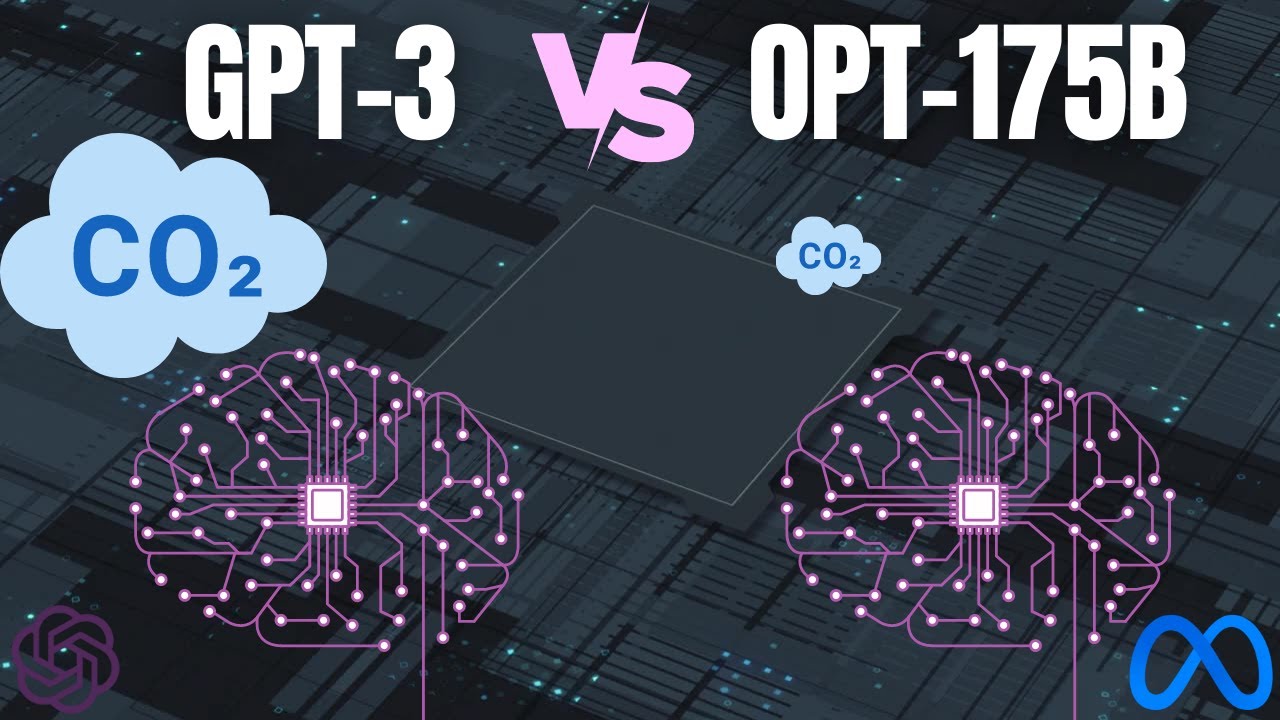
Sponsor of the video: http://wandb.me/whats-ai
References:
►Read the full article: https://www.louisbouchard.ai/opt-meta/
►Zhang, Susan et al. “OPT: Open Pre-trained Transformer Language Models.” https://arxiv.org/abs/2205.01068
►My GPT-3's video for large language models: https://youtu.be/gDDnTZchKec
►Meta's post: https://ai.facebook.com/blog/d....emocratizing-access-
►Code: https://github.com/facebookresearch/metaseq
https://github.com/facebookresearch/metaseq/tree/main/projects/OPT
►My Newsletter (A new AI application explained weekly to your emails!): https://www.louisbouchard.ai/newsletter/
Join Our Discord channel, Learn AI Together:
►https://discord.gg/learnaitogether
Chapters:
0:00 Hey! Tap the Thumbs Up button and Subscribe. You'll learn a lot of cool stuff, I promise.
1:34 Sponsor: w&b
2:28 OPT-175B
#GPT3 #OPT #Meta

Transformers are the rage nowadays, but how do they work? This video demystifies the novel neural network architecture with step by step explanation and illustrations on how transformers work.
CORRECTIONS:
The sine and cosine functions are actually applied to the embedding dimensions and time steps!
Audo Studio | Automagically Make Audio Recordings Studio Quality
https://www.audostudio.com/
Magic Mic | Join waitlist and get it FREE forever when launched! 🎙️
https://magicmic.ai/
Audo AI | Audio Background Noise Removal Developer API and SDK
https://audo.ai/
Subscribe to my email newsletter for updated Content. No spam 🙅♂️ only gold 🥇.
https://bit.ly/320hUdx
Discord Server: Join a community of A.I. Hackers
https://discord.gg/9wSTT4F
Hugging Face Write with Transformers
https://transformer.huggingface.co/

Learn how to get started with Hugging Face and the Transformers Library in 15 minutes! Learn all about Pipelines, Models, Tokenizers, PyTorch & TensorFlow integration, and more!
Get your Free Token for AssemblyAI Speech-To-Text API 👇https://www.assemblyai.com/?utm_source=youtube&utm_medium=referral&utm_campaign=yt_pat_26
Hugging Face Tutorial
Hugging Face Crash Course
Sentiment Analysis, Text Generation, Text Classification
Resources:
Website: https://huggingface.co
Course: https://huggingface.co/course
Finetune: https://huggingface.co/docs/transformers/training
▬▬▬▬▬▬▬▬▬▬▬▬ CONNECT ▬▬▬▬▬▬▬▬▬▬▬▬
🖥️ Website: https://www.assemblyai.com
🐦 Twitter: https://twitter.com/AssemblyAI
🦾 Discord: https://discord.gg/Cd8MyVJAXd
▶️ Subscribe: https://www.youtube.com/c/Asse....mblyAI?sub_confirmat
🔥 We're hiring! Check our open roles: https://www.assemblyai.com/careers
▬▬▬▬▬▬▬▬▬▬▬▬▬▬▬▬▬▬▬▬▬▬▬▬▬▬▬▬▬▬▬▬▬
Timestamps:
00:00 Intro
00:40 Installation
01:02 Pipeline
04:37 Tokenizer & Model
08:32 PyTorch / TensorFlow
11:07 Save / Load
11:35 Model Hub
13:25 Finetune
HuggingFace Tutorial
HuggingFace Crash Course
#MachineLearning #DeepLearning #HuggingFace
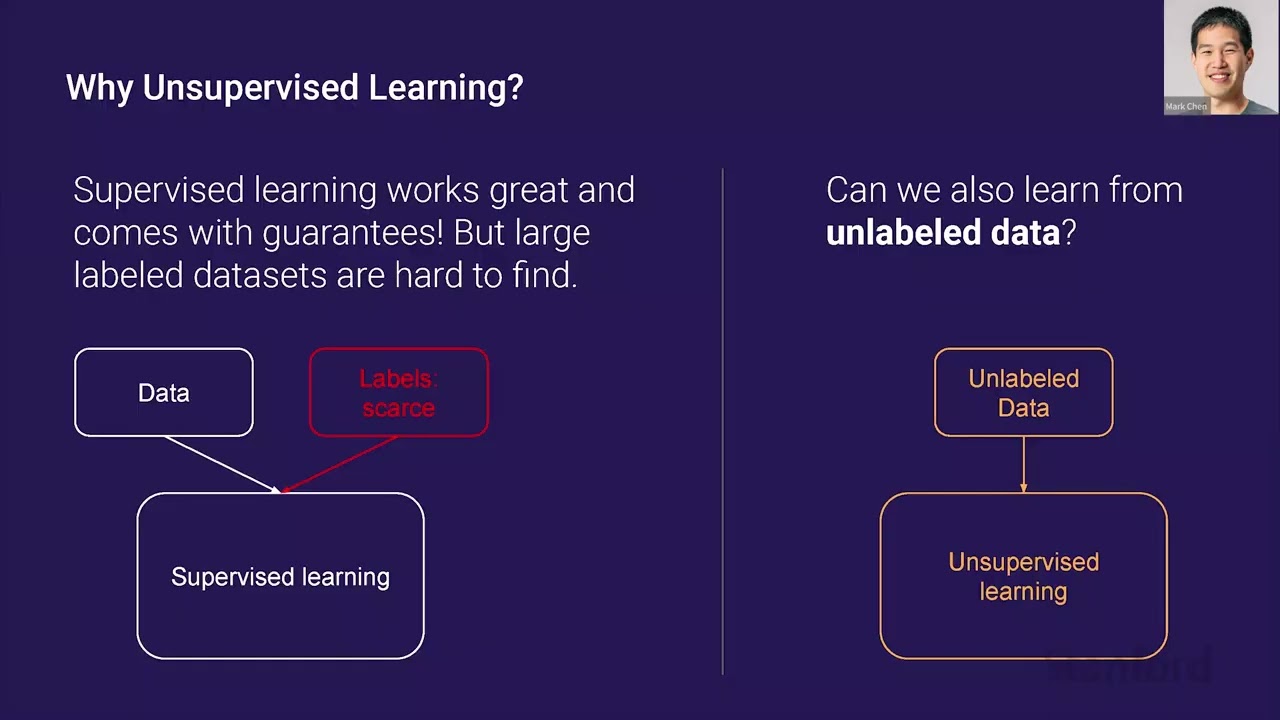
While the Transformer architecture is used in a variety of applications across a number of domains, it first found success in natural language. Today, Transformers remain the de facto model in language - they achieve state-of-the-art results on most natural language benchmarks, and can generate text coherent enough to deceive human readers. In this talk, we will review recent progress in neural language modeling, discuss the link between generating text and solving downstream tasks, and explore how this led to the development of GPT models at OpenAI. Next, we’ll see how the same approach can be used to produce generative models and strong representations in other domains like images, text-to-image, and code. Finally, we will dive into the recently released code generating model, Codex, and examine this particularly interesting domain of study.
Mark Chen is a research scientist at OpenAI, where he manages the Algorithms Team. His research interests include generative modeling and representation learning, especially in the image and multimodal domains. Prior to OpenAI, Mark worked in high frequency trading and graduated from MIT. Mark is also a coach for the USA Computing Olympiad team.
A full list of guest lectures can be found here: https://www.youtube.com/playli....st?list=PLoROMvodv4r
0:00 Introduction
0:08 3-Gram Model (Shannon 1951)
0:27 Recurrent Neural Nets (Sutskever et al 2011)
1:12 Big LSTM (Jozefowicz et al 2016)
1:52 Transformer (Llu and Saleh et al 2018)
2:33 GPT-2: Big Transformer (Radford et al 2019)
3:38 GPT-3: Very Big Transformer (Brown et al 2019)
5:12 GPT-3: Can Humans Detect Generated News Articles?
9:09 Why Unsupervised Learning?
10:38 Is there a Big Trove of Unlabeled Data?
11:11 Why Use Autoregressive Generative Models for Unsupervised Learnin
13:00 Unsupervised Sentiment Neuron (Radford et al 2017)
14:11 Radford et al 2018)
15:21 Zero-Shot Reading Comprehension
16:44 GPT-2: Zero-Shot Translation
18:15 Language Model Metalearning
19:23 GPT-3: Few Shot Arithmetic
20:14 GPT-3: Few Shot Word Unscrambling
20:36 GPT-3: General Few Shot Learning
23:42 IGPT (Chen et al 2020): Can we apply GPT to images?
25:31 IGPT: Completions
26:24 IGPT: Feature Learning
32:20 Isn't Code Just Another Modality?
33:33 The HumanEval Dataset
36:00 The Pass @ K Metric
36:59 Codex: Training Details
38:03 An Easy Human Eval Problem (pass@1 -0.9)
38:36 A Medium HumanEval Problem (pass@1 -0.17)
39:00 A Hard HumanEval Problem (pass@1 -0.005)
41:26 Calibrating Sampling Temperature for Pass@k
42:19 The Unreasonable Effectiveness of Sampling
43:17 Can We Approximate Sampling Against an Oracle?
45:52 Main Figure
46:53 Limitations
47:38 Conclusion
48:19 Acknowledgements
#gpt3

This week we’re looking into transformers. Transformers were introduced a couple of years ago with the paper Attention is All You Need by Google Researchers. Since its introduction transformers has been widely adopted in the industry.
Get your Free Token for AssemblyAI Speech-To-Text API 👇
https://www.assemblyai.com/?utm_source=youtube&utm_medium=referral&utm_campaign=yt_mis_8&utm_id=yt_mis_8
Models like BERT, GPT-3 made groundbreaking improvements in the world of NLP using transformers. Since then model libraries like hugging face made it possible for everyone to use transformer based models in their projects. But what are transformers and how do they work? How are they different from other deep learning models like RNNs, LSTMs? Why are they better?
In this video, we learn about it all!
Some of my favorite resources on Transformers:
The original paper - https://arxiv.org/pdf/1706.03762.pdf
If you’re interested in following the original paper with the code - http://nlp.seas.harvard.edu/20....18/04/03/attention.h
The Illustrated Transformer – https://jalammar.github.io/ill....ustrated-transformer
Blog about positional encodings - https://kazemnejad.com/blog/tr....ansformer_architectu
About attention - Visualizing A Neural Machine Translation Model - https://jalammar.github.io/vis....ualizing-neural-mach
Layer normalization - https://arxiv.org/abs/1607.06450
Some images used in this video are from:
https://colah.github.io/posts/....2015-08-Understandin
https://jalammar.github.io/vis....ualizing-neural-mach
https://medium.com/nanonets/ho....w-to-easily-build-a-
https://medium.com/swlh/elegan....t-intuitions-behind-

Connect and follow the speaker:
Abhilash Majumder - https://linktr.ee/abhilashmajumder
A blog used in the video:
https://jalammar.github.io/illustrated-gpt2/
Join and follow us on social media to get notified about our online and offline activities,
Website: https://colearninglounge.com
LinkedIn: https://www.linkedin.com/company/colearninglounge
Facebook: https://www.facebook.com/groups/colearninglounge
Github: https://github.com/colearningl....ounge/co-learning-lo
Telegram: https://t.me/ColearningLounge_AIRoom
Instagram: https://www.instagram.com/colearninglounge
Twitter: https://twitter.com/ColearninLounge
Medium: https://medium.com/co-learning-lounge

Hi friends,
This is the first video in a series on implementing a GPT-style model in Tensorflow. I scoured the web for days to find a video tutorial on Tensorflow and GPT-style transformer models to no avail. So I decided to make my own after reading through a dozen or so blog posts and PyTorch implementations.
Notable inspiration:
- https://colab.research.google.....com/github/d2l-ai/d2
- Apoory Nandan's Text Generation with Miniature GPT
- and many, many others.
I'm still learning this myself, so any questions or comments are valued. Thanks for your time.

colab linkhttps://colab.research.google.....com/drive/1o_-QIR8yV
⭐ Kite is a free AI-powered coding assistant that will help you code faster and smarter. The Kite plugin integrates with all the top editors and IDEs to give you smart completions and documentation while you’re typing. I've been using Kite for a few months and I love it! https://www.kite.com/get-kite/?utm_medium=referral&utm_source=youtube&utm_campaign=krishnaik&utm_content=description-only
All Playlist In My channel
Interview Playlist: https://www.youtube.com/playli....st?list=PLZoTAELRMXV
Complete DL Playlist: https://www.youtube.com/watch?v=9jA0KjS7V_c&list=PLZoTAELRMXVPGU70ZGsckrMdr0FteeRUi
Julia Playlist: https://www.youtube.com/watch?v=Bxp1YFA6M4s&list=PLZoTAELRMXVPJwtjTo2Y6LkuuYK0FT4Q-
Complete ML Playlist :https://www.youtube.com/playli....st?list=PLZoTAELRMXV
Complete NLP Playlist:https://www.youtube.com/playli....st?list=PLZoTAELRMXV
Docker End To End Implementation: https://www.youtube.com/playli....st?list=PLZoTAELRMXV
Live stream Playlist: https://www.youtube.com/playli....st?list=PLZoTAELRMXV
Machine Learning Pipelines: https://www.youtube.com/playli....st?list=PLZoTAELRMXV
Pytorch Playlist: https://www.youtube.com/playli....st?list=PLZoTAELRMXV
Feature Engineering :https://www.youtube.com/playli....st?list=PLZoTAELRMXV
Live Projects :https://www.youtube.com/playli....st?list=PLZoTAELRMXV
Kaggle competition :https://www.youtube.com/playli....st?list=PLZoTAELRMXV
Mongodb with Python :https://www.youtube.com/playli....st?list=PLZoTAELRMXV
MySQL With Python :https://www.youtube.com/playli....st?list=PLZoTAELRMXV
Deployment Architectures:https://www.youtube.com/playli....st?list=PLZoTAELRMXV
Amazon sagemaker :https://www.youtube.com/playli....st?list=PLZoTAELRMXV
Please donate if you want to support the channel through GPay UPID,
Gpay: krishnaik06@okicici
Telegram link: https://t.me/joinchat/N77M7xRvYUd403DgfE4TWw
Please join as a member in my channel to get additional benefits like materials in Data Science, live streaming for Members and many more
https://www.youtube.com/channe....l/UCNU_lfiiWBdtULKOw
Connect with me here:
Twitter: https://twitter.com/Krishnaik06
Facebook: https://www.facebook.com/krishnaik06
instagram: https://www.instagram.com/krishnaik06