Learning

With plenty of machine learning tools currently available, why would you ever choose an artificial neural network over all the rest? This clip and the next could open your eyes to their awesome capabilities! You'll get a closer look at neural nets without any of the math or code - just what they are and how they work. Soon you'll understand why they are such a powerful tool!
Deep Learning TV on
Facebook: https://www.facebook.com/DeepLearningTV/
Twitter: https://twitter.com/deeplearningtv
Deep Learning is primarily about neural networks, where a network is an interconnected web of nodes and edges. Neural nets were designed to perform complex tasks, such as the task of placing objects into categories based on a few attributes. This process, known as classification, is the focus of our series.
Classification involves taking a set of objects and some data features that describe them, and placing them into categories. This is done by a classifier which takes the data features as input and assigns a value (typically between 0 and 1) to each object; this is called firing or activation; a high score means one class and a low score means another. There are many different types of classifiers such as Logistic Regression, Support Vector Machine (SVM), and Naïve Bayes. If you have used any of these tools before, which one is your favorite? Please comment.
Neural nets are highly structured networks, and have three kinds of layers - an input, an output, and so called hidden layers, which refer to any layers between the input and the output layers. Each node (also called a neuron) in the hidden and output layers has a classifier. The input neurons first receive the data features of the object. After processing the data, they send their output to the first hidden layer. The hidden layer processes this output and sends the results to the next hidden layer. This continues until the data reaches the final output layer, where the output value determines the object's classification. This entire process is known as Forward Propagation, or Forward prop. The scores at the output layer determine which class a set of inputs belongs to.
Links:
Michael Nielsen's book - http://neuralnetworksanddeeplearning.com/
Andrew Ng Machine Learning - https://www.coursera.org/learn/machine-learning
Andrew Ng Deep Learning - https://www.coursera.org/speci....alizations/deep-lear
Have you worked with neural nets before? If not, is this clear so far? Please comment.
Neural nets are sometimes called a Multilayer Perceptron or MLP. This is a little confusing since the perceptron refers to one of the original neural networks, which had limited activation capabilities. However, the term has stuck - your typical vanilla neural net is referred to as an MLP.
Before a neuron fires its output to the next neuron in the network, it must first process the input. To do so, it performs a basic calculation with the input and two other numbers, referred to as the weight and the bias. These two numbers are changed as the neural network is trained on a set of test samples. If the accuracy is low, the weight and bias numbers are tweaked slightly until the accuracy slowly improves. Once the neural network is properly trained, its accuracy can be as high as 95%.
Credits:
Nickey Pickorita (YouTube art) -
https://www.upwork.com/freelan....cers/~0147b8991909b2
Isabel Descutner (Voice) -
https://www.youtube.com/user/IsabelDescutner
Dan Partynski (Copy Editing) -
https://www.linkedin.com/in/danielpartynski
Jagannath Rajagopal (Creator, Producer and Director) -
https://ca.linkedin.com/in/jagannathrajagopal
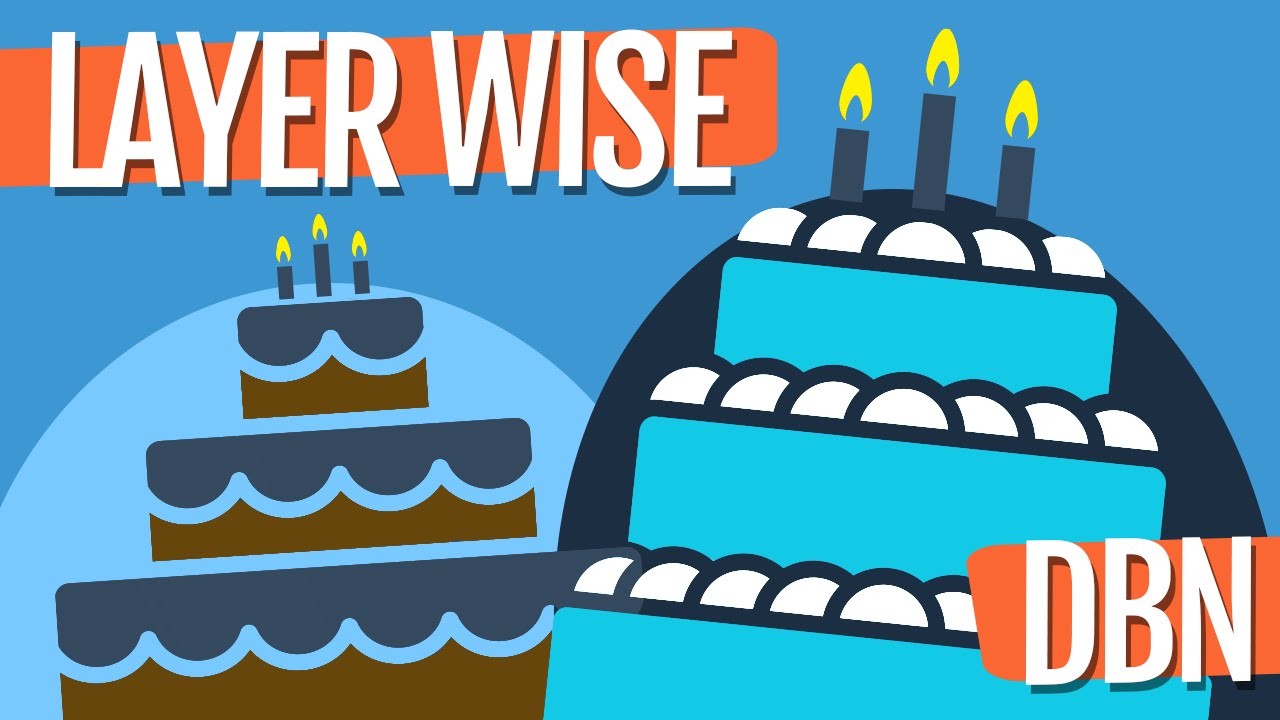
An RBM can extract features and reconstruct input data, but it still lacks the ability to combat the vanishing gradient. However, through a clever combination of several stacked RBMs and a classifier, you can form a neural net that can solve the problem. This net is known as a Deep Belief Network.
Deep Learning TV on
Facebook: https://www.facebook.com/DeepLearningTV/
Twitter: https://twitter.com/deeplearningtv
The Deep Belief Network, or DBN, was also conceived by Geoff Hinton. These powerful nets are believed to be used by Google for their work on the image recognition problem. In terms of structure, a Deep Belief is identical to a Multilayer Perceptron, but structure is where their similarities end – a DBN has a radically different training method which allows it to tackle the vanishing gradient.
The method is known as Layer-wise, unsupervised, greedy pre-training. Essentially, the DBN is trained two layers at a time, and these two layers are treated like an RBM. Throughout the net, the hidden layer of an RBM acts as the input layer of the adjacent one. So the first RBM is trained, and its outputs are then used as inputs to the next RBM. This procedure is repeated until the output layer is reached.
Have you ever used this method to train a Deep Belief Network? Please comment and let me know your thoughts.
After this training process, the DBN is capable of recognizing the inherent patterns in the data. In other words, it’s a sophisticated, multilayer feature extractor. The unique aspect of this type of net is that each layer ends up learning the full input structure. In other types of deep nets, layers generally learn progressively complex patterns – for facial recognition, early layers could detect edges and later layers would combine them to form facial features. On the other hand, A DBN learns the hidden patterns globally, like a camera slowly bringing an image into focus.
In the end, a DBN still requires a set of labels to apply to the resulting patterns. As a final step, the DBN is fine-tuned with supervised learning and a small set of labeled examples. After making minor tweaks to the weights and biases, the net will achieve a slight increase in accuracy.
This entire process can be completed in a reasonable amount of time using GPUs, and the resulting net is typically very accurate. Thus the DBN is an effective solution to the vanishing gradient problem. As an added real-world bonus, the training process only requires a small set of labelled data.
Credits
Nickey Pickorita (YouTube art) -
https://www.upwork.com/freelan....cers/~0147b8991909b2
Isabel Descutner (Voice) -
https://www.youtube.com/user/IsabelDescutner
Dan Partynski (Copy Editing) -
https://www.linkedin.com/in/danielpartynski
Jagannath Rajagopal (Creator, Producer and Director) -
https://ca.linkedin.com/in/jagannathrajagopal

Deep Learning libraries provide pre-written, professional-quality code that you can use for your own projects. Given the complexity of deep net applications, reusing code is a wise choice for a developer.
Deep Learning TV on
Facebook: https://www.facebook.com/DeepLearningTV/
Twitter: https://twitter.com/deeplearningtv
A library is a set of functions and modules that you can call through your own programs. Library code is typically created by highly-qualified software teams, and many libraries bring together large communities that support and extend the codebase. If you’re a developer, you’ve almost certainly used a library at one point in time.
For a commercial-grade deep learning application, the best libraries are deeplearning4j, Torch, and Caffe. The library Theano is suited for educational, research, and scientific projects. Other available libraries include Deepmat and Neon.
Have you ever tried to code your own deep net? Did you use a library to help simplify the process? Please comment and share your thoughts.
Credits
Nickey Pickorita (YouTube art) -
https://www.upwork.com/freelan....cers/~0147b8991909b2
Isabel Descutner (Voice) -
https://www.youtube.com/user/IsabelDescutner
Dan Partynski (Copy Editing) -
https://www.linkedin.com/in/danielpartynski
Marek Scibior (Prezi creator, Illustrator) -
http://brawuroweprezentacje.pl/
Jagannath Rajagopal (Creator, Producer and Director) -
https://ca.linkedin.com/in/jagannathrajagopal

What is Transfer Learning? It is a way to transfer knowledge and learning from one neural network to nets in other domains. indico a group of Deep Learning innovators from Boston, MA has used Transfer Learning to build a demo on fashion-matching. This video is in two parts - Part 1 showcases Transfer Learning.
Online clothing stores typically recommend products by simply analyzing the past purchasing behaviors of their customers. Deep learning is currently revolutionizing this paradigm by using algorithms to determine which fashion items are likely to match from a human’s point of view. The demo as you'll see in Part 2 of this video, is built using their Custom Collections API. The API works on the concept of Transfer Learning which allows deep nets trained on one task, to be tweaked to work for other tasks using about 100x data than starting from scratch.
Deep Learning TV on
Facebook: https://www.facebook.com/DeepLearningTV/
Twitter: https://twitter.com/deeplearningtv
Indico Links
Post on Transfer Learning - https://indico.io/blog/deep-le....arning-fashion-trans
Tutorial - Site - https://indico.io/blog/fashion-matching-tutorial/
Fashion Matching Demo - https://indico.io/demos/clothing-matching
Blog (the blog has great content) - https://indico.io/blog/
Site - https://indico.io/
Credits
Nickey Pickorita (YouTube art) -
https://www.upwork.com/freelan....cers/~0147b8991909b2
Isabel Descutner (Voice) -
https://www.youtube.com/user/IsabelDescutner
Dan Partynski (Copy Editing) -
https://www.linkedin.com/in/danielpartynski
Marek Scibior (Prezi creator, Illustrator) -
http://brawuroweprezentacje.pl/
Jagannath Rajagopal (Creator, Producer and Director) -
https://ca.linkedin.com/in/jagannathrajagopal

Our previous discussions of deep net applications were limited to static patterns, but how can a net decipher and label patterns that change with time? For example, could a net be used to scan traffic footage and immediately flag a collision? Through the use of a recurrent net, these real-time interactions are now possible.
Deep Learning TV on
Facebook: https://www.facebook.com/DeepLearningTV/
Twitter: https://twitter.com/deeplearningtv
The Recurrent Neural Net (RNN) is the brainchild of Juergen Schmidhuber and Sepp Hochreiter. The three deep nets we’ve seen thus far – MLP, DBN, and CNN – are known as feedforward networks since a signal moves in only one direction across the layers. In contrast, RNNs have a feedback loop where the net’s output is fed back into the net along with the next input. Since RNNs have just one layer of neurons, they are structurally one of the simplest types of nets.
Like other nets, RNNs receive an input and produce an output. Unlike other nets, the inputs and outputs can come in a sequence. Here are some sample applications for different input-output scenarios:
- Single input, sequence of outputs: image captioning
- Sequence of inputs, single output: document classification
- Sequence of inputs, sequence of outputs: video processing by frame, statistical forecasting of demand in Supply Chain Planning
Have you ever used an RNN in one of your projects before? If so, please comment and tell us about your experience.
RNNs are trained using backpropagation through time, which reintroduces the vanishing gradient problem. In fact, the problem is worse with an RNN because each time step is the equivalent of a layer in a feedforward net. Thus if the net is trained for 1000 time steps, the gradient will vanish exponentially as it would in a 1000-layer MLP.
There are different approaches to address this problem, the most popular of which is gating. Gating takes the output of any time step and the next input, and performs a transformation before feeding the result back into the RNN. There are several types of gates, the LSTM being the most popular. Other approaches to address this problem include gradient clipping, steeper gates, and better optimizers.
GPUs are an essential tool for training an RNN. A team at Indico compared the speed boost from using a GPU over a CPU, and found a 250-fold increase. That’s the difference between 1 day and over 8 months!
A recurrent net has one additional capability – it can predict the next item in a sequence, essentially acting as a forecasting engine.
Credits
Nickey Pickorita (YouTube art) -
https://www.upwork.com/freelan....cers/~0147b8991909b2
Isabel Descutner (Voice) -
https://www.youtube.com/user/IsabelDescutner
Dan Partynski (Copy Editing) -
https://www.linkedin.com/in/danielpartynski
Marek Scibior (Prezi creator, Illustrator) -
http://brawuroweprezentacje.pl/
Jagannath Rajagopal (Creator, Producer and Director) -
https://ca.linkedin.com/in/jagannathrajagopal

Out of all the current Deep Learning applications, machine vision remains one of the most popular. Since Convolutional Neural Nets (CNN) are one of the best available tools for machine vision, these nets have helped Deep Learning become one of the hottest topics in AI.
Deep Learning TV on
Facebook: https://www.facebook.com/DeepLearningTV/
Twitter: https://twitter.com/deeplearningtv
CNNs are deep nets that are used for image, object, and even speech recognition. Pioneered by Yann Lecun at New York University, these nets are currently utilized in the tech industry, such as with Facebook for facial recognition. If you start reading about CNNs you will quickly discover the ImageNet challenge, a project that was started to showcase the state of the art and to help researchers access high-quality image data. Every top Deep Learning team in the world joins the competition, but each time it’s a CNN that ends up taking first place.
A CNN tends to be a difficult concept to grasp. If you’ve ever struggled while trying to learn about these nets, please comment and share your experiences.
CNNs have multiple types of layers, the first of which is the convolutional layer. To visualize this layer, imagine a set of evenly spaced flashlights all shining directly at a wall. Every flashlight is looking for the exact same pattern through a process called convolution. A flashlight’s area of search is fixed in place, and it is bounded by the individual circle of light cast on the wall. The entire set of flashlights forms one filter, which is able to output location data of the given pattern. A CNN typically uses multiple filters in parallel, each scanning for a different pattern in the image. Thus the entire convolutional layer is a 3-dimensional grid of these flashlights.
Connecting some dots
- A series of filters forms layer one, called the convolutional layer. The weights and biases in this layer determine the effectiveness of the filtering process.
- Each flashlight represents a single neuron. Typically, neurons in a layer activate or fire. On the other hand, in the convolutional layer, neurons search for patterns through convolution. Neurons from different filters search for different patterns, and thus they will process the input differently.
- Unlike the nets we've seen thus far where every neuron in a layer is connected to every neuron in the adjacent layers, a CNN has the flashlight effect. A convolutional neuron will only connect to the input neurons that it “shines” upon.
The convoluted input is then sent to the next layer for activation. CNNs use backprop for training, but because a special engine called RELU is used for activation, the nets don’t suffer from the vanishing gradient problem.
In real world applications, image convolution results in 100s of millions of weights and biases, which has an adverse effect on performance. Thus after RELU, the activations are typically pooled in an adjacent layer to reduce dimensionality. Afterwards, there is usually a fully connected layer that acts as a classifier.
CNNs that are in use typically have an architecture with repeated sets of layers. Set 1 is a convolutional layer followed by a RELU. This set can be repeated a few times, and the repeated structure is followed by a pooling layer. This resulting combination forms set 2, which is also repeated a few more times. The final resulting structure is then attached to a fully connected layer at the end. This architecture allows the net to continuously build complex patterns from simple ones, all while lowering computing costs with dimensionality reduction.
CNNs are a powerful tool, but there is one drawback – they require 10s of millions of labelled data points for training. They also must be trained with GPUs for the process to be completed in a reasonable amount of time.
Credits
Nickey Pickorita (YouTube art) -
https://www.upwork.com/freelan....cers/~0147b8991909b2
Isabel Descutner (Voice) -
https://www.youtube.com/user/IsabelDescutner
Dan Partynski (Copy Editing) -
https://www.linkedin.com/in/danielpartynski
Jagannath Rajagopal (Creator, Producer and Director) -
https://ca.linkedin.com/in/jagannathrajagopal
🔥𝐄𝐝𝐮𝐫𝐞𝐤𝐚 𝐁𝐥𝐨𝐜𝐤𝐜𝐡𝐚𝐢𝐧 𝐂𝐞𝐫𝐭𝐢𝐟𝐢𝐜𝐚𝐭𝐢𝐨𝐧 𝐓𝐫𝐚𝐢𝐧𝐢𝐧𝐠 𝐂𝐨𝐮𝐫𝐬𝐞 : https://www.edureka.co/blockchain-training (𝐔𝐬𝐞 𝐂𝐨𝐝𝐞: 𝐘𝐎𝐔𝐓𝐔𝐁𝐄𝟐𝟎)
This Edureka Blockchain Development Training video will give you a complete fundamental understanding on blockchain development to set your career as a blockchain developer. This video helps you to learn following topics:
00:00 Agenda
00:50 What is Blockchain
04:39 Blockchain Profiles in the Market
05:35 Requirements for Blockchain Development
07:01 Blockchain Development Platforms
10:00 Hands On
28:04 Blockchain Roadmap
📝Feel free to comment your doubts in the comment section below, and we will be happy to answer📝
-------𝐄𝐝𝐮𝐫𝐞𝐤𝐚 𝐎𝐧𝐥𝐢𝐧𝐞 𝐓𝐫𝐚𝐢𝐧𝐢𝐧𝐠 𝐚𝐧𝐝 𝐂𝐞𝐫𝐭𝐢𝐟𝐢𝐜𝐚𝐭𝐢𝐨𝐧---------
🔵 DevOps Online Training:https://bit.ly/3r7xtvQ
🌕 AWS Online Training: https://bit.ly/3r6sawS
🔵 Azure DevOps Online Training:https://bit.ly/3r8shaX
🌕 Tableau Online Training: https://bit.ly/3LMOLGE
🔵 Power BI Online Training: https://bit.ly/3J9uOrP
🌕 Selenium Online Training: https://bit.ly/3jeSvEx
🔵 PMP Online Training: https://bit.ly/3DNgUKX
🌕 Salesforce Online Training: https://bit.ly/3j8VyxW
🔵 Cybersecurity Online Training: https://bit.ly/3LJBoGV
🌕 Java Online Training: https://bit.ly/35K5hrk
🔵 Big Data Online Training: https://bit.ly/3ugVAua
🌕 RPA Online Training: https://bit.ly/3LIqcKT
🔵 Python Online Training:https://bit.ly/3jbsAxr
🌕 Azure Online Training:https://bit.ly/3j8WOBa
🔵 GCP Online Training: https://bit.ly/3LHJb8g
🌕 Microservices Online Training:https://bit.ly/3r7Xwmt
🔵 Data Science Online Training: https://bit.ly/3r9dgFX
---------𝐄𝐝𝐮𝐫𝐞𝐤𝐚 𝐑𝐨𝐥𝐞-𝐁𝐚𝐬𝐞𝐝 𝐂𝐨𝐮𝐫𝐬𝐞𝐬---------
🔵 DevOps Engineer Masters Program: https://bit.ly/37p4goY
🌕 Cloud Architect Masters Program: https://bit.ly/35LP0SV
🔵 Data Scientist Masters Program: https://bit.ly/3NULA1q
🌕 Big Data Architect Masters Program:https://bit.ly/38qZTud
🔵 Machine Learning Engineer Masters Program:https://bit.ly/3ueP9rm
🌕 Business Intelligence Masters Program: https://bit.ly/3x9qpT5
🔵 Python Developer Masters Program:https://bit.ly/3j8YYkg
🌕 RPA Developer Masters Program: https://bit.ly/3JgqQ0g
🔵 Web Development Masters Program: https://bit.ly/3KlZJT1
🌕 Computer Science Bootcamp Program : https://bit.ly/3Kg70Uh
🔵 Cyber Security Masters Program: https://bit.ly/3uo98UN
🌕 Full Stack Developer Masters Program : https://bit.ly/3NUlVGb
🔵 Automation Testing Engineer Masters Program : https://bit.ly/3E0rFcZ
🌕 Python Developer Masters Program : https://bit.ly/3j8YYkg
🔵 Azure Cloud Engineer Masters Program: https://bit.ly/3NQb9Ax
--------𝐄𝐝𝐮𝐫𝐞𝐤𝐚 𝐏𝗼𝘀𝘁 𝗚𝗿𝗮𝗱𝘂𝗮𝘁𝗲 𝐂𝐨𝐮𝐫𝐬𝐞𝐬--------
🔵 Artificial and Machine Learning PGD with E & ICT Academy
NIT Warangal: https://bit.ly/3Kji6bb
🌕 Post Graduate Program in DevOps with Purdue University: https://bit.ly/3uoajDH
📢📢 𝐓𝐨𝐩 𝟏𝟎 𝐓𝐫𝐞𝐧𝐝𝐢𝐧𝐠 𝐓𝐞𝐜𝐡𝐧𝐨𝐥𝐨𝐠𝐢𝐞𝐬 𝐭𝐨 𝐋𝐞𝐚𝐫𝐧 𝐢𝐧 𝟐𝟎𝟐𝟐 𝐒𝐞𝐫𝐢𝐞𝐬 📢📢
⏩𝐓𝐨𝐩 𝟏𝟎 𝐓𝐞𝐜𝐡𝐧𝐨𝐥𝐨𝐠𝐢𝐞𝐬 𝐭𝐨 𝐋𝐞𝐚𝐫𝐧 𝐢𝐧 𝟐𝟎𝟐𝟮: https://bit.ly/3yhEs7S
⏩𝐓𝐨𝐩 𝟏𝟎 𝐇𝐢𝐠𝐡𝐞𝐬𝐭 𝐏𝐚𝐲𝐢𝐧𝐠 𝐉𝐨𝐛𝐬 𝐅𝐨𝐫 𝟐𝟎𝟐𝟐: https://bit.ly/3HcpPG6
⏩𝐓𝐨𝐩 𝟏𝟎 𝐏𝐫𝐨𝐠𝐫𝐚𝐦𝐦𝐢𝐧𝐠 𝐋𝐚𝐧𝐠𝐮𝐚𝐠𝐞𝐬 𝐟𝐨𝐫 𝟐𝟎𝟐𝟐: https://bit.ly/3FW6F69
⏩𝐓𝐨𝐩 𝟏𝟎 𝐂𝐞𝐫𝐭𝐢𝐟𝐢𝐜𝐚𝐭𝐢𝐨𝐧𝐬 𝐟𝐨𝐫 𝟐𝟎𝟐𝟐: https://bit.ly/3gH57mr
📌𝐓𝐞𝐥𝐞𝐠𝐫𝐚𝐦: https://t.me/edurekaupdates
📌𝐓𝐰𝐢𝐭𝐭𝐞𝐫: https://twitter.com/edurekain
📌𝐋𝐢𝐧𝐤𝐞𝐝𝐈𝐧: https://www.linkedin.com/company/edureka
📌𝐈𝐧𝐬𝐭𝐚𝐠𝐫𝐚𝐦: https://www.instagram.com/edureka_learning/
📌𝐅𝐚𝐜𝐞𝐛𝐨𝐨𝐤: https://www.facebook.com/edurekaIN/
📌𝐒𝐥𝐢𝐝𝐞𝐒𝐡𝐚𝐫𝐞: https://www.slideshare.net/EdurekaIN
📌𝐂𝐚𝐬𝐭𝐛𝐨𝐱: https://castbox.fm/networks/505?country=IN
📌𝐌𝐞𝐞𝐭𝐮𝐩: https://www.meetup.com/edureka/
📌𝐂𝐨𝐦𝐦𝐮𝐧𝐢𝐭𝐲: https://www.edureka.co/community/
About Course
About the Blockchain training course
Edureka’s best Blockchain Training provides you with an in-depth knowledge of the technology underlying various platforms such as Bitcoin, Ethereum, Hyperledger and MultiChain. As a beginner, you will be learning the importance of consensus in transactions, how transactions are stored on Blockchain, history of Bitcoin and how to use Bitcoin. In this Blockchain training you will be then taught about the Ethereum platform and how to develop custom smart contracts using Solidity and Remix IDE and deploy them on the test Blockchain network using Truffle, TestRPC and Web3.js. You will learn how to setup a private Blockchain using Multichain platform and cover the practical use cases of Blockchain in various industries.
What are the pre-requisites for this Blockchain Course?
Development experience with an Object-oriented language is required. Also, basic knowledge of networking and Linux would be advantageous. Experience with JavaScript, git will be beneficial. However, you will be provided with fundamentals of the following self-paced Blockchain developer certification courses as complimentary:
Linux Fundamentals
Node.js Fundamentals
JavaScript Training
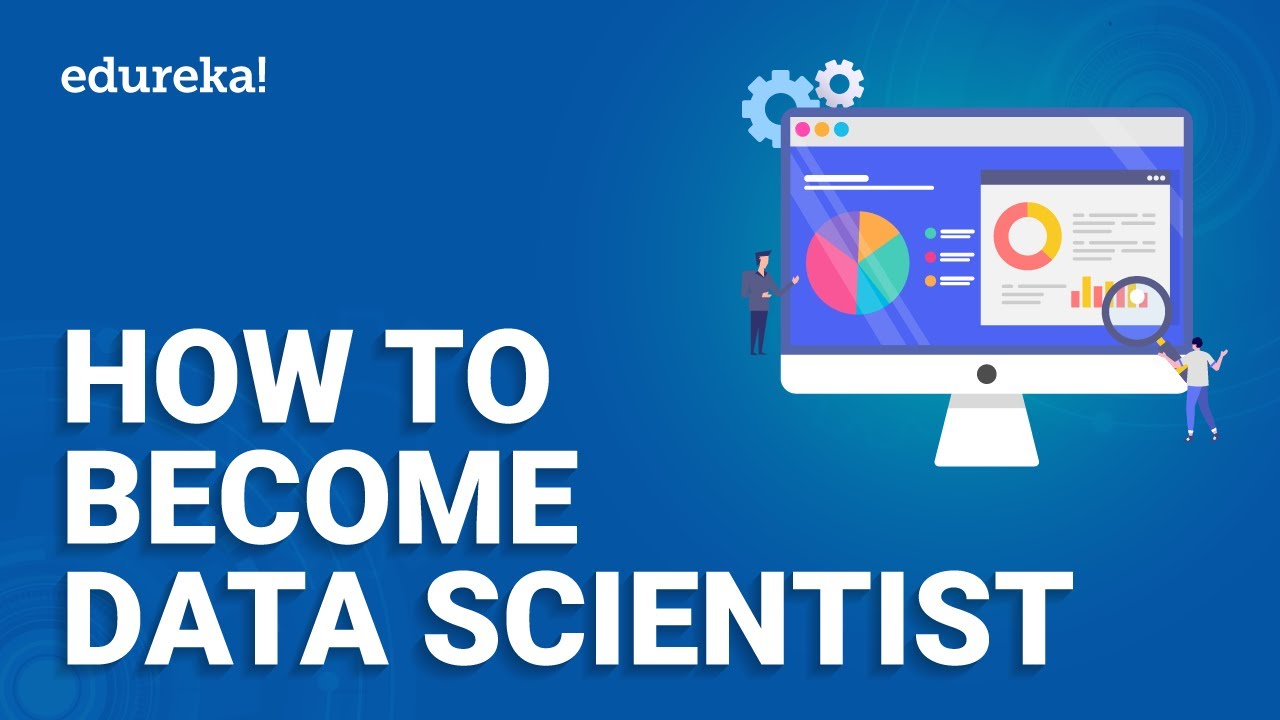
🔥 Edureka Data Science Master Program Training Certification (Use Code: YOUTUBE20) : https://www.edureka.co/masters....-program/data-scient
This Edureka video on 'How to become a Data Scientist' will give you an insight into why the data scientist job is in such a high demand. It then elaborates on different roles and responsibilities of a Data Scientist and what skills are required to fulfill those roles and responsibilities. Then, it build a roadmap that you can follow to become a Data Science Wizard (i.e. Data Scientist) and also it briefly provides you with a sense of how much time it takes to go through the roadmap. The video ends with some incredibly useful resources and courses to help you achieve your goal of becoming a Data Scientist.
00:00:00 Agenda
00:01:28 Why Become a Data Scientist?
00:03:58 What does a Data Scientist do?
00:07:14 Skills Required
00:09:50 How to become a Data Scientist?
00:18:35 Useful Resources
Following pointers are covered in this How to Become an AI Engineer:
1) Why become a Data Scientist?
2) What does a Data Scientist do?
3) Skills required
4) How to become a Data Scientist
5) Useful Resources
------------------------------------
Check out Edureka's Data Science Blog & Tutorial Series to learn more concepts of Data Science:
✅Blog Series: http://bit.ly/data-science-blogs
✅Data Science Tutorial Playlist: http://bit.ly/3tdteya
🔴Subscribe to our channel to get video updates. Hit the subscribe button above: https://goo.gl/6ohpTV
Twitter: https://twitter.com/edurekain
LinkedIn: https://www.linkedin.com/company/edureka
Instagram: https://www.instagram.com/edureka_learning/
Facebook: https://www.facebook.com/edurekaIN/
SlideShare: https://www.slideshare.net/EdurekaIN
Castbox: https://castbox.fm/networks/505?country=in
Meetup: https://www.meetup.com/edureka/
#Edureka #DataScience #DataScientistRoadmap #DataScienceCareer #DataScienceCertification #DataScienceTraining #DataScienceMasterProgram #WhatIsDataScience #DataScienceIn2021 #DataScienceCourse #DataScienceEdureka #EdurekaTraining
------------Edureka Online Training and Certification-----------
🔵Data Science Online Training: https://bit.ly/2NCT239
🔵AWS Online Training: https://bit.ly/2ZnbW3s
🔵DevOps Online Training: https://bit.ly/2BPwXf0
🟣Python Online Training: https://bit.ly/2CQYGN7
🟣RPA Online Training: https://bit.ly/2Zd0ac0
🟣Big Data Online Training: https://bit.ly/3g8zksu
🔵Java Online Training: https://bit.ly/31rxJcY
🟣Selenium Online Training: https://bit.ly/3dIrh43
🔵PMP Online Training: https://bit.ly/3dJxMTW
🟣Tableau Online Training: https://bit.ly/3g784KJ
-----------Edureka Masters Programs--------------
🔵Data Scientist Masters Program: https://bit.ly/2YHaolS
🔵Machine Learning Engineer Masters Program: https://bit.ly/388NXJi
🟣Cloud Architect Masters Program: https://bit.ly/3i9z0eJ
🔵DevOps Engineer Masters Program: https://bit.ly/2B9tZCp
🟣Big Data Architect Masters Program: https://bit.ly/31qrOVv
🟣Business Intelligence Masters Program: https://bit.ly/2BPLtn2
🔵Python Developer Masters Program: https://bit.ly/2Vn7tgb
🟣RPA Developer Masters Program: https://bit.ly/3eHwPNf
-------------------------------------------------------
About the Master's Program
This program follows a set structure with 6 core courses and 8 electives spread across 26 weeks. It makes you an expert in key technologies related to Data Science. At the end of each core course, you will be working on a real-time project to gain hands-on expertise. By the end of the program, you will be ready for seasoned Data Science job roles.
----------------------------------------------------
Why should I enroll for the Masters Program?
The Data Scientist Masters Program has been curated after thorough research and recommendations from industry experts. It will help you master concepts of Data Management, Statistics, Machine Learning and Big Data together with hands-on experience of tools & systems used by Data Scientists including Data Visualisation using Tableau. Edureka will be by your side throughout the learning journey - We’re Ridiculously Committed.
----------------------------------------------------
What are the prerequisites for enrollment?
There are no prerequisites for enrollment to the Masters Program. Whether you are an experienced professional working in the IT industry, or an aspirant planning to enter the world of Data Scientist, Masters Program is designed and developed to accommodate various professional backgrounds.
----------------------------------------------------
How long will it take me to be a Certified Data Science professional?
The recommended duration to complete this program is 34 weeks, however, it is up to the individual to complete this program as per their own pace
For more information, please write back to us at [email protected] or call us at IND: 9606058406 / US: 18338555775 (toll-free)

🔥𝐄𝐝𝐮𝐫𝐞𝐤𝐚 𝐃𝐞𝐯𝐎𝐩𝐬 𝐜𝐞𝐫𝐭𝐢𝐟𝐢𝐜𝐚𝐭𝐢𝐨𝐧 𝐭𝐫𝐚𝐢𝐧𝐢𝐧𝐠 : https://www.edureka.co/devops-....certification-traini (𝐔𝐬𝐞 𝐂𝐨𝐝𝐞: 𝐘𝐎𝐔𝐓𝐔𝐁𝐄𝟐𝟎)
This DevOps tutorial takes you through what is DevOps all about and basic concepts of DevOps and DevOps Tools. This DevOps tutorial is ideal for beginners to get started with DevOps.
Topics Covered:
00:00:00 Introduction
00:04:50 Limitations of Waterfall Model
00:12:02 Limitations of Agile
00:14:44 Solution is DevOps!
00:19:14 What is DevOps?
00:25:39 DevOps Stages
00:29:20 Source Code Management
00:34:53 Continuous Integration
00:38:19 Continuous Deployment
00:41:52 Configuration Management
00:45:28 Containerization
00:49:21 Continuous Monitoring
🔴 Subscribe to our channel to get video updates. Hit the subscribe button above: https://goo.gl/6ohpTV
🔴 𝐄𝐝𝐮𝐫𝐞𝐤𝐚 𝐎𝐧𝐥𝐢𝐧𝐞 𝐓𝐫𝐚𝐢𝐧𝐢𝐧𝐠 𝐚𝐧𝐝 𝐂𝐞𝐫𝐭𝐢𝐟𝐢𝐜𝐚𝐭𝐢𝐨𝐧𝐬
🌕 AWS Online Training: http://bit.ly/3ADYwDY
🌕 Azure Online Training: http://bit.ly/3i4P85F
🔴 𝐄𝐝𝐮𝐫𝐞𝐤𝐚 𝐑𝐨𝐥𝐞-𝐁𝐚𝐬𝐞𝐝 𝐂𝐨𝐮𝐫𝐬𝐞𝐬
🔵 DevOps Engineer Masters Program: http://bit.ly/3Oud9PC
🌕 Cloud Architect Masters Program: http://bit.ly/3OvueZy
🔵 Data Scientist Masters Program: http://bit.ly/3tUAOiT
🌕 Big Data Architect Masters Program: http://bit.ly/3tTWT0V
🔵 Machine Learning Engineer Masters Program: http://bit.ly/3AEq4c4
🌕 Business Intelligence Masters Program: http://bit.ly/3UZPqJz
🔵 Cyber Security Masters Program: http://bit.ly/3U25rNR
🌕 Full Stack Developer Masters Program : http://bit.ly/3tWCE2S
🔵 Automation Testing Engineer Masters Program : http://bit.ly/3AGXg2J
🌕 Python Developer Masters Program : https://bit.ly/3EV6kDv
🔵 Azure Cloud Engineer Masters Program: http://bit.ly/3AEBHzH
🔴 𝐄𝐝𝐮𝐫𝐞𝐤𝐚 𝐔𝐧𝐢𝐯𝐞𝐫𝐬𝐢𝐭𝐲 𝐏𝐫𝐨𝐠𝐫𝐚𝐦𝐬
🌕 Professional Certificate Program in DevOps with Purdue University: https://bit.ly/3Ov52lT
📢📢 𝐓𝐨𝐩 𝟏𝟎 𝐓𝐫𝐞𝐧𝐝𝐢𝐧𝐠 𝐓𝐞𝐜𝐡𝐧𝐨𝐥𝐨𝐠𝐢𝐞𝐬 𝐭𝐨 𝐋𝐞𝐚𝐫𝐧 𝐢𝐧 2023 𝐒𝐞𝐫𝐢𝐞𝐬 📢📢
⏩ NEW Top 10 Technologies To Learn In 2023 - https://youtu.be/udD_GQVDt5g
📌𝐓𝐞𝐥𝐞𝐠𝐫𝐚𝐦: https://t.me/edurekaupdates
📌𝐓𝐰𝐢𝐭𝐭𝐞𝐫: https://twitter.com/edurekain
📌𝐋𝐢𝐧𝐤𝐞𝐝𝐈𝐧: https://www.linkedin.com/company/edureka
📌𝐈𝐧𝐬𝐭𝐚𝐠𝐫𝐚𝐦: https://www.instagram.com/edureka_learning/
📌𝐅𝐚𝐜𝐞𝐛𝐨𝐨𝐤: https://www.facebook.com/edurekaIN/
📌𝐒𝐥𝐢𝐝𝐞𝐒𝐡𝐚𝐫𝐞: https://www.slideshare.net/EdurekaIN
📌𝐂𝐚𝐬𝐭𝐛𝐨𝐱: https://castbox.fm/networks/505?country=IN
📌𝐌𝐞𝐞𝐭𝐮𝐩: https://www.meetup.com/edureka/
📌𝐂𝐨𝐦𝐦𝐮𝐧𝐢𝐭𝐲: https://www.edureka.co/community/
What will you learn as a part of this DevOps course?
This DevOps training course is designed keeping in mind the latest trends in the industry. The course focuses on creating a strong base for various DevOps tools including Git, Jenkins, Docker, Ansible, Kubernetes, Prometheus and Grafana, and Terraform. The training is completely hands-on oriented and designed in a way that will help you in becoming a certified practitioner by providing you an intensified training for the best practices about Continuous Development, Continuous Testing, Configuration Management, including Continuous Integration and Continuous Deployment and finally Continuous Monitoring of the software throughout its development life cycle.
What are the pre-requisites for this DevOps Certification Course?
Any Scripting Language Knowledge
Linux Fundamentals
To help you brush up these skills, you will get the following self-paced modules as pre-requisites in your LMS:
Python Scripting
Linux Fundamentals
Got a question on the topic? Please share it in the comment section below and our experts will answer it for you.
Please write back to us at [email protected] or call us at IND: 9606058406 / US: 18338555775 (toll-free) for more information.
Welcome to part 3 of the sockets tutorial with Python. We've learned how to send and receive string data via sockets, and now I want to talk about is pickles. Not the food, but the serialization technique in Python.
Text-based tutorial and sample code: https://pythonprogramming.net/....pickle-objects-socke
Channel membership: https://www.youtube.com/channe....l/UCfzlCWGWYyIQ0aLC5
Discord: https://discord.gg/sentdex
Support the content: https://pythonprogramming.net/support-donate/
Twitter: https://twitter.com/sentdex
Facebook: https://www.facebook.com/pythonprogramming.net/
Twitch: https://www.twitch.tv/sentdex
G+: https://plus.google.com/+sentdex

In a quest to teach neural networks via transformers to write Python code. Project name: Generative Python Transformers!
Neural Networks from Scratch book: https://nnfs.io
Channel membership: https://www.youtube.com/channe....l/UCfzlCWGWYyIQ0aLC5
Discord: https://discord.gg/sentdex
Reddit: https://www.reddit.com/r/sentdex/
Support the content: https://pythonprogramming.net/support-donate/
Twitter: https://twitter.com/sentdex
Instagram: https://instagram.com/sentdex
Facebook: https://www.facebook.com/pythonprogramming.net/
Twitch: https://www.twitch.tv/sentdex

We'll be using the numpy module to convert data to numpy arrays, which is what Scikit-learn wants. We will talk more on preprocessing and cross_validation when we get to them in the code, but preprocessing is the module used to do some cleaning/scaling of data prior to machine learning, and cross_ alidation is used in the testing stages. Finally, we're also importing the LinearRegression algorithm as well as svm from Scikit-learn, which we'll be using as our machine learning algorithms to demonstrate results.
At this point, we've got data that we think is useful. How does the actual machine learning thing work? With supervised learning, you have features and labels. The features are the descriptive attributes, and the label is what you're attempting to predict or forecast. Another common example with regression might be to try to predict the dollar value of an insurance policy premium for someone. The company may collect your age, past driving infractions, public criminal record, and your credit score for example. The company will use past customers, taking this data, and feeding in the amount of the "ideal premium" that they think should have been given to that customer, or they will use the one they actually used if they thought it was a profitable amount.
Thus, for training the machine learning classifier, the features are customer attributes, the label is the premium associated with those attributes.
https://pythonprogramming.net
https://twitter.com/sentdex
https://www.facebook.com/pythonprogramming.net/
https://plus.google.com/+sentdex
So now that you know the basics of what Pytorch is, let's apply it using a basic neural network example. The very first thing we have to consider is our data.
Text-based tutorials and sample code: https://pythonprogramming.net/....data-deep-learning-n
Linode Cloud GPUs $20 credit: https://linode.com/sentdex
Channel membership: https://www.youtube.com/channe....l/UCfzlCWGWYyIQ0aLC5
Discord: https://discord.gg/sentdex
Support the content: https://pythonprogramming.net/support-donate/
Twitter: https://twitter.com/sentdex
Instagram: https://instagram.com/sentdex
Facebook: https://www.facebook.com/pythonprogramming.net/
Twitch: https://www.twitch.tv/sentdex
#pytorch #deeplearning #machinelearning
Welcome to part 2 of the web scraping with Beautiful Soup 4 tutorial mini-series. In this tutorial, we're going to talk about navigating source code to get just the slice of data we want.
Tutorial code: https://pythonprogramming.net/....navigating-pages-scr
https://pythonprogramming.net
https://twitter.com/sentdex
https://www.facebook.com/pythonprogramming.net/
https://plus.google.com/+sentdex

The next loop is the For loop. The idea of the for loop is to "iterate" through something. For each thing in that something, it will do a block of code. Most often, you will a for loop's structure very much like
for eachThing in thisThing:
do this stuff
in this block
So, again, why would someone use each type of loop?
Typically, you will see the while loop being used for finite tasks that have predetermined length, and the for loop being used for tasks that have uncertain and variable time-frames.
That said, the for loop can be used for the exact same tasks as the while loop.
For this reason, I prefer the for loop myself, but again, it comes down to personal preference.
Python 3 Programming tutorial Playlist: http://www.youtube.com/watch?v=oVp1vrfL_w4&feature=share&list=PLQVvvaa0QuDe8XSftW-RAxdo6OmaeL85M
Sample code for this basics series: http://pythonprogramming.net/b....eginner-python-progr
This python 3 tutorial covers the for loop in python 3.3.3
http://seaofbtc.com
http://sentdex.com
http://hkinsley.com
https://twitter.com/sentdex
Bitcoin donations: 1GV7srgR4NJx4vrk7avCmmVQQrqmv87ty6

Text-based tutorial and sample code: https://pythonprogramming.net/....autoencoders-tutoria
Neural Networks from Scratch book: https://nnfs.io
Channel membership: https://www.youtube.com/channe....l/UCfzlCWGWYyIQ0aLC5
Discord: https://discord.gg/sentdex
Reddit: https://www.reddit.com/r/sentdex/
Support the content: https://pythonprogramming.net/support-donate/
Twitter: https://twitter.com/sentdex
Instagram: https://instagram.com/sentdex
Facebook: https://www.facebook.com/pythonprogramming.net/
Twitch: https://www.twitch.tv/sentdex