Top videos




This lecture, by DeepMind Research Scientist Felix Hill, first discusses the motivation for modelling language with ANNs: language is highly contextual, typically non-compositional and relies on reconciling many competing sources of information. This section also covers Elman's Finding Structure in Time and simple recurrent networks, the importance of context and transformers. In the second part, he explores unsupervised and representation learning for language from Word2Vec to BERT. Finally, Felix discusses situated language understanding, grounding and embodied language learning.
Download the slides here:
https://storage.googleapis.com..../deepmind-media/UCLx
Find out more about how DeepMind increases access to science here:
https://deepmind.com/about#access_to_science
Speaker Bio:
Felix Hill is a Research Scientist working on grounded language understanding, and has been at DeepMind for almost 4 years. He studied pure maths as an undergrad, then got very interested in linguistics and psychology after reading the PDP books by McClelland and Rumelhart, so started graduate school at the University of Cambridge, and ended up in the NLP group. To satisfy his interest in artificial neural networks, he visited Yoshua Bengio's lab in 2013 and started a series of collaborations with Kyunghyun Cho and Yoshua applying neural nets to text processing. This led to some of the first work on transfer learning with sentence representations (and a neural crossword solver). He also interned at FAIR in NYC with Jason Weston. At DeepMind, he's worked on developing agents that can understand language in the context of interactive 3D worlds, together with problems relating to mathematical and analogical reasoning.
About the lecture series:
The Deep Learning Lecture Series is a collaboration between DeepMind and the UCL Centre for Artificial Intelligence. Over the past decade, Deep Learning has evolved as the leading artificial intelligence paradigm providing us with the ability to learn complex functions from raw data at unprecedented accuracy and scale. Deep Learning has been applied to problems in object recognition, speech recognition, speech synthesis, forecasting, scientific computing, control and many more. The resulting applications are touching all of our lives in areas such as healthcare and medical research, human-computer interaction, communication, transport, conservation, manufacturing and many other fields of human endeavour. In recognition of this huge impact, the 2019 Turing Award, the highest honour in computing, was awarded to pioneers of Deep Learning.
In this lecture series, research scientists from leading AI research lab, DeepMind, deliver 12 lectures on an exciting selection of topics in Deep Learning, ranging from the fundamentals of training neural networks via advanced ideas around memory, attention, and generative modelling to the important topic of responsible innovation.

LSTM model can train a deep neural network to classify sequence data. An #LSTM network allows us to feed sequence data into a system and identify conclusions based on the sequences data's distinct time steps. Access premium content at https://matlabhelper.com/cours....e/deeplearning-m2c3l or Buy & Download MATLAB Code from https://matlabhelper.com/cart/?add-to-cart=16336
00:00 Introduction
00:38 About LSTM network
01:00 Loading of data
01:15 Time series analysis
03:48 Training of network
#Deep #learning is a subset of machine learning where artificial neural networks, algorithms inspired by the human brain, learn from extensive data. Like how we learn from experience, the deep learning algorithm would repeatedly perform a task, each time tweaking it a little to improve the outcome. MATLAB makes deep learning easy. Learn how to create and train #neural #network architectures, including #Convolutional Neural Networks, #Recurrent Neural Networks, #LSTMs, etc., with MATLAB Helper. Enroll today to begin your journey toward becoming a Deep Learning Expert! Book our premium online course at https://mlhp.link/DeepLearning & get access to MATLAB codes, explanations, and support files. Want to see more #DeepLearning videos? Watch playlist: https://www.youtube.com/playli....st?list=PLmyWlxlLCcz
If you found this video helpful, Like, Comment & Share it. Make sure to Subscribe to our YouTube Channel. You can buy Super Thanks and show your support to this video and our channel.
If you are looking for #Expert Help, a paid service, then share your requirement on website chat at https://mlhp.link/services or email at [email protected] with your service preference, timeline, and any necessary attachments. We provide live sessions & offline work on #MATLAB & #Simulink Projects, including Homework, Assignment, Thesis, and #Research.
Join #training module of MATLAB Associate, MATLAB Professional, Simulink Fundamental, Image Processing, Arduino Interfacing, AppDesigner, or Machine Learning and get trained from #Mathworks Certified MATLAB Associate & Experts. Get training syllabus & proposal from https://mlhp.link/training
Explore our learning portal at https://mlhp.link/lms
Join a self-paced online #course at https://mlhp.link/courses
Participate in our #quiz & contests at https://mlhp.link/quiz
Watch and learn from our #webinar at https://mlhp.link/live
WhatsApp us at +91-8104622179 or https://mlhp.link/WhatsApp
Follow us on Linkedin: https://mlhp.link/LinCompany
Like us on Facebook: https://mlhp.link/facebook
Follow us on Instagram: https://mlhp.link/instagram
Education is our future. MATLAB is our feature. Happy MATLABing!


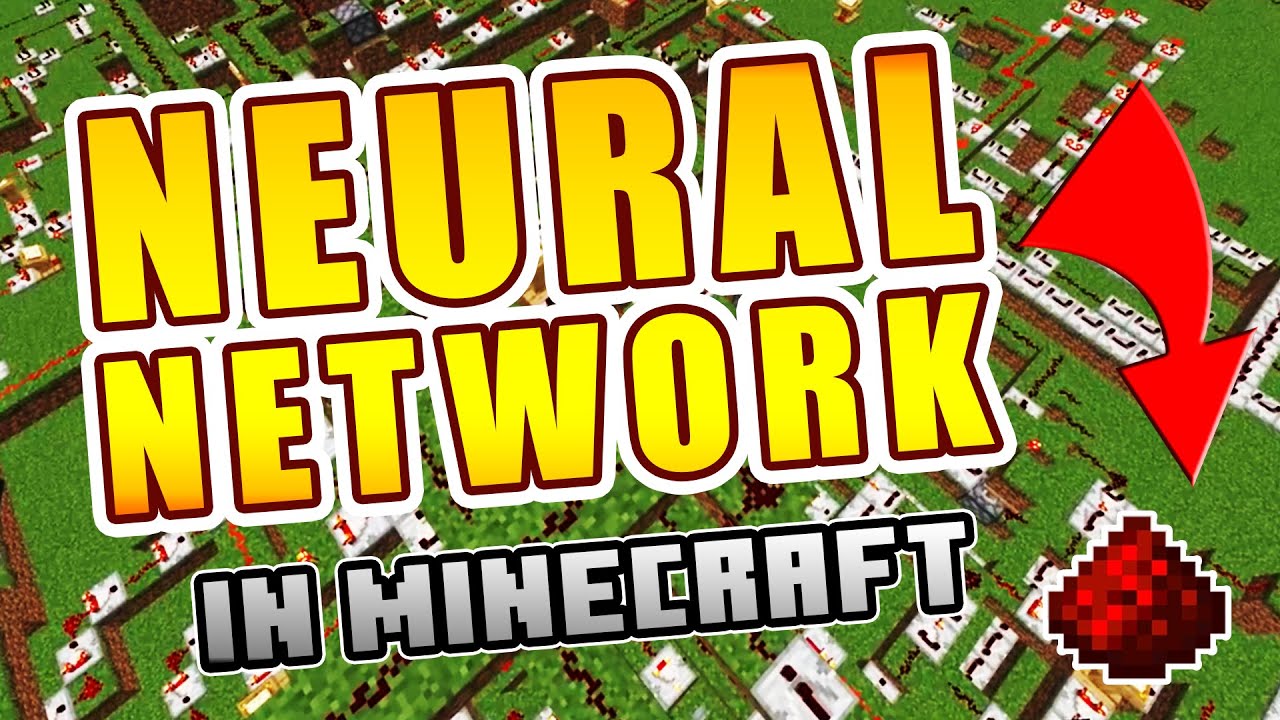
#minecraft #neuralnetwork #backpropagation
I built an analog neural network in vanilla Minecraft without any mods or command blocks. The network uses Redstone wire power strengths to carry the signal through one hidden layer, including nonlinearities, and then do automatic backpropagation and even weight updates.
OUTLINE:
0:00 - Intro & Overview
1:50 - Redstone Components Explained
5:00 - Analog Multiplication in Redstone
7:00 - Gradient Descent for Square Root Computation
9:35 - Neural Network Demonstration
10:45 - Network Schema Explained
18:35 - The Network Learns a Datapoint
20:20 - Outro & Conclusion
I built this during a series of live streams and want to thank everyone who helped me and cheered for me in the chat!
World saves here: https://github.com/yk/minecraft-neural-network
Game here: https://www.minecraft.net
Multiplier Inspiration: https://www.youtube.com/channe....l/UCLmzk4TlnLXCXCHcj
Credits to Lanz for editing!
Links:
TabNine Code Completion (Referral): http://bit.ly/tabnine-yannick
YouTube: https://www.youtube.com/c/yannickilcher
Twitter: https://twitter.com/ykilcher
Discord: https://discord.gg/4H8xxDF
BitChute: https://www.bitchute.com/channel/yannic-kilcher
Minds: https://www.minds.com/ykilcher
Parler: https://parler.com/profile/YannicKilcher
LinkedIn: https://www.linkedin.com/in/ya....nnic-kilcher-4885341
BiliBili: https://space.bilibili.com/1824646584
If you want to support me, the best thing to do is to share out the content :)
If you want to support me financially (completely optional and voluntary, but a lot of people have asked for this):
SubscribeStar: https://www.subscribestar.com/yannickilcher
Patreon: https://www.patreon.com/yannickilcher
Bitcoin (BTC): bc1q49lsw3q325tr58ygf8sudx2dqfguclvngvy2cq
Ethereum (ETH): 0x7ad3513E3B8f66799f507Aa7874b1B0eBC7F85e2
Litecoin (LTC): LQW2TRyKYetVC8WjFkhpPhtpbDM4Vw7r9m
Monero (XMR): 4ACL8AGrEo5hAir8A9CeVrW8pEauWvnp1WnSDZxW7tziCDLhZAGsgzhRQABDnFy8yuM9fWJDviJPHKRjV4FWt19CJZN9D4n