Top videos

🔥1000+ Free Courses With Free Certificates: https://www.mygreatlearning.com/academy?ambassador_code=GLYT_DES_Top_SEP22&utm_source=GLYT&utm_campaign=GLYT_DES_Top_SEP22
Machine Learning Full Course for Beginners | Machine Learning Tutorial | Machine Learning Course
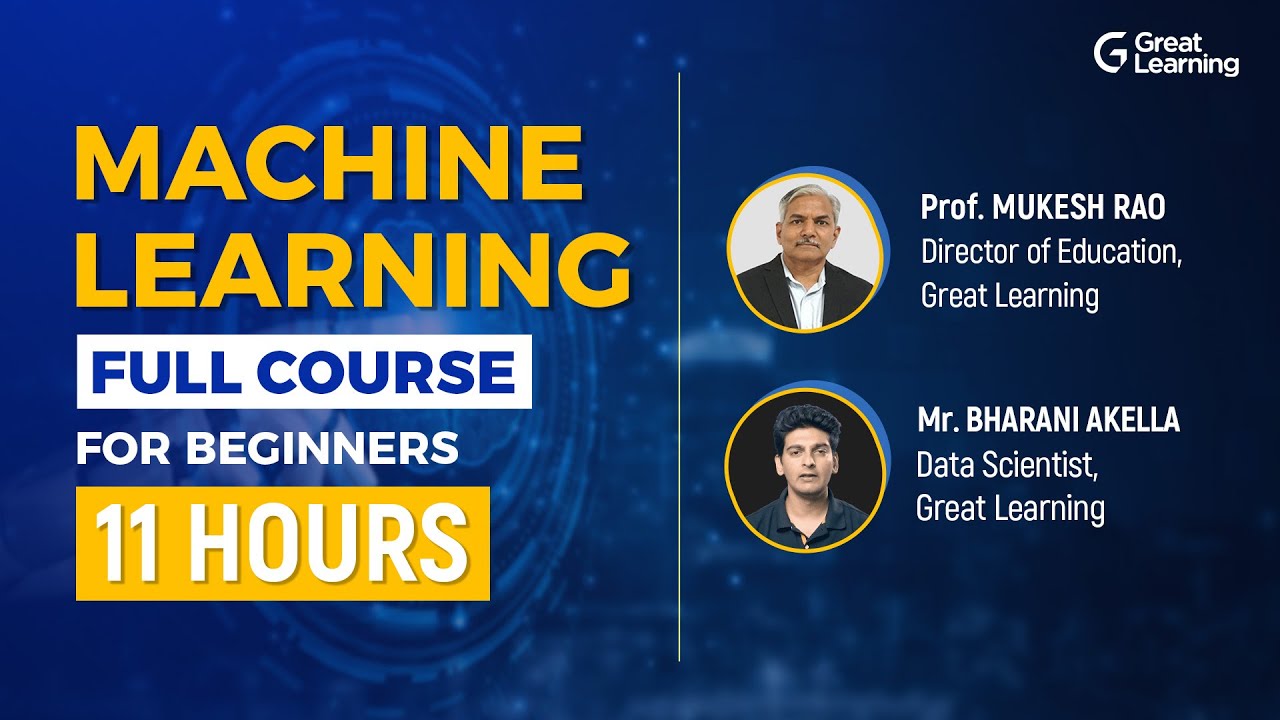
Hello and welcome to the Machine Learning Full Course for Beginners using python. In this video, you will learn from basics to advanced machine learning concepts from Great Learning’s top faculties, including professor Mukesh Rao, Bharani Akella & many other leading industry experts. If you are an enthusiast who wants to start with machine learning from scratch, this machine learning beginner video is the best to start with.
#machinelearningfullcourse #machinelearning #machinelearningbasics
Agenda:
• Python for Machine Learning
• Role of Statistics in Machine Learning
• Introduction to Machine Learning and its types
• How does a Machine learning model learn?
• Supervised and Unsupervised learning algorithms
• Principal component analysis for dimensionality reduction
• Application of Machine Learning
Topics Covered:
00:01:09 – What Is Machine learning? (Introduction to Machine Learning)
00:03:00 – Why Machine Learning?
00:04:22 – Road Map to Machine Learning
00:01:09 – How to Use Kaggle (www.kaggle.com)
Machine Learning with Python (Python Libraries for Machine Learning)
00:11:25 - NumPy Python Tutorial (How to Create NumPy Array)
00:14:58 - How to Initialize NumPy Array
00:22:19 - How to check the shape of NumPy arrays
00:24:42 - How to Join NumPy Arrays
00:28:15 - NumPy Intersection & Difference
00:31:50 - NumPy Array Mathematics
00:39:15 - NumPy Matrix
00:42:28 - How to Transpose NumPy Matrix
00:43:21 - NumPy Matrix Multiplication
00:45:45 - NumPy Save & Load
00:47:44 - Python Pandas Tutorial
00:48:09 - Pandas Series Object
00:58:44 - Pandas Dataframe
01:12:00 - Matplotlib Python Tutorial
01:12:12 - Line plot
01:26:32 - Bar plot
01:32:37 - Scatter Plot
01:40:35 - Histogram
01:46:16 - Box Plot
01:51:03 - Violin Plot
01:51:57 - Pie Chart
01:56:39 - DoughNut Chart
01:59:04 - SeaBorn Line Plot
02:07:27 - SeaBorn Bar Plot
02:15:15 - SeaBorn ScatterPlot
02:20:25 - SeaBorn Histogram/Distplot
02:26:52 - SeaBorn JointPlot
02:30:23 - SeaBorn BoxPlot
02:38:59 – Role of Mathematics in Data Science
02:40:23 – What is data?
02:42:34 – What is Information?
02:43:21 – What is Statistics?
02:43:58 – What is Population?
02:46:48 – What is Sample?
02:47:33 – What are Parameters?
02:47:55 – Measures of Central Tendency
02:51:10 – Understanding Empirical Rule
02:53:16 – What is Mean, median, and mode?
02:57:04 – Measures of Spread (Understanding Range, Inter Quartile Range & Box-plot)
03:12:56 – Types of Machine Learning (Supervised, Unsupervised & Reinforcement Learning)
03:27:43 – How does a Machine Learning Model Learn?
03:35:31 – Supervised Machine Learning (Mukesh Rao)
04:34:51 – Python for Machine Learning
04:46:40 – Linear Regression Algorithm (Hands-on)
05:21:13 – What is Logistic Regression
05:29:39 – Linear Regression vs Logistic Regression
05:40:15 – Naïve Bayes Algorithm
05:49:32 – Diabetes Prediction using Naïve Bayes
06:15:18 – Decision Tree and Random Forest Algorithm
07:55:01 – Introduction to Support Vector Machines (SVMs)
08:07:08 – Kernel Functions
08:11:56 – Advantages & Disadvantages of SVMs
08:31:37 – K-NN Algorithm (K-Nearest Neighbour Algorithm)
08:40:13 – Introduction to Unsupervised Learning - Clustering
08:48:35 – Introduction to Principal Component Analysis
09:09:39 – PCA for Dimensionality Reduction
09:15:27 – Introduction to Hierarchical Clustering
09:28:38 – Types of Hierarchical Clustering
09:34:02 – How does Agglomerative hierarchical clustering work
09:42:32 – Euclidean Distance
09:45:10 – Manhattan Distance
09:48:01 – Minkowski Distance
09:50:02 – Jaccard Similarity Coefficient/Jaccard Index
09:54:02 – Cosine Similarity
09:58:18 – How to find an optimal number for clustering
10:03:02 – Applications Machine Learning
Enroll now for Machine Learning Certification Course from Reputed Universities:
https://www.mygreatlearning.com/pg-program-artificial-intelligence-course?ambassador_code=GLYT_QRcd7_JeUeU_DES&utm_source=GLYT&utm_campaign=GLYT_QRcd7_JeUeU_DES
Free Machine Learning Courses with Free Certificates:
Machine Learning Algorithms: https://www.mygreatlearning.com/academy/learn-for-free/courses/machine-learning-algorithms?ambassador_code=GLYT_DES_Middle_SEP22&utm_source=GLYT&utm_campaign=GLYT_DES_Middle_SEP37
Statistics for Machine Learning: https://www.mygreatlearning.com/academy/learn-for-free/courses/statistics-for-machine-learning?ambassador_code=GLYT_DES_Middle_SEP22&utm_source=GLYT&utm_campaign=GLYT_DES_Middle_SEP39
For more updates on courses and tips, follow us on:
Telegram: https://t.me/GreatLearningAcademy
Facebook: https://www.facebook.com/GreatLearningOfficial/
LinkedIn: https://www.linkedin.com/schoo....l/great-learning/myc
Follow our Blog: https://glacad.me/GL_Blog


Blog: https://pysource.com/2022/02/0....8/the-best-deep-lear
Today we will see a video card with 24GB of memory sold for less than $ 350. This is the Nvidia Tesla K80. Due to the shortage of microchips, and the use of video cards for cryptocurrency mining, the price of the hardware can reach up to 3 times the original price. In this case, the Nvidia Tesla K80 becomes the solution for Deep Learning.
➤ Courses:
Full Computer Vision course: https://pysource.com/object-de....tection-opencv-deep-
Training Mask R-CNN PRO (Notebook + Mini-Course): https://pysource.com/mask-rcnn-training-pro/
➤ Follow me on:
LinkedIn: https://www.linkedin.com/company/pysource
➤ For business inquiries:
https://pysource.com/contact
#TeslaK80 #computervision #deeplearning


Prof. Geoffrey Ye Li (Imperial College London)
It has been demonstrated recently that deep learning (DL) has great potential to break the bottleneck of conventional communication systems. In this talk, we present our recent work in DL in wireless communications, including physical layer processing and resource allocation.
DL can improve the performance of each individual (traditional) block in a conventional communication system or jointly optimize the whole transmitter or receiver. Therefore, we can categorize the applications of DL in physical layer communications into with and without block processing structures. For DL-based communication systems with block structures, we present joint channel estimation and signal detection based on a fully connected deep neural network, model-drive DL for signal detection. For those without block structures, we provide our recent endeavors in developing end-to-end learning communication systems with the help of deep reinforcement learning (DRL) and generative adversarial net (GAN).
Judicious resource (spectrum, power, etc.) allocation can significantly improve the efficiency of wireless networks. The traditional wisdom is to explicitly formulate resource allocation as an optimization problem and then exploit mathematical programming to solve it to a certain level of optimality. Deep learning represents a promising alternative due to its remarkable power to leverage data for problem-solving and can help solve optimization problems for resource allocation or can be directly used for resource allocation. We will first present our research results in using deep learning to reduce the complexity of mixed-integer non-linear programming (MINLP). We will then discuss how to use deep reinforcement learning directly for wireless resource allocation with applications in vehicular networks.
Bio:
Dr. Geoffrey Ye Li is the Chair Professor in Wireless Systems in Department of EEE, Imperial College London. Before joining Imperial College London in 2020, he was a professor with Georgia Institute of Technology, GA, USA, for 20 years and a Principal Technical Staff Member with AT&T (Bell) Labs – Research in New Jersey, USA, for around 5 years. He is currently focusing on machine learning and statistical signal processing for wireless communications. His research topics in the past couple decades include machine learning for wireless signal detection and resource allocation, cognitive radios, cross-layer optimisation for spectrum- and energy-efficient wireless networks, OFDM and MIMO techniques for wireless systems, and blind signal processing.
Dr. Geoffrey Ye Li was awarded IEEE Fellow for his contributions to signal processing for wireless communications in 2005. He won several prestigious awards from IEEE Signal Processing Society (Donald G. Fink Overview Paper Award in 2017), IEEE Vehicular Technology Society (James Evans Avant Garde Award in 2013 and Jack Neubauer Memorial Award in 2014), and IEEE Communications Society (Stephen O. Rice Prize Paper Award in 2013, Award for Advances in Communication in 2017, and Edwin Howard Armstrong Achievement Award in 2019). He also received the 2015 Distinguished ECE Faculty Achievement Award from Georgia Tech. He has been recognised as the Highly-Cited Researcher by Thomson Reuters almost every year.
- - -
Wireless ML Seminars is a series of lectures focused on Machine Learning in the wireless space. Invited speakers for the series are leaders in their fields, hailing from respected research institutions worldwide. The seminar series is curated by Prof. Jeff Andrews and Prof. Hyeji Kim from the Wireless Networking and Communications Group at the University of Texas at Austin.
Find out more here: https://sites.utexas.edu/wirelessmlseminars/



![#13 Machine Learning Engineering for Production (MLOps) Specialization [Course 1, Week 2, Lesson 5]](https://i.ytimg.com/vi/8Covj8F-NNc/maxresdefault.jpg)