Top videos

For more information about Stanford’s Artificial Intelligence professional and graduate programs, visit: https://stanford.io/ai
October 14, 2025
This lecture covers adversarial robustness and generative models.
To learn more about enrolling in this course, visit: https://online.stanford.edu/co....urses/cs230-deep-lea
To follow along with the course schedule and syllabus, visit: https://cs230.stanford.edu/syllabus/
More lectures will be published regularly.
View the playlist: https://www.youtube.com/playli....st?list=PLoROMvodv4r
Andrew Ng
Founder of DeepLearning.AI
Adjunct Professor, Stanford University’s Computer Science Department
Kian Katanforoosh
CEO and Founder of Workera
Adjunct Lecturer, Stanford University’s Computer Science Department



NVIDIA GeForce RTX 3050 GPU on Acer Nitro 5 vs CPU performance comparison. Thanks To Acer & NVIDIA for sharing this amazing laptop.If you're thinking of getting an RTX Laptop, then NVIDIA is also providing an amazing opportunity for Students, if you purchase an RTX Laptop then you can avail a Deep Learning Instructor-Led Certification Course from Deep Learning Institute which will give you a head start in your Deep Learning Career.
▶ Learn more about the offer here : https://amzn.to/33DqTV0
▶ Follow NVIDIA GeForce India at - https://www.facebook.com/NVIDIAGeForceIN
▶ Sponsor me on GitHub : https://github.com/sponsors/bhattbhavesh91/
▶ Join this channel to get access to perks: https://bit.ly/BhaveshBhattJoin
▶ Join the Telegram channel for regular updates: https://t.me/bhattbhavesh91
▶ If you like my work, you can buy me a coffee : https://bit.ly/BuyBhaveshCoffee
*I use affiliate links on the products that I recommend. These give me a small portion of the sales price at no cost to you. I appreciate the proceeds and they help me to improve my channel!
▶ Best Book for Python : https://amzn.to/3qYThqu
▶ Best Book for Statistics : https://amzn.to/3vzvHEn
▶ Best Book for BERT: https://amzn.to/3lpX0fz
▶ Best Book for Machine Learning : https://amzn.to/2P6aZuT
▶ Best Book for Deep Learning : https://amzn.to/30UMTGl
▶ Best Intro Book for MLOps : https://amzn.to/3AoPZmM
Equipments I use for recording the videos:
▶ 1st Laptop I use : https://amzn.to/3AqI8Fp
▶ 2nd Laptop I use : https://amzn.to/3KAiYsB
▶ Microphone : https://amzn.to/3qUPxtz
▶ Camera : https://amzn.to/3rKQsM2
▶ Mobile Phone : https://amzn.to/3nRHP1f
▶ Ring Light : https://amzn.to/33LedM5
▶ RGB Light : https://amzn.to/3KzLgmS
▶ Bag I use : https://amzn.to/3AsM3RZ
If you do have any questions with what we covered in this video then feel free to ask in the comment section below & I'll do my best to answer those.
If you enjoy these tutorials & would like to support them then the easiest way is to simply like the video & give it a thumbs up & also it's a huge help to share these videos with anyone who you think would find them useful.
Please consider clicking the SUBSCRIBE button to be notified for future videos & thank you all for watching.
You can find me on:
▶ Blog - https://bhattbhavesh91.github.io
▶ Twitter - https://twitter.com/_bhaveshbhatt
▶ GitHub - https://github.com/bhattbhavesh91
▶ Medium - https://medium.com/@bhattbhavesh91
▶ About.me - https://about.me/bhattbhavesh91
▶ Linktree - https://linktr.ee/bhattbhavesh91
▶ DEV Community - https://dev.to/bhattbhavesh91
▶ Telegram - https://t.me/bhattbhavesh91
#NVIDIA #RTX3050

Kaggle notebook with all the code: https://www.kaggle.com/wwsalmo....n/simple-mnist-nn-fr
Blog article with more/clearer math explanation: https://www.samsonzhang.com/20....20/11/24/understandi


🔥Post Graduate Program In Full Stack Web Development: https://www.simplilearn.com/pg....p-full-stack-web-dev
&utm_medium=DescriptionFirstFold&utm_source=youtube
🔥Caltech Coding Bootcamp(US Only): https://www.simplilearn.com/coding-bootcamp?utm_campaign=09May2023LGLoopEvening1utm_medium=DescriptionFirstFold&utm_source=youtube
This Javascript Tutorial video will help you become proficient in JavaScript Programming Language. This Javascript Full Course video will cover all the important aspects of Javascript from Basics to advance. At the end of the video, you will have a strong understanding of the concepts required to build complex JS applications. Towards the end of this Javascript Tutorial for Beginners, we will work on Javascript Projects Hands-on Demo.
✅Subscribe to our Channel to learn more about the top Technologies: https://bit.ly/2VT4WtH
⏩ Check out our JavaScript training videos playlist: https://www.youtube.com/watch?v=LO5eTH4Pe8E&list=PLEiEAq2VkUULeP75xLYYnY1wqddxPdSXj
#JavaScriptDeveloperTutorial #JavaScriptCourse #JavaScriptTutorial #LearnJavaScript #JavaScriptTraining #JavaScriptForBeginner #JavaScriptTutorial #JavaScript #JavaScriptTutorialForBeginners #Simplilearn #SimpliCode
🔥FREE JavaScript Course With Completion Certificate: https://www.simplilearn.com/learn-javascript-basics-free-course-skillup?utm_campaign=09May2023LGLoopEvening1&utm_medium=Description&utm_source=youtube
Introduction to JavaScript:
JavaScript is a scripting language that is used to create and manage dynamic web pages, basically anything that moves on your screen without requiring you to refresh your browser. It can be anything from animated graphics to an automatically generated Facebook timeline. When most people get interested in web development, they start with good old HTML and CSS. From there, they move on to JavaScript, which makes sense, because, these three elements together form the backbone of web development. HTML is the structure of your page like the headers, the body text, any images you want to include. It basically defines the contents of a web page.
CSS controls how that page looks (it’s what you’ll use to customize fonts, background colors, etc.). JavaScript is the third element. Once you’ve created your structure (HTML) and your aesthetic vibe (CSS), JavaScript makes your site dynamic (automatically updateable).
To learn more about JavaScript, check our Full Stack Web Developer program: https://www.simplilearn.com/full-stack-web-developer-mean-stack-certification-training?utm_campaign=09May2023LGLoopEvening1&utm_medium=Description&utm_source=youtube
About Full Stack Web Developer - MEAN Stack Course:
This program will advance your career as a MEAN stack developer. You’ll learn top skills such as MongoDB, Express.js, Angular, and Node.js (“MEAN”), plus GIT, HTML, CSS, and JavaScript to build and deploy interactive applications and services. This Full Stack MEAN Developer program provides complete knowledge of software development and testing technologies such as JavaScript, Node.js, Angular, Docker, and Protractor. You'll build an end-to-end application, test and deploy code, and store data using MongoDB.
Key Features:
✅ Comprehensive Blended Learning program
✅ 270 hours of in-depth training
✅ 150 hours of instructor-led training
✅120 hours of self-paced learning
✅ 20 + in-demand tools and skills
✅ 10 lesson-end & 4 phase-end projects
✅Choose from 4 industry-aligned capstone projects
Learn more at: https://www.simplilearn.com/full-stack-web-developer-mean-stack-certification-training?utm_campaign=09May2023LGLoopEvening1&utm_medium=Description&utm_source=youtube
🔥FREE JavaScript Course With Completion Certificate: https://www.simplilearn.com/learn-javascript-basics-free-course-skillup?utm_campaign=09May2023LGLoopEvening1&utm_medium=Description&utm_source=youtube
For more updates on courses and tips follow us on:
- Facebook: https://www.facebook.com/Simplilearn
- Twitter: https://twitter.com/simplilearn
- LinkedIn: https://www.linkedin.com/company/simplilearn/
- Website: https://www.simplilearn.com
- Instagram: https://www.instagram.com/simplilearn_elearning
- Telegram Mobile: https://t.me/simplilearnupdates
- Telegram Desktop: https://web.telegram.org/#/im?....p=@simplilearnupdate
Get the Simplilearn app: https://simpli.app.link/OlbFAhqMqgb
🔥🔥 Interested in Attending Live Classes? Call Us: IN - 18002127688 / US - +18445327688
Businesses are integrating large language models (LLM) to build the next generation of applications. Examples include generating personalized marketing text and imagery, summarizing long-form reports, and building entirely new experiences with customer service chatbots. With Azure OpenAI Service, businesses can apply the most advanced AI models—including Dall-E 2, GPT-3.5, GPT-4, Codex, and ChatGPT to address these use-cases, unlock efficiencies, mitigate risk, and more.
To learn more, please check out these resources:
* https://aka.ms/exploreazureopenAI
* https://aka.ms/BuildCollectionBRK214H
* https://aka.ms/learnatbuild
*Speakers:*
* Andy Beatman
* Pablo Castro
* Dom Divakaruni
* Keiji Kanazawa
* Derek Legenzoff
* Christian Montecillo
* Nannette Sperling
* Alison Walters
*Session Information:*
This video is one of many sessions delivered for the Microsoft Build 2023 event. View the full session schedule and learn more about Microsoft Build at https://build.microsoft.com
BRK214H | English (US) | AI
#MSBuild
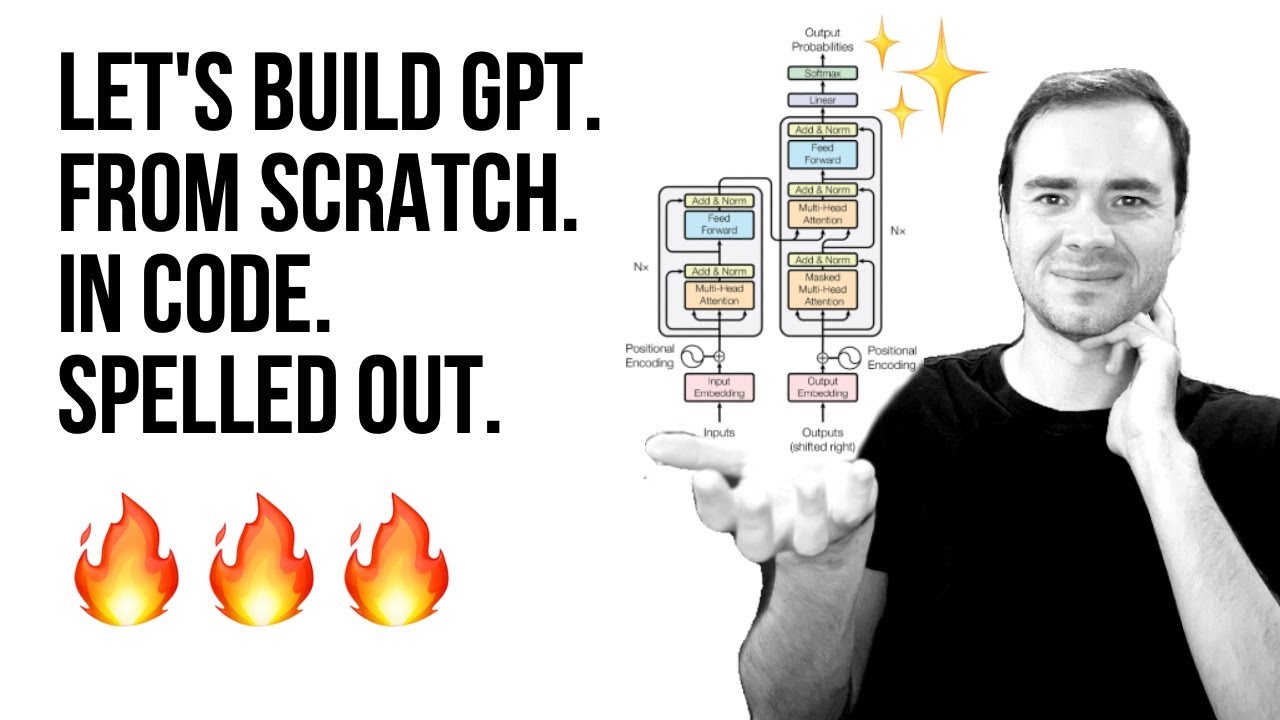
We build a Generatively Pretrained Transformer (GPT), following the paper "Attention is All You Need" and OpenAI's GPT-2 / GPT-3. We talk about connections to ChatGPT, which has taken the world by storm. We watch GitHub Copilot, itself a GPT, help us write a GPT (meta :D!) . I recommend people watch the earlier makemore videos to get comfortable with the autoregressive language modeling framework and basics of tensors and PyTorch nn, which we take for granted in this video.
Links:
- Google colab for the video: https://colab.research.google.....com/drive/1JMLa53HDu
- GitHub repo for the video: https://github.com/karpathy/ng-video-lecture
- Playlist of the whole Zero to Hero series so far: https://www.youtube.com/watch?v=VMj-3S1tku0&list=PLAqhIrjkxbuWI23v9cThsA9GvCAUhRvKZ
- nanoGPT repo: https://github.com/karpathy/nanoGPT
- my website: https://karpathy.ai
- my twitter: https://twitter.com/karpathy
- our Discord channel: https://discord.gg/3zy8kqD9Cp
Supplementary links:
- Attention is All You Need paper: https://arxiv.org/abs/1706.03762
- OpenAI GPT-3 paper: https://arxiv.org/abs/2005.14165
- OpenAI ChatGPT blog post: https://openai.com/blog/chatgpt/
- The GPU I'm training the model on is from Lambda GPU Cloud, I think the best and easiest way to spin up an on-demand GPU instance in the cloud that you can ssh to: https://lambdalabs.com . If you prefer to work in notebooks, I think the easiest path today is Google Colab.
Suggested exercises:
- EX1: The n-dimensional tensor mastery challenge: Combine the `Head` and `MultiHeadAttention` into one class that processes all the heads in parallel, treating the heads as another batch dimension (answer is in nanoGPT).
- EX2: Train the GPT on your own dataset of choice! What other data could be fun to blabber on about? (A fun advanced suggestion if you like: train a GPT to do addition of two numbers, i.e. a+b=c. You may find it helpful to predict the digits of c in reverse order, as the typical addition algorithm (that you're hoping it learns) would proceed right to left too. You may want to modify the data loader to simply serve random problems and skip the generation of train.bin, val.bin. You may want to mask out the loss at the input positions of a+b that just specify the problem using y=-1 in the targets (see CrossEntropyLoss ignore_index). Does your Transformer learn to add? Once you have this, swole doge project: build a calculator clone in GPT, for all of +-*/. Not an easy problem. You may need Chain of Thought traces.)
- EX3: Find a dataset that is very large, so large that you can't see a gap between train and val loss. Pretrain the transformer on this data, then initialize with that model and finetune it on tiny shakespeare with a smaller number of steps and lower learning rate. Can you obtain a lower validation loss by the use of pretraining?
- EX4: Read some transformer papers and implement one additional feature or change that people seem to use. Does it improve the performance of your GPT?
Chapters:
00:00:00 intro: ChatGPT, Transformers, nanoGPT, Shakespeare
baseline language modeling, code setup
00:07:52 reading and exploring the data
00:09:28 tokenization, train/val split
00:14:27 data loader: batches of chunks of data
00:22:11 simplest baseline: bigram language model, loss, generation
00:34:53 training the bigram model
00:38:00 port our code to a script
Building the "self-attention"
00:42:13 version 1: averaging past context with for loops, the weakest form of aggregation
00:47:11 the trick in self-attention: matrix multiply as weighted aggregation
00:51:54 version 2: using matrix multiply
00:54:42 version 3: adding softmax
00:58:26 minor code cleanup
01:00:18 positional encoding
01:02:00 THE CRUX OF THE VIDEO: version 4: self-attention
01:11:38 note 1: attention as communication
01:12:46 note 2: attention has no notion of space, operates over sets
01:13:40 note 3: there is no communication across batch dimension
01:14:14 note 4: encoder blocks vs. decoder blocks
01:15:39 note 5: attention vs. self-attention vs. cross-attention
01:16:56 note 6: "scaled" self-attention. why divide by sqrt(head_size)
Building the Transformer
01:19:11 inserting a single self-attention block to our network
01:21:59 multi-headed self-attention
01:24:25 feedforward layers of transformer block
01:26:48 residual connections
01:32:51 layernorm (and its relationship to our previous batchnorm)
01:37:49 scaling up the model! creating a few variables. adding dropout
Notes on Transformer
01:42:39 encoder vs. decoder vs. both (?) Transformers
01:46:22 super quick walkthrough of nanoGPT, batched multi-headed self-attention
01:48:53 back to ChatGPT, GPT-3, pretraining vs. finetuning, RLHF
01:54:32 conclusions
Corrections:
00:57:00 Oops "tokens from the _future_ cannot communicate", not "past". Sorry! :)
01:20:05 Oops I should be using the head_size for the normalization, not C

In this video I show you how to setup and install GPT4All and create local chatbots with GPT4All and LangChain! Privacy concerns around sending customer and organizational data to OpenAI APIs is a huge issue in AI right now but using local models like GPT4All, LLaMa, Alpaca etc can be a viable alternative.
I did some research and figured out how to make your own version of ChatGPT trained on your own data (PDFs, docs etc) using only open source models like GPT4All which is based on GPT-J or LLaMa depending on the version you use. LangChain has great support for models like these so in this video we use LangChain to integrate LLaMa embeddings with GPT4All and a FAISS local vector database to store out documents.
My AI Consulting Services 👋🏼
Want to speak with me about your next big project? Book here:
https://calendly.com/liamottley/consulting-call
Join My Newsletter! 🗞️
Get your fix of the latest AI news direct to your inbox:
https://morningsideai.beehiiv.com/
My AI Entrepreneurship Community 📈
Find top shelf co-founders for your next AI venture:
http://discord.gg/dAa78Zj7yj
My Links 🔗
👉🏻 Subscribe: https://www.youtube.com/channe....l/UCui4jxDaMb53Gdh-A
👉🏻 Twitter: https://twitter.com/liamottley_
👉🏻 LinkedIn: https://www.linkedin.com/in/liamottley/
👉🏻 Instagram: https://instagram.com/liamottley
Mentioned in the video:
Code: https://github.com/wombyz/gpt4....all_langchain_chatbo
GPT4ALL (Pre-Converted):
https://huggingface.co/mrgaang..../aira/blob/main/gpt4
Embedding Model:
https://huggingface.co/Pi3141/....alpaca-native-7B-ggm
Mac User Troubleshooting: https://docs.google.com/docume....nt/d/1JDMBTOjbRtJo49
Timestamps:
0:00 - What is GPT4All?
2:28 - Setup & Install
7:13 - LangChain + GPT4All
11:42 - Custom Knowledge Query
19:42 - Chatbot App
24:19 - My Thoughts on GPT4All
About Me 👋🏼
Hi! My name is Liam Ottley and I’m an AI developer and entrepreneur, founder of my own AI development company: Morningside AI (https://morningside.ai). You’ve found my YouTube channel where I help other entrepreneur’s wrap their heads around AI with tutorials on how to get started with building AI apps!
With developments in AI moving so fast, I’m constantly working on my own projects and those of clients and sharing my learnings with my viewers 2-3x per week.
I don’t have anything to sell you, my only hope is that one day some of you will learn enough from my videos to see an exciting opportunity in the AI space and want to work with my development company to make it a reality.

People claim that 70-80% of household dust is dead skin, but is it true?
Thanks to Google for sponsoring this video! Learn more about Search here: https://www.google.com/search/howsearchworks/
Special thanks to J.M.E.H van Bronswijk, author of 'House Dust Biology'. We exchanged emails to make sure I got my facts straight for this video. Below is an excerpt from her email to me, responding to my claims that start with a dash:
- Around half of airborne dust particles under 100um are skin scales
This is true for climates, regions and seasons where people live mostly indoors.
The 1 to 2 g of skin scales shed each 24 hours will end up in places where people are present (and rub their skin or have textile moving over the skin).
You can also look at it from a different angle: What else has the same size and could contribute? That will usually be pollen from outdoor sources, also depending on season, region and climate, as well as the ventilation regime of the building.
However, taken as the median value over a whole year, I consider your statement correct for regions with a temperate climate.
- 53% of dust particles vacuumed from a mattress were found to be skin scales
It depends a little on the type of mattress. For polyether mattresses the amount may even be larger.
For mattresses made of natural material it could be less since the mattress-material will also give off small particles.
- larger particles consist mostly of fibers, eg. cotton, paper, wool, synthetics
That's true .. including bread crumbs ..... 🙂
- skin scales seem to form a larger fraction of dust where we spend more time, e.g. in or near bed.
..... and on the couch used to view television or be active in gaming.
It has to do with the constant production of skin scales over the 24 hours.
- skin scales form a smaller fraction of dust if there are significant other sources, e.g. carpeting, dirt from outside etc.
Yes, everyting you walk on with your shoes or that recieves dirt from the outside with other means, will have a lessr percentage of human skin scales.
However, do not forget the skin scales of pets that will also be an active allergen for many people, and a food source for house dust mites.
Information on dust particle size ©ISO. This material is adapted from ISO 7708:1995, with permission of the American National Standards Institute (ANSI) on behalf of the International Organization for Standardization. All rights reserved.
Research and Writing by AJ Fillo and Derek Muller
Editing, Audio Mix & Master, and Computer animations by Jonny Hyman
Dust and character animation by Ivy Tello
Filming by Raquel Nuno
Thumbnail by Fictionalhead https://www.youtube.com/fictionalhead
Intro Music composed by Jonny Hyman
Additional Music from Epidemic Sound: Colored Spirals, Observations


🔥Full Stack Java Developer Program (Discount Code - YTBE15) - https://www.simplilearn.com/java-full-stack-developer-certification?utm_campaign=1Q47-GXGaPc&utm_medium=DescriptionFirstFold&utm_source=Youtube
🔥Full Stack Developer - MERN Stack Program (Discount Code - YTBE15) - https://www.simplilearn.com/full-stack-developer-course-mern-certification-training?utm_campaign=1Q47-GXGaPc&utm_medium=DescriptionFirstFold&utm_source=Youtube
🔥Caltech Coding Bootcamp (US Only) - https://www.simplilearn.com/coding-bootcamp?utm_campaign=1Q47-GXGaPc&utm_medium=DescriptionFirstFold&utm_source=Youtube
In this video on What Is LangChain,we will cover what LangChain is, why we need LangChain, how does LangChain work, and some applications of LangChian and at last we will see the demo part in which we covered how you chain your outside resources using LLM's (OpenAI Chatgpt). LangChain is an open-source framework that allows you to build applications using LLMs (Large Language Models).
Below are the topics covered in this LangChain tutorial:
00:00 LangChain Explained in 14 Minutes
00:04 Introduction to LangChain
02:48 What is LangChain ?
03:43 Why do we need LangChain?
04:34 How does LangChain Work?
05:43 Use cases of LangChain
07:13 LangChain Demo Explained
✅ Subscribe to our Channel to learn more about the top Technologies: https://bit.ly/2VT4WtH
#LangChain #AITrainingforBeginners #AITraining #AI #ArtificialIntelligence #Simplilearn
➡️ About Caltech Post Graduate Program In AI And Machine Learning
Designed to boost your career as an AI and ML professional, this program showcases Caltech CTME's excellence and IBM's industry prowess. The artificial intelligence course covers key concepts like Statistics, Data Science with Python, Machine Learning, Deep Learning, NLP, and Reinforcement Learning through an interactive learning model with live sessions.
✅ Key Features
- Simplilearn's JobAssist helps you get noticed by top hiring companies
- PGP AI & ML completion certificate from Caltech CTME
- Masterclasses delivered by distinguished Caltech faculty and IBM experts
- Caltech CTME Circle Membership
- Earn up to 22 CEUs from Caltech CTME
- Online convocation by Caltech CTME Program Director
- IBM certificates for IBM courses
- Access to hackathons and Ask Me Anything sessions from IBM
- 25+ hands-on projects from the likes of Twitter, Mercedes Benz, Uber, and many more
- Seamless access to integrated labs
- Capstone projects in 3 domains
- 8X higher interaction in live online classes by industry experts
✅ Skills Covered
- Statistics
- Python
- Supervised Learning
- Unsupervised Learning
- Recommendation Systems
- NLP
- Neural Networks
- GANs
- Deep Learning
- Reinforcement Learning
- Speech Recognition
- Ensemble Learning
- Computer Vision
✅ Enroll Now: https://www.simplilearn.com/artificial-intelligence-masters-program-training-course?utm_campaign=11July2023WhatIsLangChain&utm_medium=Description&utm_source=youtube
🔥🔥 *Interested in Attending Live Classes? Call Us:* IN - 18002127688 / US - +18445327688
MIT Introduction to Deep Learning 6.S191: Lecture 2
Recurrent Neural Networks
Lecturer: Ava Amini
** New 2024 Edition **
For all lectures, slides, and lab materials: http://introtodeeplearning.com
Lecture Outline
0:00 - Introduction
3:42 - Sequence modeling
5:30 - Neurons with recurrence
12:20 - Recurrent neural networks
14:08 - RNN intuition
17:14 - Unfolding RNNs
19:54 - RNNs from scratch
22:41 - Design criteria for sequential modeling
24:24 - Word prediction example
31:50 - Backpropagation through time
33:40 - Gradient issues
37:15 - Long short term memory (LSTM)
40:00 - RNN applications
44:00- Attention fundamentals
46:46 - Intuition of attention
49:13 - Attention and search relationship
51:22 - Learning attention with neural networks
57:45 - Scaling attention and applications
1:00:08 - Summary
Subscribe to stay up to date with new deep learning lectures at MIT, or follow us @MITDeepLearning on Twitter and Instagram to stay fully-connected!!

For a code implementation, check out this repo:
https://github.com/luisguiserr....ano/manning/tree/mas
Announcement: New Book by Luis Serrano! Grokking Machine Learning. bit.ly/grokkingML
40% discount code: serranoyt
An introduction to support vector machines (SVMs) that requires very little math (no calculus or linear algebra), only a visual mind.
This is the third of a series of three videos.
- Linear Regression: https://www.youtube.com/watch?v=wYPUhge9w5c
- Logistic Regression: https://www.youtube.com/watch?v=jbluHIgBmBo
0:00 Introduction
1:42 Classification goal: split data
3:14 Perceptron algorithm
6:00 Split data - separate lines
7:05 How to separate lines?
12:01 Expanding rate
18:19 Perceptron Error
19:26 SVM Classification Error
20:34 Margin Error
25:13 Challenge - Gradient Descent
27:25 Which line is better?
28:24 The C parameter
30:16 Series of 3 videos
30:30 Thank you!

