Top videos

A quantum computer in the next decade could crack the encryption our society relies on using Shor's Algorithm. Head to https://brilliant.org/veritasium to start your free 30-day trial, and the first 200 people get 20% off an annual premium subscription.
▀▀▀
A huge thank you to those who helped us understand this complex field and ensure we told this story accurately - Dr. Lorenz Panny, Prof. Serge Fehr, Dr. Dustin Moody, Prof. Benne de Weger, Prof. Tanja Lange, PhD candidate Jelle Vos, Gorjan Alagic, and Jack Hidary.
A huge thanks to those who helped us with the math behind Shor’s algorithm - Prof. David Elkouss, Javier Pagan Lacambra, Marc Serra Peralta, and Daniel Bedialauneta Rodriguez.
▀▀▀
References:
Joseph, D., et al. (2022). Transitioning organizations to post-quantum cryptography. Nature, 605(7909), 237-243. - https://ve42.co/Joseph2022
Bernstein, D. J., & Lange, T. (2017). Post-quantum cryptography. Nature, 549(7671), 188-194. - https://ve42.co/Bernstein2017
An Insight, An Idea with Sundar Pichai - Quantum Computing, Wold Economic Forum via YouTube - https://ve42.co/QCWEFyt
Migrating to Post-Quantum Cryptography, The White House - https://ve42.co/PQCWhiteHouse
Kotas, W. A. (2000). A brief history of cryptography. University of Tennessee - https://ve42.co/Kotas2000
Hellman, M. (1976). New directions in cryptography. IEEE transactions on Information Theory, 22(6), 644-654. - https://ve42.co/Hellman1976
Rivest, R. L., Shamir, A., & Adleman, L. (1978). A method for obtaining digital signatures and public-key cryptosystems. Communications of the ACM, 21(2), 120-126. - https://ve42.co/Rivest1978
Kak, A. (2023). Lecture 12: Public-Key Cryptography and the RSA Algorithm - https://ve42.co/Kak2023
Calderbank, M. (2007). The RSA Cryptosystem: History, Algorithm, Primes. University of Chicago. - https://ve42.co/Calderbank2007
Cryptographic Key Length Recommendation, Keylength - https://ve42.co/KeyLength
Coppersmith, D. (2002). An approximate Fourier transform useful in quantum factoring. arXiv preprint quant-ph/0201067. - https://ve42.co/Coppersmith2002
Quantum Fourier Transform, Qiskit - https://ve42.co/Qiskit
Shor, P. W. (1994, November). Algorithms for quantum computation: discrete logarithms and factoring. In Proceedings 35th annual symposium on foundations of computer science (pp. 124-134). IEEE. - https://ve42.co/Shor1994
Shor’s algorithm, Wikipedia - https://ve42.co/ShorWiki
Euler’s totient function, Wikipedia - https://ve42.co/EulerWiki
Asfaw, A. (2020). Shor’s Algorithm Lecture Series, Qiskit Summer School - https://ve42.co/ShorYT
How Quantum Computers Break Encryption, minutephysics via YouTube - https://ve42.co/PQCmpyt
Breaking RSA Encryption - an Update on the State-of-the-Art, QuintessenceLabs - https://ve42.co/QuintessenceLabs
O'Gorman, J., & Campbell, E. T. (2017). Quantum computation with realistic magic-state factories. Physical Review A, 95(3), 032338. - https://ve42.co/OGorman2017
Gidney, C., & Ekerå, M. (2021). How to factor 2048 bit RSA integers in 8 hours using 20 million noisy qubits. Quantum, 5, 433. - https://ve42.co/Gidney2021
2021 Quantum Threat Timeline Report, Global Risk Institute - https://ve42.co/QuantumRisk
The IBM Quantum Development Roadmap, IBM - https://ve42.co/IBMQC
Post-Quantum Cryptography, Computer Security Resource Center (NIST) - https://ve42.co/CSRCPQC
Alagic, G., et al. (2022). Status report on the third round of the NIST post-quantum cryptography standardization process. US Department of Commerce, NIST. - https://ve42.co/Alagic2022
Thijs, L. (2015). Lattice cryptography and lattice cryptanalysis - https://ve42.co/Thijs2015
▀▀▀
Special thanks to our Patreon supporters:
Tj Steyn, Meg Noah, Bernard McGee, KeyWestr, Elliot Miller, Jerome Barakos, M.D., Amadeo Bee, TTST, Balkrishna Heroor, Chris LaClair, John H. Austin, Jr., Eric Sexton, john kiehl, Anton Ragin, Diffbot, Gnare, Dave Kircher, Burt Humburg, Blake Byers, Evgeny Skvortsov, Meekay, Bill Linder, Paul Peijzel, Josh Hibschman, Mac Malkawi, Juan Benet, Ubiquity Ventures, Richard Sundvall, Lee Redden, Stephen Wilcox, Marinus Kuivenhoven, Michael Krugman, Cy 'kkm' K'Nelson, Sam Lutfi.
▀▀▀
Written by Casper Mebius & Derek Muller
Edited by Trenton Oliver
Filmed by Raquel Nuno
Animated by Ivy Tello & Mike Radjabov
Additional video/photos supplied by Getty Images & Pond5
Music from Epidemic Sound & Jonny Hyman
Produced by Derek Muller, Petr Lebedev, & Emily Zhang

#8k #china #hdr
I inserted a lot of useful information into subtitles to make watching my films more enjoyable.
Please click on CC button to activate subtitles and to choose from different languages available.
This film was created for educational, entertainment and informative purposes.
Some footage have been originally recorded in 8K resolution and some in 4K. I upscaled all 4K footage to 8K resolution, resulting something new.
This film was re-edited in HDR10 standard and color corrected (high color correction , color grading , adjusted the blacks, adjusted the highlights and the saturation).
To watch this video in real HDR, you should use a HDR television set.
If you want to know more about my films, then you can access:
My Website: https://8kvideoshdr.com
Facebook: https://www.facebook.com/8kvideoshdr/
There are a lot of interesting facts that you probably didn’t know.
Shanghai is a financial and cultural hub for the entire world. Shanghai has the longest metro system in the world with 644 km of tunnels and track.
"The Pearl of Asia" and "The Paris of the East" are two nicknames for Shanghai.
Hong Kong is famous for many towering skyscrapers. The tallest skyscraper in Hong Kong is The International Commerce Center. Hong Kong is recognized as the crossroads of East and West.
Hangzhou is a famous tourist destination in this country. One of China's seven historic capitals is Hangzhou. Hangzhou has been known as "Capital of Tea" since ancient times.
Chapters:
0:00-0:10 Intro
0:11-0:31 Shanghai
0:32-0:48 Hong Kong
0:49-1:01 Shanghai
1:02-2:17 Hangzhou, Zhejiang province
2:18-3:47 Hong Kong
3:48-4:20 Hangzhou, Zhejiang province
4:21-4:32 Suzhou, Jiangsu Province
4:33-4:38 Village, South China
4:39-4:48 Li River, Guangxi Province
4:49-5:02 Huangshan Mountain, Anhui Province
5:03-5:18 Great Wall
5:19-5:28 Hong Kong
5:29-5:35 Chinese clothes
5:36-5:45 Yu Garden, Shanghai
5:46-5:52 Hong Kong traffic
5:53-6:25 Shanghai traffic
Music:
Path Of The Fireflies by AERØHEAD
Somewhere Down The Line by AERØHEAD
https://soundcloud.com/aerohead/
Thumbnail image by Jeremy Zhu
Thanks for watching! Please do not forget to like, comment and subscribe.
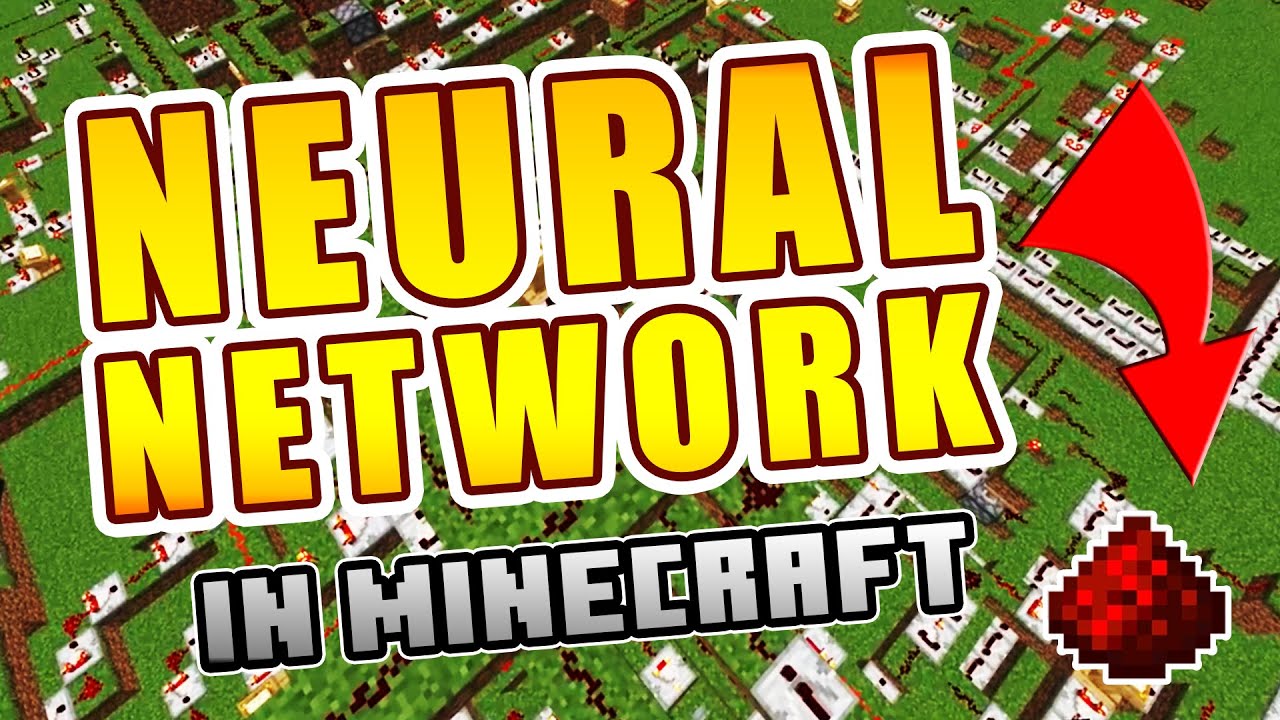
#minecraft #neuralnetwork #backpropagation
I built an analog neural network in vanilla Minecraft without any mods or command blocks. The network uses Redstone wire power strengths to carry the signal through one hidden layer, including nonlinearities, and then do automatic backpropagation and even weight updates.
OUTLINE:
0:00 - Intro & Overview
1:50 - Redstone Components Explained
5:00 - Analog Multiplication in Redstone
7:00 - Gradient Descent for Square Root Computation
9:35 - Neural Network Demonstration
10:45 - Network Schema Explained
18:35 - The Network Learns a Datapoint
20:20 - Outro & Conclusion
I built this during a series of live streams and want to thank everyone who helped me and cheered for me in the chat!
World saves here: https://github.com/yk/minecraft-neural-network
Game here: https://www.minecraft.net
Multiplier Inspiration: https://www.youtube.com/channe....l/UCLmzk4TlnLXCXCHcj
Credits to Lanz for editing!
Links:
TabNine Code Completion (Referral): http://bit.ly/tabnine-yannick
YouTube: https://www.youtube.com/c/yannickilcher
Twitter: https://twitter.com/ykilcher
Discord: https://discord.gg/4H8xxDF
BitChute: https://www.bitchute.com/channel/yannic-kilcher
Minds: https://www.minds.com/ykilcher
Parler: https://parler.com/profile/YannicKilcher
LinkedIn: https://www.linkedin.com/in/ya....nnic-kilcher-4885341
BiliBili: https://space.bilibili.com/1824646584
If you want to support me, the best thing to do is to share out the content :)
If you want to support me financially (completely optional and voluntary, but a lot of people have asked for this):
SubscribeStar: https://www.subscribestar.com/yannickilcher
Patreon: https://www.patreon.com/yannickilcher
Bitcoin (BTC): bc1q49lsw3q325tr58ygf8sudx2dqfguclvngvy2cq
Ethereum (ETH): 0x7ad3513E3B8f66799f507Aa7874b1B0eBC7F85e2
Litecoin (LTC): LQW2TRyKYetVC8WjFkhpPhtpbDM4Vw7r9m
Monero (XMR): 4ACL8AGrEo5hAir8A9CeVrW8pEauWvnp1WnSDZxW7tziCDLhZAGsgzhRQABDnFy8yuM9fWJDviJPHKRjV4FWt19CJZN9D4n
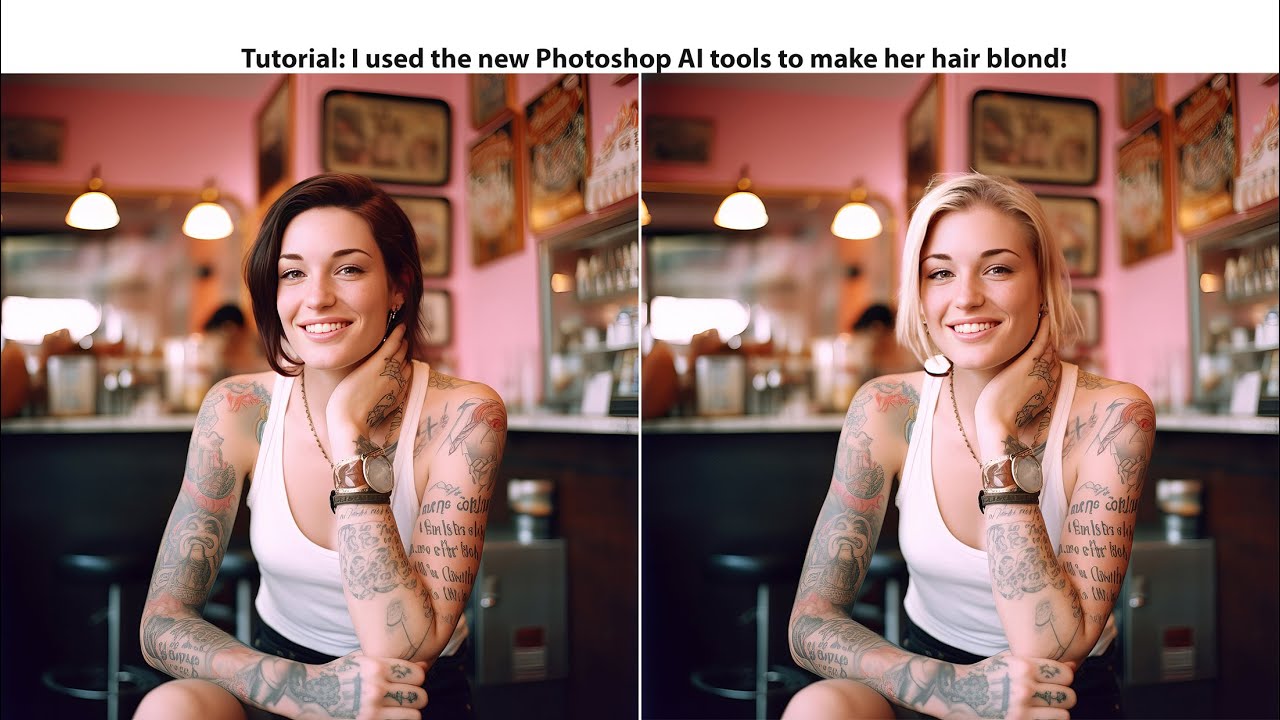
Adobe has released a new Photoshop beta version that introduces game-changing AI features, changing the way you edit images and photos, particularly beneficial for photographers, graphic designers, and creators.
The first AI feature, "Generate Objects", lets users select a certain area of an image and then input text specifying a desired change. The tool uses AI to make this change, for example, changing hair color.
The second feature, "Generate Backgrounds", allows users to select the subject of a photo and then specify a new background, with AI then generating various samples.
The third AI feature, "Extend Image", helps in expanding the image boundaries by adding extra elements such as extending a sky or a sandy beach, based on a user's text prompt.
The fourth feature, "Remove Objects", helps in removing selected elements from a picture by selecting the area and leaving the text prompt empty, allowing AI to remove all elements within the frame.
Timecodes:
0:00 Intro
0:31 The new AI imaging revolutions
1:40 The FOUR new Photoshop AI features
1:54 First feature: Generate Objects
3:47 Second feature: Generate Backgrounds
5:02 Third feature: Extend Images
7:07 Fourth feature: Remove Objects
8:08 Outro
#photoshop #sony

🔥Product Management Professional Program: https://www.simplilearn.com/product-management-training-course-online?utm_campaign=4VwM4oTqRD0&utm_medium=Lives&utm_source=youtube
🔥Professional Certification in Product Management: https://www.simplilearn.com/product-management-certification-training-course?utm_campaign=4VwM4oTqRD0&utm_medium=Lives&utm_source=youtube
This Product Management Full Course by Simplilearn provides a complete overview of the field, starting with What is Product Management and What a Product Manager Does, followed by essential Product Management Skills and creating a Product Roadmap. It covers key concepts like Product Market Fit, Product Backlog, and PM Roles and Responsibilities, alongside distinctions such as Product Manager vs. Project Manager and Product Manager vs. Product Owner. The course delves into practical frameworks like Go-To-Market Strategy, Market Research, and Agile Principles, while offering tools such as Top 10 PM Tools and Product Manager KPI Techniques. It also addresses critical concepts like MVP, SCRUM Meetings, User Persona Creation, and Product Lifecycle Management, culminating with strategies to ace Product Management Interview Questions.
These are the following topics covered in this Product Manager Full Course:
00:00:00 Introduction to Product Management Full Course
00:11:35 What is Product Management
00:11:52 What does a product manager do?
00:19:09 Product Management Skills
00:38:16 Product Roadmap
00:42:01 Certification in product Manager
00:51:45 What is product market fit
01:07:04 Product sense mock interview
01:26:39 Product Manager Vs Project Manager
01:33:20 product Backlog
01:41:58 PM Roles and responsibilities
02:06:11 Top 10 PM Tools
02:39:04 Product Manager KPI Techniques
03:01:38 Product Manager Vs Product owner
03:03:03 Go TO Market Strategy Framework
03:20:57 What is Market Research
03:30:18 Agile Principles
03:31:18 How to create user persona
03:55:13 What is MVP
03:57:43 SCRUM Meeting Explained
03:59:28 Product Lifecycle Management
04:10:49 How to answer Product Management Interview Questions
✅ Subscribe to our Channel to learn more about the top Technologies: https://bit.ly/2VT4WtH
#ProductManagementFullCourse #productmanagement #productmanager #simplilearn #2025
➡️About Professional Certification In Product Management
Professional Product Management Course by SP Jain School of Global Management prepares you to become a product manager via an exhaustive curriculum covering all aspects of product management. This program focuses on the latest industry trends, advancements and related industry applications taught by top product experts via live sessions.
Key Features
✅ Certificate from SP Jain School of Global Management
✅ Live sessions by SP Jain top global faculties
✅ Get access to SPJ Exec Ed Alumni benefits post program completion
✅ Leverage Generative AI as a Product Manager using tools such as ChatGPT, Google Bard, Gencraft, Midjourney, & Picsart
✅ Product management masterclass by industry experts from companies like Google, Facebook, Amazon, Microsoft and more
✅ Hands-on learning experience by solving real-life product problems via projects on Facebook, Tesla, Instagram, Netflix & Nike
✅ Product manager toolkit training
✅ JIRA, Mixpanel, Google Analytics & Balsamiq
✅ Hands-on learning via case studies and assignments
✅ Simplilearn's JobAssist helps you get noticed by top hiring companies
Skills Covered
✅ Product Strategy
✅ Product Market fit
✅ Product Ideation
✅ Rapid Prototyping
✅ Product Lifecycle Management
Learning Path
✅ UCSD PM: Induction Session for Product Management Program
✅ UCSD PM: Essentials - Introduction to Product Management
✅ UCSD PM: Essentials - Building Key Assets That Drive Product
✅ UCSD PM: Essentials - Building a Product Strategy
✅ UCSD PM: Essentials - Product Planning
✅ UCSD PM: Essentials - Working with Other Teams
✅ UCSD PM: Essentials - Hypothesis Validation
✅ UCSD PM: Essentials - Agile Development Process
✅ UCSD PM: Essentials - Building Prototypes
✅ UCSD PM: Essentials - Product Analytics
✅ UCSD PM: Essentials - Business Fundamentals
✅ UCSD PM: Essentials - Portfolio Assessment
✅ UCSD PM: User Experience Research for Product Managers
✅ UCSD PM: Product Design for Product Managers
✅ UCSD PM: Product Marketing for Product Managers
✅ UCSD PM: Introduction to Software Development Basics for Product Managers
✅ UCSD PM: Product Management Tools
✅ UCSD PM: Product Management Capstone Project
Electives:
✅ Masterclass by UC San Diego Division of Extended Studies
✅ UCSD PM: Product Management Masterclass by Industry Experts
✅ UCSD PM: Product Teardown Sessions
✅ UCSD PM: AI- Powered Product Management
🔥Learn More about Product Management Professional Program: https://www.simplilearn.com/product-management-training-course-online?utm_campaign=4VwM4oTqRD0&utm_medium=Lives&utm_source=youtube

Game development veteran, creator of libGDX, and 17-year open-source contributor Mario Zechner tells the story of how he ended up building pi, his own minimal, opinionated terminal coding agent.
It started in April 2025 when Peter Steinberger and Armin Ronacher (Flask, Sentry) dragged him into an overnight AI hackathon. Within weeks, Mario was hooked on Claude Code — until he wasn't. There was feature bloat, hidden context injection that changed daily, the infamous terminal flicker, and zero extensibility for power users.
He then surveyed the alternatives — Codex CLI, Amp, OpenCode... Eventually, he came across Terminus — an agent that gives the model nothing but a tmux session and raw keystrokes. If that's enough for the model to perform, what are all those extra features actually doing?
Mario's thesis: we're still in the "messing around and finding out" stage, and coding agents need to become more malleable so developers can experiment faster.
Pi is his answer: four tools (read, write, edit, bash), the shortest system prompt of any major agent, tree-structured sessions, full cost tracking, hot-reloading TypeScript extensions, and nothing injected behind your back. No MCP, no sub-agents, no plan mode — but all of it buildable in minutes through extensions.
The community has already shipped pi-annotate (visual frontend feedback), pi-messenger (a multi-agent chatroom), and someone even got Doom running. On TerminalBench, pi with Claude Opus 4.5 landed right behind Terminus — before it even had compaction.
🔗 LINKS & RESOURCES
pi coding agent: https://pi.dev
Mario Zechner: https://mariozechner.at
Peter Steinberger / OpenClaw: https://github.com/steipete
Armin Ronacher: https://lucumr.pocoo.org
Claude Code: https://docs.anthropic.com/en/docs/claude-code
Aider: https://aider.chat
OpenCode: https://github.com/anthropics/opencode
Amp (Sourcegraph): https://sourcegraph.com/amp
TerminalBench: https://terminalbench.com
Ghostty: https://ghostty.org
Vouch: https://github.com/mitchellh/vouch
libGDX: https://libgdx.com
AI Engineer London is a community meetup for engineers and founders building with AI, covering everything from agent frameworks and RAG pipelines to LLMs in production. Each event features technical talks, live demos, and hands-on networking. This talk was recorded at AI Engineer London #10, hosted by Tessl, in collaboration with AI Engineer London.
AI ENGINEER LONDON
📅 Events: https://lu.ma/aiengineerlondon
💼 LinkedIn: https://linkedin.com/company/a....i-engineer-london-me
📚 MASTRA RESOURCES
Mastra: https://mastra.ai
Learn Mastra in the world's first MCP-Based Course: https://mastra.ai/course
Principles of Building AI Agents (Book): https://mastra.ai/books/principles-of-building-ai-agents
Patterns for Building AI Agents (New Book): https://mastra.ai/books/patterns-of-building-ai-agents
MASTRA?
Mastra is an open-source TypeScript framework designed for building and shipping AI-powered applications and agents with minimal friction. It supports the full lifecycle of agent development—from prototype to production. You can integrate it with frontend and backend stacks (e.g., React, Next.js, Node) or run agents as standalone services. If you're a JavaScript or TypeScript developer looking to build an agentic or AI-powered product without starting from first principles, Mastra provides the scaffolding, tools, and integrations to accelerate that process.
📑 CHAPTERS
00:00 Intro
02:17 The history of coding agents: ChatGPT → Copilot → Aider → Claude Code
04:52 What Claude Code got right — and where it became a spaceship
06:04 Claude Code Drawbacks
09:39 Claude Code Alternatives
11:38 OpenCode's compaction problem and prompt cache busting
12:51 Why LSP feedback mid-edit is a terrible idea
14:26 OpenCode's architecture issues and security vulnerability
16:06 TerminalBench and Terminus
18:13 Mario's Two Theses
19:08 Introducing pi — strip everything, build a minimal extensible core
20:01 The system prompt
21:18 What's not in pi — and what you build instead
22:40 Extensions: custom tools, custom UI, hot reloading
24:00 Community extensions
24:59 Tree-structured sessions, cost tracking, HTML export
25:33 TerminalBench results
25:54 Open source under siege and human verification

![The Complete Machine Learning Roadmap [2024]](https://i.ytimg.com/vi/7IgVGSaQPaw/maxresdefault.jpg)
Go from zero to a machine learning engineer in 12 months. This step-by-step roadmap covers the essential skills you must learn to become a machine learning engineer in 2024.
Download the FREE roadmap PDF here: https://mosh.link/machine-learning-roadmap
✋ Stay connected
- Complete courses: https://codewithmosh.com
- Twitter: https://twitter.com/moshhamedani
- Facebook: https://www.facebook.com/programmingwithmosh/
- Instagram: https://www.instagram.com/codewithmosh.official/
- LinkedIn: https://www.linkedin.com/school/codewithmosh/
🔗 Other roadmaps
https://youtu.be/Tef1e9FiSR0?si=QpVnZ_o9-DAXzT71
https://youtu.be/OeEHJgzqS1k?si=qd0ZIqAzUpZQn6BX
📚 Tutorials
https://youtu.be/_uQrJ0TkZlc?si=ZhlCrQs1SkaPNVa8
https://youtu.be/8JJ101D3knE?si=OGTuS35LQqSunuhh
https://youtu.be/BBpAmxU_NQo?si=dm-ZCPxVBYWS1Qhn
https://youtu.be/7S_tz1z_5bA?si=QL7s_M2Ao90RDwG8
📖 Chapters
00:00 - Introduction
00:20 - Programming Languages
00:42 - Version Control
01:03 - Data Structures & Algorithms
01:35 - SQL
01:55 - The Complete Roadmap PDF
02:19 - Mathematics & Statistics
02:40 - Data Handling
03:15 - Machine Learning Fundamentals
03:57 - Advanced Topics
04:28 - Model Deployment
#machinelearning #ai #datascience #coding #programming
👉 GET $500 IN FREE CREDITS (first 500 people only):
https://www.hyperagent.com/vaibhav
👉 GRAB EVERY PROMPT AND BUILD ALONG (FREE):
https://links.stayingahead.com/YT67
━━━━━━━━━━━━━━━━━━━━━━
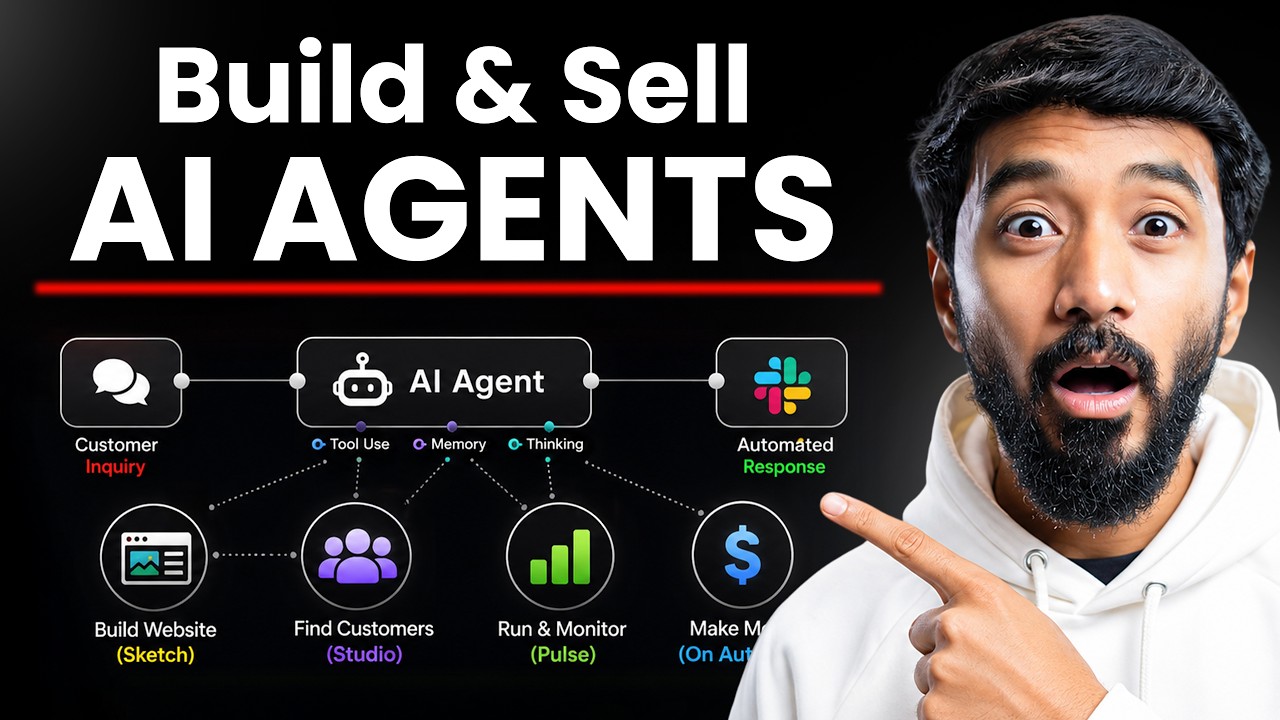
Millions of AI agents are already working right now — and almost nobody outside
of tech knows how to build one. In this video you'll build 3 no code AI agents
in 15 minutes, including one that builds and manages an entire army of AI agents
for you. Zero coding. Nothing to install. Total cost: under $10.
Everyone learned ChatGPT and Claude. Almost nobody learned what came after it.
Here's the difference. Today you open a tab, ask a question, get an answer, close
it and tomorrow you start from zero. An AI agent doesn't work like that. You
build it once, it remembers you, and it keeps working long after you've shut the
laptop.
This is a complete no code AI agent tutorial for beginners. No developer
background needed, no terminal, no API keys pasted from a doc you don't
understand. Everything runs in your browser, on whatever laptop you already own.
WHAT YOU'RE BUILDING:
Level 1 — Your first AI agent. The simplest working version there is.
Level 2 — An AI agent that builds and manages an army of other AI agents,
running multiple jobs at the same time.
Level 3 — A fully autonomous agent that runs on its own every morning and has
a report waiting for you before you wake up.
We're using Hyperagent, built by the founder of Airtable. A normal AI forgets
everything about you the second you close the tab. This one remembers your whole
setup and keeps working on its own — less like a chatbot you re-explain yourself
to every time, more like an employee you hire once.
People are already selling agent builds like these for a couple thousand dollars.
This one cost under ten dollars to make. That's what a one person business looks
like in 2026.
━━━━━━━━━━━━━━━━━━━━━━
⏱ TIMESTAMPS
0:00 Everyone learned ChatGPT. Nobody learned this
0:40 The real question: how AI makes money
1:04 The tool that makes this possible
1:21 Free credits + all prompts
1:38 BUILD 1: The offer that brings money in
2:29 Building the wedding decor agent
3:38 One photo, three decorated venues
4:12 Saving it as a reusable agent
4:44 The pricing page that sells itself
5:16 What it actually cost: $11
5:39 BUILD 2: The agent that builds a whole company
6:53 Setting up the startup team
7:37 How it saves money mid-task
7:54 The research report
8:19 The builder and the brand
9:03 Finding 7 real customers, live
9:22 Turning it into reusable skills
9:42 Plugging into Gmail, Slack, GitHub
9:58 BUILD 3: The agent that runs it all
10:20 Setting up your always-on analyst
11:52 The agent that grades itself
12:12 Your daily report, built automatically
12:45 The whole one person business
13:01 Claim your credits
━━━━━━━━━━━━━━━━━━━━━━
❓ QUESTIONS PEOPLE ASK
Do I need to know coding to build an AI agent?
No. Every build in this video is no code. Nothing gets installed and nothing runs
locally.
What is an AI agent, in simple terms?
A normal AI answers one question and forgets you. An agent is set up once, keeps
your context, and keeps working on its own without being prompted again.
Is Hyperagent free?
No, it's a paid tool. The first 500 people through the link get $500 in credits,
which covers everything built in this video.
Can I sell AI agents I build?
People are charging a couple thousand dollars for builds like these. The video
shows exactly what goes into one.
━━━━━━━━━━━━━━━━━━━━━━
#AIAgents #NoCodeAI #AIAutomation #AITutorial #Hyperagent
--------
To Know More,
Follow Vaibhav Sisinty On ⤵︎
Instagram @VaibhavSisinty
https://www.instagram.com/vaibhavsisinty
Twitter @VaibhavSisinty
https://twitter.com/VaibhavSisinty
Facebook @VaibhavSisinty
https://www.facebook.com/vaibhavsisinty/
LinkedIn - Vaibhav Sisinty
https://www.linkedin.com/in/vaibhavsisinty

MIT RES.14-004 Seven Questions About Tariffs That Everyone Should Know the Answer To, IAP 2026
Instructor: Arnaud Costinot
View the complete course: https://ocw.mit.edu/courses/re....s-14-004-seven-quest
YouTube Playlist: https://www.youtube.com/playli....st?list=PLUl4u3cNGP6
It is hard to predict what US tariffs will look like in a few months, or even in a few weeks from now. But there are many questions about tariffs that can be answered through a combination of theory and data. This lecture discusses seven that everyone should know the answers to.
Question #1: What Is (Always) Bad About Tariffs? (05:16)
Question #2: What is (Potentially) Good About Tariffs? (13:22)
Question #3: Should a Country (Sometimes) Use Tariffs? (28:15)
Question #4: How Do We Know Whether (a Particular Set of) Tariffs Are Good or Bad? (43:08)
Question #5: What Was the Impact of the 2018–2019 Trade War? (46:59)
Question #6: Are Global Tariffs Unfair to the United States? (56:56)
Question #7: What Is (Really) Bad about Trade Wars? (1:02:27)
License: Creative Commons BY-NC-SA
More information at https://ocw.mit.edu/terms
More courses at https://ocw.mit.edu
Support OCW at http://ow.ly/a1If50zVRlQ
We encourage constructive comments and discussion on OCW’s YouTube and other social media channels. Personal attacks, hate speech, trolling, and inappropriate comments are not allowed and may be removed. More details at https://ocw.mit.edu/comments.

This is a video about how Japanese samurai swords, aka katanas, are made – from the gathering of the iron sand, to the smelting of the steel, to the forging of the blade. Head over to https://hensonshaving.com/veritasium and enter code 'Veritasium' for 100 free blades with the purchase of a razor. Make sure to add both the razor and the blades to your cart for the code to take effect.
Special thanks to our Patreon supporters! Join this list to help us keep our videos free, forever:
https://ve42.co/PatreonDEB
If you’re looking for a molecular modeling kit, try Snatoms, a kit I invented where the atoms snap together magnetically - https://ve42.co/SnatomsV
▀▀▀
A massive thank you to John McBride for making this entire project happen. This would not have been possible without John. Please check out his japan walking tours https://walkjapan.com/
Massive thanks to Craig Mod, Inoue-san, everyone in the Tanabe family, and Takanashi-san. Also a massive thank you to Kevin Cashen – https://cashenblades.com/
▀▀▀
References:
Tanii, H., Inazumi, T., & Terashima, K. (2014). Mineralogical study of iron sand with different metallurgical characteristic to smelting with use of Japanese classic iron-making furnace “Tatara”. ISIJ international, 54(5), 1044-1050.
Tate, M. (2005). History of Iron and Steel Making Technology in Japan Mainly on the smelting of iron sand by Tatara. Tetsu-to-Hagane, 91(1), 2-10.
Krauss, G. (1999). Martensite in steel: strength and structure. Materials science and engineering: A, 273, 40-57.
Krauss, G., & Marder, A. R. (1971). The morphology of martensite in iron alloys. Metallurgical Transactions, 2, 2343-2357.
Yalçın, Ü. (1999). Early iron metallurgy in Anatolia. Anatolian Studies, 49, 177-187.
Kapp, L., Kapp, H., & Yoshihara, Y. (1987). The craft of the Japanese sword. Kodansha International.
Matsumoto, C., Das, A. K., Ohba, T., Morito, S., Hayashi, T., & Takami, G. (2013). Characteristics of Japanese sword produced from tatara steel. Journal of Alloys and Compounds, 577, S673-S677.
Inoue, T. (2010). Tatara and the Japanese sword: the science and technology. Acta Mechanica, 214(1), 17-30.
Images & Video:
Great video from NHK – https://ve42.co/NHK
▀▀▀
Special thanks to our Patreon supporters:
Adam Foreman, Anton Ragin, Balkrishna Heroor, Bill Linder, Blake Byers, Burt Humburg, Chris Harper, Dave Kircher, David Johnston, Diffbot, Evgeny Skvortsov, Garrett Mueller, Gnare, I.H., John H. Austin, Jr. ,john kiehl, Josh Hibschman, Juan Benet, KeyWestr, Lee Redden, Marinus Kuivenhoven, Max Paladino, Meekay, meg noah, Michael Krugman, Orlando Bassotto, Paul Peijzel, Richard Sundvall, Sam Lutfi, Stephen Wilcox, Tj Steyn, TTST, Ubiquity Ventures
▀▀▀
Directed by Petr Lebedev
Written by Petr Lebedev and Derek Muller
Edited by Trenton Oliver, Jack Saxon, Peter Nelson
Animated by Fabio Albertelli, Jakub Misiek, David Szakaly
Filmed by Petr Lebedev and Lui Kimishima
Produced by Petr Lebedev, Derek Muller, Han Evans, Giovanna Utichi, Emily Taylor
Additional research by Gregor Čavlović
Thumbnail by Peter Sheppard
Additional video/photos supplied by Getty Images
Music from Epidemic Sound

🔥PGP in Generative AI and ML in collaboration with Illinois Tech: https://www.edureka.co/executi....ve-programs/pgp-gene
🔥Generative AI Course: Masters Program: https://www.edureka.co/masters....-program/generative-
00:00:00 Introduction
00:04:16 What is Generative AI?
00:17:44 Generative AI Examples
00:36:23 Generative AI Tools
00:54:10 What Is Artificial Intelligence?
01:00:14 Types Of Artificial Intelligence
01:10:29 What is Deep Learning
01:21:42 TensorFlow Explained
01:46:28 Convolutional Neural Network
02:07:04 Artificial Neural Network
02:38:55Recurrent Neural Networks
03:07:38 Keras
03:32:58 Generative AI Course - Part 1 - What is LLM?
03:52:42 What Are GANs?
04:05:03 Transformers In Gen AI
04:12:42 Prompt Engineering Explained
04:26:27 Prompt Engineering for Code Generation
04:35:46 How to Become a Prompt Engineer
04:40:50 Building a Chatbot with Prompt Engineering
04:57:00 GitHub Copilot
05:14:25 Generative AI Course - Part 2 - What is LangChain?
05:31:40 Generative AI Course - Part 3 - What is RAG?
05:54:33 Generate Images Using DC-GAN
06:19:07 Midjourney
06:37:28 OpenAI API using Python
06:45:43 Generative AI in Marketing
06:56:13 What is Agentic AI?
07:06:13 The Future of Generative AI and Job Opportunities
07:11:57 Nvidia's Latest Breakthrough in Generative AI
07:18:34 DeepSeek vs OpenAI: Who Wins the AI Race?
07:31:07 Alibaba’s Qwen 2.5-Max Just Beat GPT-4 & DeepSeek?
07:35:30 DeepSeek Training Cost
07:40:59 Exploring the 07:48:29 Ethics of Generative AI
Dangers of AI
08:11:15 Artificial Intelligence Project Ideas
08:24:52 Top 10 Benefits Of Artificial Intelligence
08:36:40 GenAI Roadmap
08:45:25 Top 5 Generative AI Career Opportunities
09:01:38 Generative AI Interview Questions
Explore *Generative AI* with this Beginner to Advanced Full Course! Learn key concepts like LLMs, GANs, Transformers, Prompt Engineering, and AI Ethics with hands-on projects. Whether you're a beginner or an AI enthusiast, this course will guide you step-by-step to mastering Generative AI. Watch now and start building with AI today
"✅Subscribe to our channel to get video updates. Hit the subscribe button above: https://goo.gl/6ohpTV
📝Feel free to share your comments below.📝
𝐄𝐝𝐮𝐫𝐞𝐤𝐚 𝐎𝐧𝐥𝐢𝐧𝐞 𝐓𝐫𝐚𝐢𝐧𝐢𝐧𝐠 𝐚𝐧𝐝 𝐂𝐞𝐫𝐭𝐢𝐟𝐢𝐜𝐚𝐭𝐢𝐨𝐧𝐬
🔵 DevOps Online Training: http://bit.ly/3VkBRUT
🌕 AWS Online Training: http://bit.ly/3ADYwDY
🔵 React Online Training: http://bit.ly/3Vc4yDw
🌕 Tableau Online Training: http://bit.ly/3guTe6J
🔵 Power BI Online Training: http://bit.ly/3VntjMY
🌕 Selenium Online Training: http://bit.ly/3EVDtis
🔵 PMP Online Training: http://bit.ly/3XugO44
🌕 Salesforce Online Training: http://bit.ly/3OsAXDH
🔵 Cybersecurity Online Training: http://bit.ly/3tXgw8t
🌕 Java Online Training: http://bit.ly/3tRxghg
🔵 Big Data Online Training: http://bit.ly/3EvUqP5
🌕 RPA Online Training: http://bit.ly/3GFHKYB
🔵 Python Online Training: http://bit.ly/3Oubt8M
🌕 Azure Online Training: http://bit.ly/3i4P85F
🔴 𝐄𝐝𝐮𝐫𝐞𝐤𝐚 𝐑𝐨𝐥𝐞-𝐁𝐚𝐬𝐞𝐝 𝐂𝐨𝐮𝐫𝐬𝐞𝐬
🔵 DevOps Engineer Masters Program: http://bit.ly/3Oud9PC
🌕 Cloud Architect Masters Program: http://bit.ly/3OvueZy
🔵 Data Scientist Masters Program: http://bit.ly/3tUAOiT
🌕 Big Data Architect Masters Program: http://bit.ly/3tTWT0V
🔵 Machine Learning Engineer Masters Program: http://bit.ly/3AEq4c4
🌕 Business Intelligence Masters Program: http://bit.ly/3UZPqJz
🔵 Python Developer Masters Program: http://bit.ly/3EV6kDv
🔴 𝐄𝐝𝐮𝐫𝐞𝐤𝐚 𝐔𝐧𝐢𝐯𝐞𝐫𝐬𝐢𝐭𝐲 𝐏𝐫𝐨𝐠𝐫𝐚𝐦𝐬
🔵 Post Graduate Program in DevOps with Purdue University: https://bit.ly/3Ov52lT
🌕 Advanced Certificate Program in Data Science with E&ICT Academy, IIT Guwahati: http://bit.ly/3V7ffrh
🔵 Advanced Certificate Program in Cloud Computing with E&ICT Academy, IIT Guwahati: https://bit.ly/43vmME8
📌𝐓𝐞𝐥𝐞𝐠𝐫𝐚𝐦: https://t.me/edurekaupdates
📌𝐓𝐰𝐢𝐭𝐭𝐞𝐫: https://twitter.com/edurekain
📌𝐋𝐢𝐧𝐤𝐞𝐝𝐈𝐧: https://www.linkedin.com/company/edureka
📌𝐈𝐧𝐬𝐭𝐚𝐠𝐫𝐚𝐦: https://www.instagram.com/edureka_learning/
📌𝐅𝐚𝐜𝐞𝐛𝐨𝐨𝐤: https://www.facebook.com/edurekaIN/
📌𝐒𝐥𝐢𝐝𝐞𝐒𝐡𝐚𝐫𝐞: https://www.slideshare.net/EdurekaIN
📌𝐂𝐚𝐬𝐭𝐛𝐨𝐱: https://castbox.fm/networks/505?country=IN
📌𝐌𝐞𝐞𝐭𝐮𝐩: https://www.meetup.com/edureka/
📌𝐂𝐨𝐦𝐦𝐮𝐧𝐢𝐭𝐲: https://www.edureka.co/community/
- - - - - - - - - - - - - -
For more information, please write back to us at [email protected] or call us at IND: 9606058406 / US & Others: +18885487823 (toll-free)"
![Falling into a black hole (Realistic Ultra HD 360 VR movie) [8K]](https://i.ytimg.com/vi/S6qw5_YA8iE/maxresdefault.jpg)
Update: check out my latest video - the most realistic simulated movie to-date of the supermassive black hole in the centre of our own Milky Way galaxy! [https://youtu.be/wU3vRKczamc]
On smartphones this video is best viewed using the youtube app. Try google cardboard on your smartphone with a VR headset for the most immersive experience (smartphone with gyro sensor required). For desktop computers try viewing in Google Chrome browser or Firefox.
If you're in a hurry, jump forward to 2:00 where it gets really interesting.
Science note: this is a real physics calculation (not simulation or rendering) I did of what we would actually see if we were unfortunate enough to fall into a black hole, from far away all the way up to the event horizon! Each frame is rendered at a resolution of 8K and the video plays at 60fps. Calculations are performed using my own general relativistic ray tracing and radiative transfer computer code, 'BHOSS' (Younsi et al. 2017), i.e., solving the equations of motion of light/photons (null geodesics) for a given spacetime, in this case a spinning black hole (Kerr).
For now there are no Doppler or gravitational redshifting effects for the sake of clarity. I've omitted an accretion disk and proper radiative transport of light as it distracts from the gravitational lensing of the starlight and the black hole's shadow. Including an accretion disk or even a torus calculated from a proper general relativistic magnetohydrodynamical computer simulation of gas falling onto a black hole is also possible and I may do this in the future.
In this movie the black hole is spinning rapidly (almost at the maximum possible rate). The starfield is taken from real observational data. The movie starts one thousand gravitational radii away from the black hole and ends at the event horizon, where eventually all light focuses into a single point and vanishes. Try looking around as you approach, or you'll miss it!
I made this VR movie to promote the "Einstein Inside" exhibition touring Germany, where it was first shown in November and December at the Goethe University of Frankfurt. Copyright: Ziri Younsi.
━━━━━━━━━━━━━━━━━━━━━━━━━━━━━━━━━━━━━━━━━━━
Movie produced from calculations utilising my general-relativistic radiation transfer code BHOSS, e.g., Ziri Younsi et al. 2012, 2016, 2020:
https://ui.adsabs.harvard.edu/....abs/2012A%26A...545A
https://ui.adsabs.harvard.edu/....abs/2016PhRvD..94h40
https://ui.adsabs.harvard.edu/....abs/2020IAUS..342...
━━━━━━━━━━━━━━━━━━━━━━━━━━━━━━━━━━━━━━━━━━━
Code: https://github.com/entbappy/OpenAI-GPT-3
Generative Pre-trained Transformer 3 (GPT 3) is an autoregressive language model that uses deep learning to produce human-like text. Given an initial text as prompt, it will produce text that continues the prompt.
Check out my other playlists:
► Complete Python Programming: https://youtube.com/playlist?l....ist=PLkz_y24mlSJaY8Y
► 100 Days of Machine Learning playlist: https://youtube.com/playlist?l....ist=PLkz_y24mlSJY0Zh
► Statistics For Machine Learning: https://youtube.com/playlist?l....ist=PLkz_y24mlSJbmCc
► Object Detection Using YOLO v6: https://youtube.com/playlist?l....ist=PLkz_y24mlSJY3H0
► Object Detection Using YOLO v7: https://youtube.com/playlist?l....ist=PLkz_y24mlSJagh6
► Sign Language Detection Using YOLO v5: https://youtube.com/playlist?l....ist=PLkz_y24mlSJYWpw
►ONNX (Open Neural Network Exchange): https://youtube.com/playlist?l....ist=PLkz_y24mlSJZJx9
😀Please donate if you want to support the channel through Buy me a coffee: https://www.buymeacoffee.com/dswithbappy
This channel focuses on providing content on Data Science, Artificial Intelligence, Machine Learning, Deep Learning, Computer Vision, Natural language processing, Python programming, etc. in Bangla and English.
My mission is to provide inspiration, motivation & good quality education to students for learning and human development, and to become an expert in Artificial Intelligence, Machine Learning, Deep Learning, Computer Vision, Natural language processing, Python programming, and so on.
#dswithbappy aims to change this education system of Bangladesh.
I believe that high-quality education is not just for the privileged few. It is the right of everyone who seeks it. My aim is to bring quality education to every single student. All I need from you is intent, a ray of passion to learn.
Thanks!
#dswithbappy
Connect with me here:
Twitter: https://twitter.com/bappy913873
Facebook: https://www.facebook.com/groups/dswithbappy
instagram: https://www.instagram.com/entbappy/
linkedin : https://www.linkedin.com/in/boktiarahmed73/
Github: https://github.com/entbappy
🙏🙏🙏🙏🙏🙏🙏🙏
YOU JUST NEED TO DO
3 THINGS to support my channel
LIKE
SHARE
&
SUBSCRIBE
TO MY YOUTUBE CHANNEL
Learn about generative models and different frameworks, investigating the production of text and visual material produced by artificial intelligence. This course was originally recorded live.
Instructors: Krish Naik, Sunny Savita, and Boktiar Ahmed Bappy.
For course details, visit: https://ineuron.ai/course/gene....rative-ai-community-
⌨️ (00:00:00) DAY 1: Introduction to Generative AI Community Course
⌨️ (01:44:14) DAY 2: Introduction to OpenAI and understanding the OpenAI API
⌨️ (03:37:49) DAY 3: Introduction to LangChain
⌨️ (05:16:48) Day 4: Hugging Face API + Langchain
⌨️ (07:13:08) DAY 5: Memory in Langchain
⌨️ (09:07:53) DAY 6: LLM Generative AI Project using OpenAI & LangChain
⌨️ (11:03:29) DAY 7: LLM Generative AI Project & Deployment
⌨️ (13:09:02) DAY 8: Introduction to Vector Database for AI & LLM
⌨️ (14:52:41) DAY 9: Mastering Vector Databases with Pinecone
⌨️ (17:02:19) DAY 10: Mastering ChromaDB Vector Databases
⌨️ (19:04:25) DAY 11: Introducing Meta Llama 2
⌨️ (20:54:33) DAY 12: End to End Medical Chatbot Project, Part 1
⌨️ (22:36:05) DAY 13: End to End Medical Chatbot Project, Part 2
⌨️ (24:22:10) Generative AI: Everything You need to know about Gemini Pro LLM Models
⌨️ (26:16:33) End to End Gen AI Project using Google Gemini Pro
⌨️ (28:24:14) Webinar - Generative AI Revolution: The Future
🎉 Thanks to our Champion and Sponsor supporters:
👾 davthecoder
👾 jedi-or-sith
👾 南宮千影
👾 Agustín Kussrow
👾 Nattira Maneerat
👾 Heather Wcislo
👾 Serhiy Kalinets
👾 Justin Hual
👾 Otis Morgan
👾 Oscar Rahnama
--
Learn to code for free and get a developer job: https://www.freecodecamp.org
Read hundreds of articles on programming: https://freecodecamp.org/news

For more information about Stanford’s graduate programs, visit: https://online.stanford.edu/graduate-education
October 17, 2025
This lecture covers:
• Pretraining
• Quantization
• Hardware optimization
• Supervised finetuning (SFT)
• Parameter-efficient finetuning (LoRA)
To follow along with the course schedule and syllabus, visit: https://cme295.stanford.edu/syllabus/
Chapters:
00:00:00 Introduction
00:07:19 Pretraining
00:13:26 FLOPs, FLOPS
00:16:34 Scaling laws, Chinchilla law
00:24:49 Training optimizations overview
00:31:09 Data parallelism with ZeRO
00:35:51 Model parallelism
00:38:26 Flash Attention
00:52:37 Quantization
00:56:00 Mixed precision training
01:02:31 Supervised finetuning
01:09:21 Instruction tuning
01:37:53 Parameter-efficient finetuning with LoRA
01:45:16 QLoRA
Afshine Amidi is an Adjunct Lecturer at Stanford University.
Shervine Amidi is an Adjunct Lecturer at Stanford University.
View the course playlist: https://www.youtube.com/playli....st?list=PLoROMvodv4r

How To Train AI Models using Unsloth
Unlock the secrets to training powerful AI models that can outperform giants like Chat GPT and Claude, right from your personal computer and for less than $5! This video reveals how specialized, fine-tuned models can achieve superior accuracy on specific tasks compared to their larger counterparts. Discover the critical, yet often overlooked, aspects of AI training that big companies don't talk about, including the most effective ways to structure your data for success with tools like Unsloth. Whether you're a business owner, developer, or AI enthusiast, learn the practical steps to build your own custom AI solutions efficiently.
🔗 What We Cover:
- The Underdog Advantage: Understand why smaller, fine-tuned AI models can surpass large language models like GPT-4 in specialized tasks, backed by surprising accuracy stats.
- Cost-Effective AI Training: Learn how to train high-performing AI models in just a couple of hours on your personal computer for minimal cost (even free using Google Colab with a T4 GPU!).
- The Data Structuring Secret: Master the simple yet crucial two-column (instruction/input and output) data format required for effective model training with Unsloth, avoiding common pitfalls.
- Practical Fine-Tuning Examples: See real-world data structuring for an AI gym trainer and a customer service response bot.
- Step-by-Step Unsloth Tutorial: Follow along as we build an AI workout generator using Unsloth in a Google Colab notebook, from data preparation to model training and testing.
- Beyond the Hype: Uncover the techniques that companies like Google, DeepMind, and OpenAI use, adapted for your own projects.
💡 Embrace the Future of AI:
Step into the world of custom AI model training! This guide empowers you to bypass the need for massive datasets and expensive infrastructure. Learn the secrets to creating specialized AI that truly understands your unique context and delivers exceptional results.
Join me as I demystify AI model training, showing you exactly how to achieve remarkable performance without breaking the bank. Don't forget to like, share, and subscribe for more insights into practical AI implementation!
👨💻 Follow Me:
Website: https://www.rolandburke.com
Be there first to know when the community drops: https://www.rolandburke.com/join-now
Twitter: https://twitter.com/rjburkejr
LinkedIn: https://www.linkedin.com/in/rolandburke
Videos I Think You'll ❤️:
How To Install Text Generation Web UI
https://youtu.be/Lm2xpJ5TQBo
How To Use ChatGPT Inside Of Airtable
https://youtu.be/extjQChhE-M
========================
🎥 Video Breakdown
0:00 - Introduction: Training AI Better Than ChatGPT for Cheap
0:06 - The High Cost of Traditional AI Training
0:25 - The Big Secret: Smaller Models, Better Results?
0:47 - Why Fine-Tuned Models Outperform Giants (Study Results)
2:09 - The Power of Small Datasets (200-500 Examples)
2:20 - Why Specialization Beats Generalization in AI
2:34 - Critical Mistake: The Importance of Training Data Structure
3:14 - Simplifying Data Structure with Unsloth: The Two-Column Method
3:54 - Example 1: Structuring Data for an AI Gym Trainer
4:44 - Example 2: Structuring Data for Customer Service AI
5:43 - Step-by-Step: Training Your AI Model with Unsloth in Google Colab
6:01 - Demo: Building an AI Workout Generator - Data Prep
6:25 - Colab Setup: Choosing a Model (Meta Llama 3.1 8B) & Lora Adapters
7:39 - Training the Model: Settings & Process (Max Steps, Epochs, Learning Rate)
8:25 - Analyzing Training Results & Loss Rate
8:31 - Testing Your Fine-Tuned AI Model: Workout Generator in Action
9:01 - Conclusion: Train Your Own AI for Free/Cheap!
9:14 - Beyond Fine-Tuning: Access a Suite of AI Tools
9:29 - Join the AI Community & Waitlist
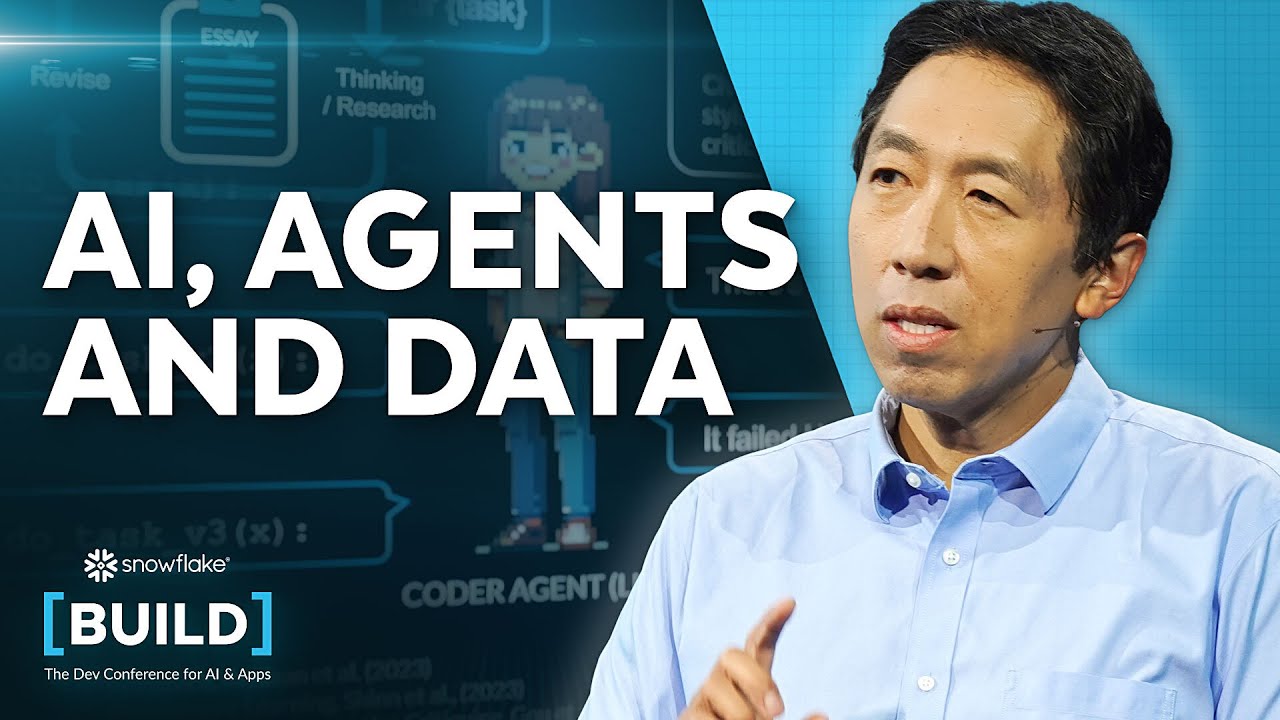
In recent years, the spotlight in AI has primarily been on large language models (LLMs) and emerging large multi-modal models (LMMs). Now, building on these tools, a new paradigm is emerging with the rise of AI agents and agentic reasoning, which are proving to be both cost-effective and powerful for building numerous new applications. As AI continues to evolve, data across all industries, particularly unstructured data such as text, images, video, and audio, is becoming more critical than ever. In this keynote session from BUILD 2024, Andrews Ng, Founder and Executive Chairman of Landing AI, explores the rise of AI, agents, and the growing role of unstructured data. He also discusses how this convergence will shape automation and application building across industries.
Andrew Ng will be a featured speaker at Snowflake Dev Day 2025. Join us on June 5 in San Francisco. Registration is free and open now: https://www.snowflake.com/en/summit/dev-day
Watch the Snowflake Summit 2024 Opening Keynote featuring Snowflake CEO Sridhar Ramaswamy and OpenAI CEO Sam Altman, moderated by Sarah Guo, founder and managing partner of Conviction here: https://youtu.be/gJf39VG87O8
Check out Andrew Ng speaking about AI agentic workflows and their potential for driving AI progress here:
👉 https://www.youtube.com/watch?v=q1XFm21I-VQ
Register to watch more BUILD on-demand here:
👉 https://www.snowflake.com/build/
Enroll in the "Introduction to Generative AI with Snowflake" course on Coursera:
👉 http://coursera.org/learn/intro-generative-ai-course-snowflake/?utm_medium=institutions&utm_source=snowflake&utm_campaign=yt-promo
❄Join our YouTube community❄ https://bit.ly/3lzfeeB
Learn more about Snowflake:
➡️ Website: https://www.snowflake.com
➡️ Careers: http://careers.snowflake.com
➡️ Podcast page: https://www.snowflake.com/thedatacloudpodcast/
➡️ Twitter: https://twitter.com/SnowflakeDB
➡️ Instagram: https://www.instagram.com/_snowflake_inc
➡️ Facebook: https://www.facebook.com/snowflakedb
➡️ LinkedIn: https://bit.ly/2QUexl4
➡️ Sign up for our weekly live demo program and have your questions answered by a Snowflake expert at https://bit.ly/2TdVCmJ
Listen on:
🔈 Apple Podcasts: https://apple.co/3cCdrCU
🔈 Spotify: https://spoti.fi/39vCNjH
🔈 Simplecast: https://bit.ly/3rFCrgA
#Snowflake #DataCloud

#ai #technology #switchtransformer
Scale is the next frontier for AI. Google Brain uses sparsity and hard routing to massively increase a model's parameters, while keeping the FLOPs per forward pass constant. The Switch Transformer compares favorably to its dense counterparts in terms of speed and sample efficiency and breaks the next magic number: One Trillion Parameters.
OUTLINE:
0:00 - Intro & Overview
4:30 - Performance Gains from Scale
8:30 - Switch Transformer Architecture
17:00 - Model-, Data- and Expert-Parallelism
25:30 - Experimental Results
29:00 - Stabilizing Training
32:20 - Distillation into Dense Models
33:30 - Final Comments
Paper: https://arxiv.org/abs/2101.03961
Codebase T5: https://github.com/google-rese....arch/text-to-text-tr
Abstract:
In deep learning, models typically reuse the same parameters for all inputs. Mixture of Experts (MoE) defies this and instead selects different parameters for each incoming example. The result is a sparsely-activated model -- with outrageous numbers of parameters -- but a constant computational cost. However, despite several notable successes of MoE, widespread adoption has been hindered by complexity, communication costs and training instability -- we address these with the Switch Transformer. We simplify the MoE routing algorithm and design intuitive improved models with reduced communication and computational costs. Our proposed training techniques help wrangle the instabilities and we show large sparse models may be trained, for the first time, with lower precision (bfloat16) formats. We design models based off T5-Base and T5-Large to obtain up to 7x increases in pre-training speed with the same computational resources. These improvements extend into multilingual settings where we measure gains over the mT5-Base version across all 101 languages. Finally, we advance the current scale of language models by pre-training up to trillion parameter models on the "Colossal Clean Crawled Corpus" and achieve a 4x speedup over the T5-XXL model.
Authors: William Fedus, Barret Zoph, Noam Shazeer
Links:
TabNine Code Completion (Referral): http://bit.ly/tabnine-yannick
YouTube: https://www.youtube.com/c/yannickilcher
Twitter: https://twitter.com/ykilcher
Discord: https://discord.gg/4H8xxDF
BitChute: https://www.bitchute.com/channel/yannic-kilcher
Minds: https://www.minds.com/ykilcher
Parler: https://parler.com/profile/YannicKilcher
LinkedIn: https://www.linkedin.com/in/ya....nnic-kilcher-4885341
BiliBili: https://space.bilibili.com/1824646584
If you want to support me, the best thing to do is to share out the content :)
If you want to support me financially (completely optional and voluntary, but a lot of people have asked for this):
SubscribeStar: https://www.subscribestar.com/yannickilcher
Patreon: https://www.patreon.com/yannickilcher
Bitcoin (BTC): bc1q49lsw3q325tr58ygf8sudx2dqfguclvngvy2cq
Ethereum (ETH): 0x7ad3513E3B8f66799f507Aa7874b1B0eBC7F85e2
Litecoin (LTC): LQW2TRyKYetVC8WjFkhpPhtpbDM4Vw7r9m
Monero (XMR): 4ACL8AGrEo5hAir8A9CeVrW8pEauWvnp1WnSDZxW7tziCDLhZAGsgzhRQABDnFy8yuM9fWJDviJPHKRjV4FWt19CJZN9D4n
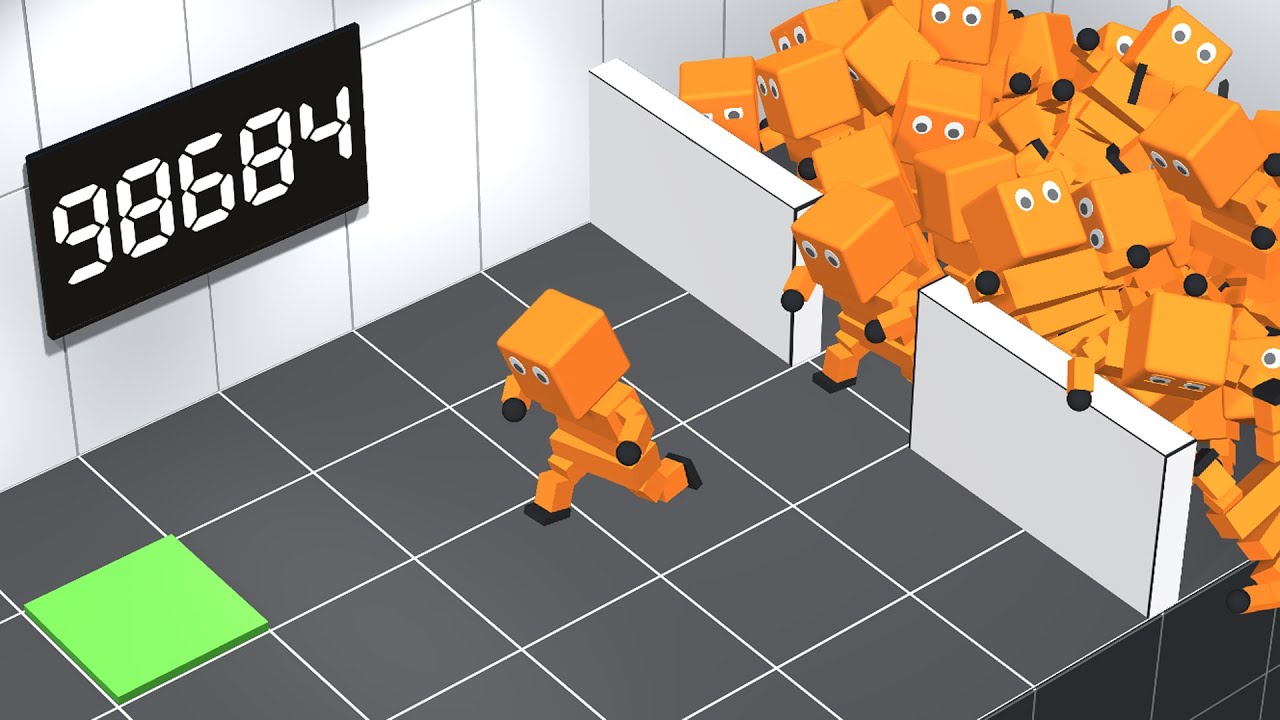
AI Teaches Itself to Walk!
In this video an AI named Albert learns how to walk to escape 5 rooms I created. The AI was trained using Deep Reinforcement Learning, a method of Machine Learning which involves rewarding the agent for doing something correctly, and punishing it for doing anything incorrectly. Albert's actions are controlled by a Neural Network that's updated after each attempt in order to try to give Albert more rewards and less punishments over time. Check the pinned comment for more information on how the AI was trained!
Current Subscribers: 135,027