Learning
Join the Bugout Slack dev community to connect with fellow data scientists, ML practitioners, and engineers: https://join.slack.com/t/bugou....t-dev/shared_invite/
The GPT-3 language models have a range of impressive capabilities; however, they also have a number of performance limitations.
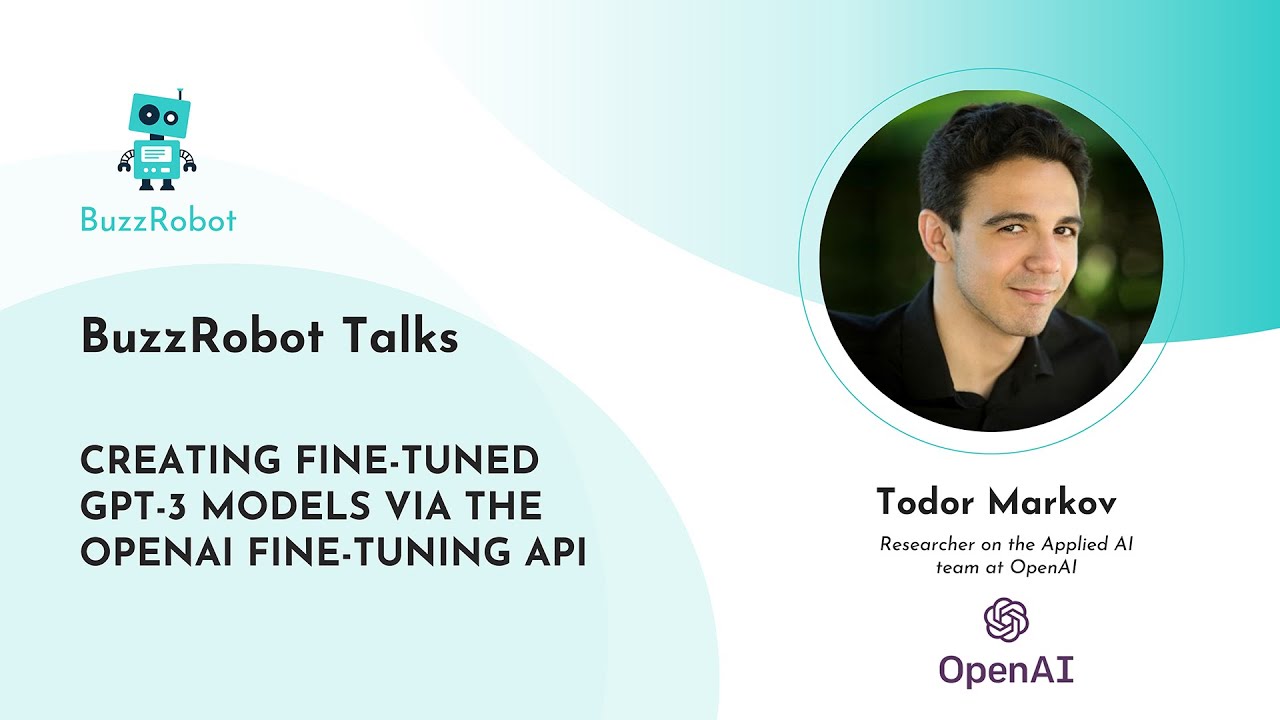
In this talk OpenAI researcher, Todor Markov, discusses a new fine-tuning API by OpenAI and show examples of how it can be used to create specialized models.
Our speaker – Todor Markov is a researcher on the Applied AI team at OpenAI. His current work focuses on improving the safety & monitoring system for the OpenAI API.
00:09:38 — Introduction Todor Markov to the Bugout community
00:11:12 — Colleges to OpenAI
00:11:36 — GTP-3 & the OpenAI API
00:24:43 — Can GTP-3 make mathematically correct statements?
00:31:11 — OpenAI fine-tuning API
00:41:55 — Questions: sizes of GTP-3 models, size of data sets, technical background of fine tuning, models for improving semantic search, GTP-3 to transfer to texts, chip models, A/B testing model quality, is it expensive. customers, limit of models, tips for people who want to work in AI, plans for meetups
Vídeo rápido sobre como treinar modelos GPT-3 usando api da OpenAI com fine-tuning.
LINKS:
- https://beta.openai.com/docs/guides/fine-tuning
- https://github.com/infoslack/y....outube/tree/main/fin

Patreon: https://www.patreon.com/daveshap (now includes Discord!)
GATO Framework: https://www.gatoframework.org/
GitHub: https://github.com/daveshap
LinkedIn: https://www.linkedin.com/in/dave-shap-automator/
Twitter: https://twitter.com/d_shap_autom8r
Relevant Subreddits:
Artificial Sentience: https://www.reddit.com/r/ArtificialSentience/
Heuristic Imperatives: https://www.reddit.com/r/HeuristicImperatives/
Autonomous AI: https://www.reddit.com/r/Autonomous_AI/
DISCLAIMER: This video is not medical, financial, or legal advice. This is just my personal story and research findings. Always consult a licensed professional.
I work to better myself and the rest of humanity.

I hacked my brain with a compact electroencephalogram (EEG) and connected it to GPT-4 with the OpenAI API. In this crazy tutorial, you'll learn how to use JavaScript to read your brainwaves.
#tech #javascript #science
💬 Chat with Me on Discord
https://discord.gg/fireship
🔗 Resources
Neurosity Crown https://neurosity.co
Brainwaves https://www.scientificamerican.....com/article/what-is
Learn JavaScript Basics https://youtu.be/lkIFF4maKMU
GPT-4 overview https://youtu.be/EunbKbPV2C0
🔥 Get More Content - Upgrade to PRO
Upgrade at https://fireship.io/pro
Use code YT25 for 25% off PRO access
🎨 My Editor Settings
- Atom One Dark
- vscode-icons
- Fira Code Font
🔖 Topics Covered
- How do you read brainwaves?
- Reading your brain with code
- Mindreading with an EEG
- How to use the OpenAI api
- How do brainwaves work?

How To Use GPT-4 (GPT-4 Tutorial)
GPT-4 is the latest and greatest language processing tool on the market, and in this video, we'll share 10 secret tips and tricks to help you get the most out of this amazing technology.
Our expert team has spent countless hours working with GPT-4, and we're excited to share our insights with you. Whether you're a content creator, researcher, or just curious about the capabilities of GPT-4, these tips and tricks will help you use it more effectively and efficiently.
From creating more natural language output to improving your model's accuracy, our tips will help you take your GPT-4 skills to the next level. So don't miss out on this valuable information! T

How To Train Large Language Models LLM like GPT 4 on PyTorch 2.0 | Distributed Model Training on GPU
Hi, thanks for watching our video about training large language models on PyTorch 2.0
In this video we’ll walk you through:
- GPT4
- GPU
- Multimodal
- LLM
- Model Training
- Model Parallelism
- Distributed Data Parallel DDP
- Deep Learning
- ChatGPT
- palm-e Models
- VALLE
- GOOGLE LAMDA
Mode Parallel, Gradient Accumulation, Data Parallel with PyTorch, Larger Batches
The PyTorch Distributed Stack is a set of PyTorch features that facilitate training models in distributed systems. PyTorch has introduced multiple new features in the distributed package to help support larger scale and higher efficiency for both data and model parallel. In this talk, Yanli Zhao (Software Engineer, Meta AI) shares tips on how to reduce memory footprint, fit larger models and achieve significant speedup with distributed systems with features like Zero Redundancy Optimizer, DistributedDataParallel, FullyShardedDataParallel, CUDA RDMA and ShardedTensor.
OpenAI has officially announced GPT-4 the latest version of its incredibly popular large language model powering artificial intelligence (AI) chatbots. ChatGPT is an AI chatbot that utilizes the language models of GPT-3 and GPT-4 for interactive communication. In other words you can use chatgpt with gpt4. A Generative Pre-Trained Transformer (GPT) is a sophisticated neural network architecture used to train large language models (LLMs). It makes use of large amounts of publicly available Internet text to simulate human communication.
Main improvements:
* It's multimodal (what it is is in video)
* Longer context length
* Better performance
* More safer
chatgpt,
gpt4,
google AI,
Google Lamda,
Google PALM,
artificial intelligence,
Machine learning,
transformer models,
deep learning,
Ray,Ray Tune,Hyperparameter optimization,machine learning,mlflow,open-source
TIMESTAMPS
0:00 Intro
0:55 PyTorch
1:25 Autograd
2:35 PyTorch Distributed
3:10 Types of Parallelization
5:20 DDP
6:38 FSDP
7:48 Fairscale
8:55 PyTorch Lightning
10:30 Model Parallel
11:48 Sagemaker Training
ABOUT OUR CHANNEL
Our channel is about AI. We cover lots of cool stuff such as Artificial Intelligence, Robotics and future tech
Check out our channel here:
https://www.youtube.com/aipowered
Don’t forget to subscribe!
CHECK OUT OUR OTHER VIDEOS
https://www.youtube.com/watch?v=t_5-d55lXbE
https://www.youtube.com/watch?v=NUfJcqSl31I
https://www.youtube.com/watch?v=1jiO23aeKQM
LINKS/Sources USED:
PyTorch Distributed : https://www.youtube.com/watch?v=3XUG7cjte2U
YC: https://www.youtube.com/watch?v=hQC5O3WTmuo
Fairscale: https://www.youtube.com/watch?v=oDt7ebOwWIc
AWS Reinvent: https://www.youtube.com/watch?v=vv52RsBM8o4
GET IN TOUCH
Contact us on
FOLLOW US ON SOCIAL
Get updates or reach out to Get updates on our Social Media Profiles!
Twitter:
Facebook:
Instagram:
Spotify:
chat gpt 4,chatgpt,chatgpt 4,chatgpt 4 review,chatgpt 4 demo,chat gpt 4 test,chat gpt 4 how to use,gpt 4,gpt 4 demo,gpt 4 live,gpt4 coding,gpt 4 review,gpt 4 video,how to use gpt 4,how to use chatgpt,chatgpt plus,chat gpt plus review,chat gpt plus india,chat gpt app download,chatgpt app , download chatgpt, chat gpt 4 news,chat gpt 4 fetaures,gpt 4 features,gpt4,chatgpt plus free,gpt4 free,use gptplus free
#artificialintelligence #gpt4 #chatgpt #Lamda #google #ai #machinelearning #dalle2 #gpt3 #gpt4 #futuretech #futureishere #technology #languagemodels #BIRT #ai #GPT4 #OpenAI #FreeAccess #ArtificialIntelligence #Tutorial

Check out this video to know how you can construct your own chatbot
by giving your own data. As we are feeding our own data and creating a knowledge base, all the responses will be based on our data.
Blog: http://www.shwetalodha.in/
Medium: https://medium.com/@shweta-lodha
** REFERRAL LINK *************
Medium referral link: https://shweta-lodha.medium.com/membership
** REFERRAL LINK *************
How-To-Fix:
- GPT_Index ModuleNotFound - https://youtu.be/nKFJHjc9xxU
- ImportModule error: GPTSimpleVectorIndex - https://youtu.be/mwGAb3AgfRM
- All borken changes: https://youtu.be/tU6EmusO43A
###### MORE PLAYLISTS ######
⭐Python for beginners: https://www.youtube.com/watch?v=z5bOe9p6SO0&list=PLb9nVWmuEUuFKkEo8JBiwNP-rPDHOSsCa&t=0s
⭐Python Pandas: https://www.youtube.com/watch?v=1TmnTDCORa4&list=PLb9nVWmuEUuGWq9OmQLEaLVWaGtjlRMe1&t=0s
⭐Python tips and tricks: https://www.youtube.com/watch?v=mcMHHJgBndQ&list=PLb9nVWmuEUuHIOvwvMg4lAgL1a2XgLTSa
⭐Jupyter tips & tricks: https://www.youtube.com/watch?v=Vabgf7lSMpw&list=PLb9nVWmuEUuHeBAAcWrYjh9MPj2qTvCka
⭐Microsoft Azure: https://www.youtube.com/watch?v=wEG8ZCqs_ls&list=PLb9nVWmuEUuFElg3ZkQhUg157NZtxFeiN
⭐Azure ML and AI: https://www.youtube.com/watch?v=t1ELLlk-Ado&list=PLb9nVWmuEUuEeut9rDlUP2NdX3IA13Jsm
⭐Visual Studio Code a.k.a. VS Code: https://www.youtube.com/watch?v=xsNANXYUZKM&list=PLb9nVWmuEUuGpOxBJmeJgPIOUoxxJk6x8
#chatbot #python #openai

Training Chat GPT with your business information involves providing the model with data specific to your business domain so that it can learn and generate relevant responses. Here are the steps to prepare a note on your business and insert it into the chat area to train Chat GPT:
Prepare a note that contains information about your business, such as its products, services, policies, and procedures. You can write the note in a document or note-taking application.
Identify the keywords and phrases that are relevant to your business and highlight them in the note. These keywords and phrases will help Chat GPT to learn and generate relevant responses.
Open the chat area where you want to train Chat GPT, such as a chatbot or messaging platform.
Copy and paste the note into the chat area. Chat GPT will analyze the text and use it to train its language model.
Interact with Chat GPT by asking it questions related to your business domain. Chat GPT will use its trained model to generate responses based on the information you provided.
Monitor the responses generated by Chat GPT and provide feedback to help it learn and improve. You can also update the note with new information to expand Chat GPT's knowledge base.
Repeat the process of training and interacting with Chat GPT until it can provide accurate and relevant responses to a wide range of questions related to your business domain.
#howto #train #chatgpt #chatgptbot #chatgpttutorial #chatgpthowtouse #chatgptexplained #chatgptprompts
Video Title: How to Train Chat GPT On Your Business | Training Chat GPT on Your own.
Subscribe: https://www.youtube.com/c/EmuB....oss?sub_confirmation
Expert Help:
If you are in need of a professional help and support on digital marketing, please drop an email at [email protected]. We are a team of 27 people working for global business that includes small as well as Enterprise corporations.
Email: [email protected]
WhatsApp: +8801717136066
Disclaimer:
This video is made for the educational purposes. Viewer is solely responsible for all of their actions and implementation. Before doin anything please do consider with a professional expert. This video might also be associated with affiliated links by which the channel could make a potential commission from the company.
![Build Your Own Custom GPT-3 Tool in under 60 seconds with Nichesss [Demo]](https://i.ytimg.com/vi/pWsq-40ZjaM/maxresdefault.jpg)
Today we look at how to create your own GPT-3 tool in under 60 seconds.
👉 Get Niches$$ here: https://go.aiprofitz.com/nichesss
This is literally so easy anyone can do it!
Is it the most advanced, most amazing use of GPT-3 yet?
Probably not. It is still a pretty amazing offer nonetheless... And it is 100% included in the lifetime deal still available on Appsumo.
👉 Get Niches$$ here: https://go.aiprofitz.com/nichesss
I'd love to hear your ideas down in the comments.
Nichesss will always be one of my favorite GPT-3 tools. I still think it holds up against any on the market, but the long form editor, and overall feel of it is definitely a step behind some of the newer products that have launched.
That being said, the best product is that which you use. I used nichesss a ton starting out. I haven't used it as much since I picked up rytr and as these tools continue to develop, I see nichesss coming back into my arsenal a bit. I hope the community adds unique perspectives and takes it to the next level
👉 Get Niches$$ here: https://go.aiprofitz.com/nichesss
Let me know your thoughts below and thanks for watching!
✅ Support aiPROFITz by shopping through our links at https://go.aiprofitz.com/appsumo
✅ Sign-up for the email list
https://aiprofitz.com/
✅ Or Buy Me A Coffee!
http://buymeacoffee.com/3ptscott
See you in the next one :)
DISCLAIMER: This video and description contain affiliate links, which means that if you click on one of the product links, I’ll receive a small commission at no cost to you. Thanks for supporting this channel by clicking the links in my description!

In today's video I am going to teach you how to create a custom GPT-4 chatbot. In this tutorial you'll discover how to train your model to respond to tweets, questions, or any text data in any personality you choose. With GPT-4's natural language processing, you can make your chatbot sound human-like and engage in intelligent conversations!
💻 Get started with MindsDB today for FREE: https://mindsdb.com/
If you want to automate your chatbot and make it reply automatically to tweets or other information you can use a feature called "JOBS" from MindsDB. JOBS work just like regular cron jobs where you can schedule a task to run every x seconds, minutes, hours etc. you can learn more about it from here: https://docs.mindsdb.com/sql/create/jobs
If you want to contribute to MindsDB here is the link! https://github.com/mindsdb/mindsdb/
💻 Chatbot Guide/Article: https://dev.to/mindsdb/build-a....-celebrity-twitter-c
💻 SnoopStein Twitter: https://twitter.com/snoop_stein/with_replies
💻 Master Blockchain and Web 3.0 development today by using BlockchainExpert: https://algoexpert.io/blockchain - use code "tim" for a discount!
💻 ProgrammingExpert is the best platform to learn how to code and become a software engineer as fast as possible! https://programmingexpert.io/tim - use code "tim" for a discount!
⭐️ Timestamps ⭐️
00:00 | Overview
00:29 | Chatbot Demo
02:25 | MindsDB Setup
04:37 | Making The Chatbot
17:08 | Using The Chatbot From Python
19:26 | Conclusion
◼️◼️◼️◼️◼️◼️◼️◼️◼️◼️◼️◼️◼️◼️
👕 Merchandise: https://teespring.com/stores/t....ech-with-tim-merch-s
📸 Instagram: https://www.instagram.com/tech_with_tim
📱 Twitter: https://twitter.com/TechWithTimm
⭐ Discord: https://discord.gg/twt
📝 LinkedIn: https://www.linkedin.com/in/tim-ruscica-82631b179/
🌎 Website: https://techwithtim.net
📂 GitHub: https://github.com/techwithtim
🔊 Podcast: https://anchor.fm/tech-with-tim
🎬 My YouTube Gear: https://www.techwithtim.net/gear/
💵 One-Time Donations: https://www.paypal.com/donate?....hosted_button_id=CU9
💰 Patreon: https://www.patreon.com/techwithtim
◼️◼️◼️◼️◼️◼️◼️◼️◼️◼️◼️◼️◼️◼️
⭐️ Tags ⭐️
- Tech With Tim
- Custom GPT-4 Bot
- Tutorial
⭐️ Hashtags ⭐️
#techwithtim #gpt4 #chatbot

Learn how to get started with the OpenAI API and GPT-3 in this Python Beginner tutorial.
Get your Free Token for AssemblyAI Speech-To-Text API 👇https://www.assemblyai.com/?utm_source=youtube&utm_medium=referral&utm_campaign=yt_pat_12
OpenAI is known for the creation of the GPT-3 model, a powerful deep learning model capable of producing human-like text.
What makes this API special is not only the powerful model but also that the API is not designed for one use-case only, but instead the API provides a general-purpose “text in, text out” interface, which allows users to try it on virtually any task in the English language.
Resources: https://openai.com/api/
Docs: https://beta.openai.com/docs/
AssemblyAI API tutorial: https://youtu.be/GvfmDGin7Zs
▬▬▬▬▬▬▬▬▬▬▬▬ CONNECT ▬▬▬▬▬▬▬▬▬▬▬▬
🖥️ Website: https://www.assemblyai.com
🐦 Twitter: https://twitter.com/AssemblyAI
🦾 Discord: https://discord.gg/Cd8MyVJAXd
▶️ Subscribe: https://www.youtube.com/c/Asse....mblyAI?sub_confirmat
🔥 We're hiring! Check our open roles: https://www.assemblyai.com/careers
▬▬▬▬▬▬▬▬▬▬▬▬▬▬▬▬▬▬▬▬▬▬▬▬▬▬▬▬▬▬▬▬▬
Timestamps:
00:00 Introduction
00:44 Pricing and Docs
01:34 Python Setup
04:00 Engine
04:42 Completion Endpoint
07:40 Playground
10:57 Classification Endpoint
14:00 Search Endpoint
16:10 Question answering Endpoint
18:57 AssemblyAI + OpenAI Virtual Assistant
#MachineLearning #DeepLearning #Python #OpenAI

In this tutorial you will learn everything you need to fine tune (train) your GPT-2 Model. By training the model on specific texts you can improve the results quality by a large margin. Fine Tuning your GPT-2 Model is quite easy and can be done in a few simple steps.
First you need to download the repository from Github. After that you need to create a training.txt file including the data on which your model should be trained on. The next step is to convert the file into an npz format from which you can then train the model. After the GPT-2 model has been trained you can then copy the files into your final model and just run the sample code.
🚨Subscribe to my Tech and Software Newsletter🚨 Everything around Tech and Software Development from tutorials to latest news, tips and tricks. Learn everything from creating Ads to configuring your own cloud infrastructure! Use:
🚨 https://noveltechmedia.com 🚨
For any thoughts, ideas, feedback or questions contact me at
🚨[email protected]🚨.
Disclaimer:
All videos are for educational purposes and use them wisely. Any video might have inaccurate or outdated information. I give my best to research every topic thoroughly but please be aware that videos can contain mistakes.
HuggingFace Space: https://huggingface.co/spaces/pritish/BookGPT
Kaggle Notebook: https://bit.ly/3kg3dP7
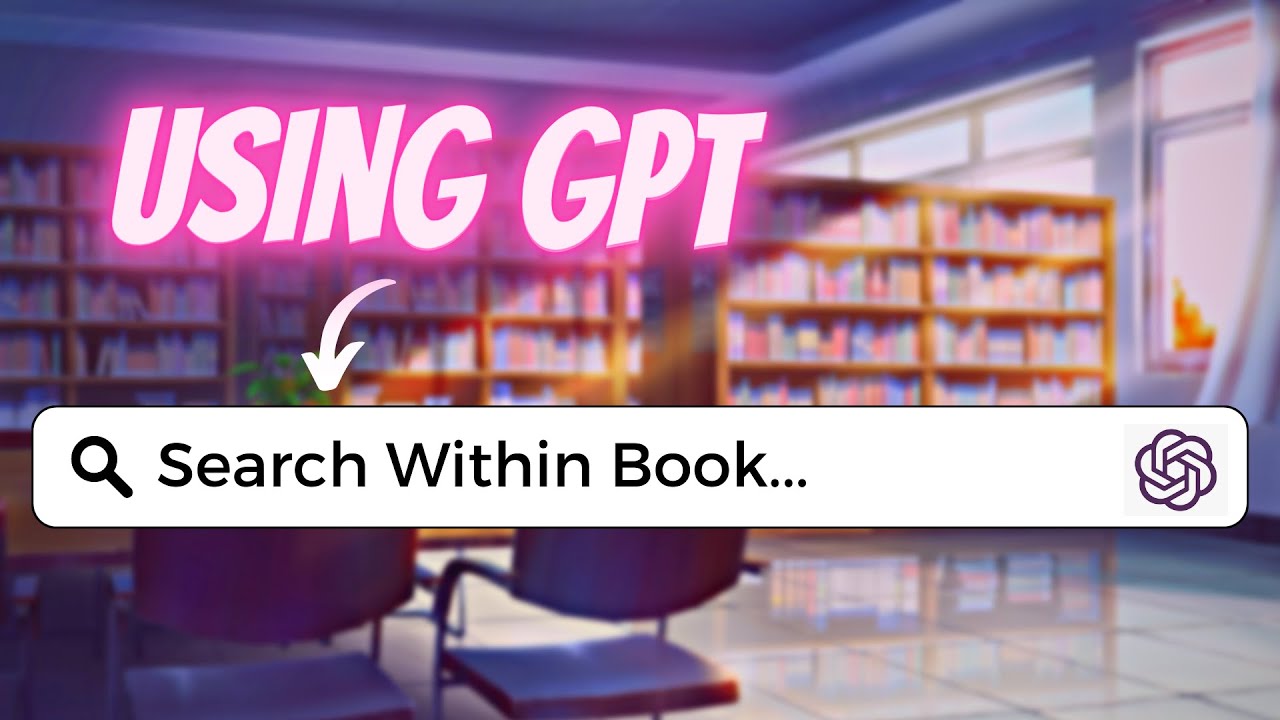
Have you ever wished you could search a book like you search the web? In this video, we'll show you how to build an AI book search using the Universal Sentence Encoder and GPT-3. We'll walk through the steps of breaking down a large book into smaller chunks, generating embeddings for each chunk using the Universal Sentence Encoder, and then using K-nearest neighbors to find the most similar chunks to a user's question. With this approach, you can quickly search through a large corpus of text and find the most relevant information. Finally, we will use GPT3 to generate a concise answer which can also refer page numbers from the book.
Movie Recommendation System: https://youtu.be/pvY0BmAFxwg
(watch this for more info on universal sentence encoder)
🔗 Social Media 🔗
📱 Twitter: https://bit.ly/42t69cG
📝 LinkedIn: https://bit.ly/3JxvkSJ
📂 GitHub: https://bit.ly/3lye8UV
gpt 3 , natural language processing, machine learning, deep learning, Universal Sentence Encoder, K Nearest Neighbor algorithm, embeddings, semantic search, text analysis, data science, artificial intelligence, Python, recommendation systems, HuggingFace
Google Search Video used from 0:19 to 0:21 and 2:04 to 2:12 -
https://youtu.be/0eKVizvYSUQ
Music from Uppbeat (free for Creators!):
https://uppbeat.io/t/jonny-boyle/funny-in-france
License code: KC0DEJS22SOOZIDE
Music from Uppbeat (free for Creators!):
https://uppbeat.io/t/soundroll/that-vibe
License code: ZT1NA5TMCOVFGSRJ
Thank you,
Pritish Mishra

In this video, I go over how to create a custom dataset to finetune GPT Neo and GPT-J-6B. To do this, I create an AI quote generator.
Github: https://github.com/mallorbc/GPT_Neo_quotes_dataset
Timestamps
00:00 - Intro
00:29 - Quotes Dataset
01:59 - Code Overview
07:07 - Running The Code
07:54 - Looking At Generated Dataset
08:35 - Running The Fine-tuned Model
09:56 - Outro

Train ChatGPT & GPT-4 For PERFECT Midjourney V5 Images! In this video, I'm gonna show you how you can craft amazing and super creative prompts for Midjourney using ChatGPT and GPT-4! Unleash the full potential of Ai art!
What did you think of this trick? Let me know in the comments!
▬▬▬▬▬▬▬▬▬▬▬▬▬▬▬▬▬▬▬▬▬
SOCIAL MEDIA LINKS!
✨ Support my work on Patreon: https://www.patreon.com/aitrepreneur
⚔️ Join the Discord server: https://discord.gg/3ErYSdyUPt
🧠 My Second Channel THE MAKER LAIR: https://bit.ly/themakerlair
📧 Business Contact: [email protected]
▬▬▬▬▬▬▬▬▬▬▬▬▬▬▬▬▬▬▬▬▬
Runpod: https://bit.ly/runpodAi
ChatGPT: https://chat.openai.com/
Midjourney: https://www.midjourney.com/app/
Full prompt: https://pastebin.com/8zeBDedK
Previous GPT-4 Secret Prompts video: https://youtu.be/OHdB5sqZMTs
All ControlNet Videos: https://www.youtube.com/playli....st?list=PLkIRB85csS_
My previous ControlNet video: https://youtu.be/PbDdtPTYm_4
3D POSE & HANDS INSIDE Stable Diffusion! Posex & Depth Map: https://youtu.be/EwWkLMhR23I
Multiple Characters With LATENT COUPLE: https://youtu.be/uR89wZMXiJ8
GET PERFECT HANDS With MULTI-CONTROLNET & 3D BLENDER: https://youtu.be/ptEZQrKgHAg
NEXT-GEN MULTI-CONTROLNET INPAINTING: https://youtu.be/MDHC7E6G1RA
CHARACTER TURNAROUND In Stable Diffusion: https://youtu.be/xMmCZ1EqMVA
EASY POSING FOR CONTROLNET : https://youtu.be/vvrH1Lcx-jo
3D Posing With ControlNet: https://youtu.be/5z71oxf8kh4
My first ControlNet video: https://youtu.be/OxFcIv8Gq8o
▬▬▬▬▬▬▬▬▬▬▬▬▬▬▬▬▬▬▬▬▬
►► My PC & Favorite Gear:
i9-12900K: https://amzn.to/3L03tLG
RTX 3090 Gigabyte Vision OC : https://amzn.to/40ANaue
SAMSUNG 980 PRO SSD 2TB PCIe NVMe: https://amzn.to/3oBR0WO
Kingston FURY Beast 64GB 3200MHz DDR4 : https://amzn.to/3osdZ6z
iCUE 4000X - White: https://amzn.to/40y9BAk
ASRock Z690 DDR4 : https://amzn.to/3Amcxph
Corsair RM850 - White : https://amzn.to/3NbXlm2
Corsair iCUE SP120 : https://amzn.to/43WR9nW
Noctua NH-D15 chromax.Black : https://amzn.to/3H7qQSa
EDUP PCIe WiFi 6E Card Bluetooth : https://amzn.to/40t5Lsk
Recording Gear:
Rode PodMic : https://amzn.to/43ZvYlm
Rode AI-1 USB Audio Interface : https://amzn.to/3N6ybFk
Rode WS2 Microphone Pop Filter : https://amzn.to/3oIo9Qw
Elgato Wave Mic Arm : https://amzn.to/3LosH7D
Stagg XLR Cable - Black - 6M : https://amzn.to/3L5Fuue
FetHead Microphone Preamp : https://amzn.to/41TWQ4o
▬▬▬▬▬▬▬▬▬▬▬▬▬▬▬▬▬▬▬▬▬
Special thanks to Royal Emperor:
- Totoro
Thank you so much for your support on Patreon! You are truly a glory to behold! Your generosity is immense, and it means the world to me. Thank you for helping me keep the lights on and the content flowing. Thank you very much!
#GPT4 #GPT3 #ChatGPT #midjourney
▬▬▬▬▬▬▬▬▬▬▬▬▬▬▬▬▬▬▬▬▬
WATCH MY MOST POPULAR VIDEOS:
RECOMMENDED WATCHING - My "Stable Diffusion" Playlist:
►► https://bit.ly/stablediffusion
RECOMMENDED WATCHING - My "Tutorial" Playlist:
►► https://bit.ly/TuTPlaylist
Disclosure: Bear in mind that some of the links in this post are affiliate links and if you go through them to make a purchase I will earn a commission. Keep in mind that I link these companies and their products because of their quality and not because of the commission I receive from your purchases. The decision is yours, and whether or not you decide to buy something is completely up to you.
Hello everyone! Today we well be going over how to fine tune OpenAI's Chat-GPT3 using either someone else's data set or out own. We'll first go over how to reformat your data into a Json file and then how to easily reformat it to make sure the AI accepts it and has your input data accepted. After that we'll go over how to use the model!