Latest videos
Today we're going to talk big picture about what Neural Networks are and how they work. Neural Networks, which are computer models that act like neurons in the human brain, are really popular right now - they're being used in everything from self-driving cars and Snapchat filters to even creating original art! As data gets bigger and bigger neural networks will likely play an increasingly important role in helping us make sense of all that data.
Special thanks to Max Deutsch giving us permission to use his Neural Network-written Harry Potter chapter in this episode! Read more about his work here:
https://medium.com/deep-writin....g/harry-potter-writt
Neural Network to create anime characters:
https://arxiv.org/pdf/1708.05509.pdf
Neural Network to great Van Gogh-like art:
https://towardsdatascience.com..../gangogh-creating-ar
Neural Network to create skate decks:
https://github.com/RJT1990/gandecks/
Crash Course is on Patreon! You can support us directly by signing up at http://www.patreon.com/crashcourse
Thanks to the following Patrons for their generous monthly contributions that help keep Crash Course free for everyone forever:
Sam Buck, Mark Brouwer, Jennifer French Lee, Brandon Westmoreland, dorsey, Indika Siriwardena, James Hughes, Kenneth F Penttinen, Trevin Beattie, Satya Ridhima Parvathaneni, Erika & Alexa Saur, Glenn Elliott, Justin Zingsheim, Jessica Wode, Eric Prestemon, Kathrin Benoit, Tom Trval, Jason Saslow, Nathan Taylor, Brian Thomas Gossett, Khaled El Shalakany, SR Foxley, Sam Ferguson, Yasenia Cruz, Eric Koslow, Caleb Weeks, Tim Curwick, D.A. Noe, Shawn Arnold, Malcolm Callis, Advait Shinde, William McGraw, Andrei Krishkevich, Rachel Bright, Kathy & Tim Philip, Jirat, Ian Dundore
--
Want to find Crash Course elsewhere on the internet?
Facebook - http://www.facebook.com/YouTubeCrashCourse
Twitter - http://www.twitter.com/TheCrashCourse
Tumblr - http://thecrashcourse.tumblr.com
Support Crash Course on Patreon: http://patreon.com/crashcourse
CC Kids: http://www.youtube.com/crashcoursekids

Kaggle notebook with all the code: https://www.kaggle.com/wwsalmo....n/simple-mnist-nn-fr
Blog article with more/clearer math explanation: https://www.samsonzhang.com/20....20/11/24/understandi
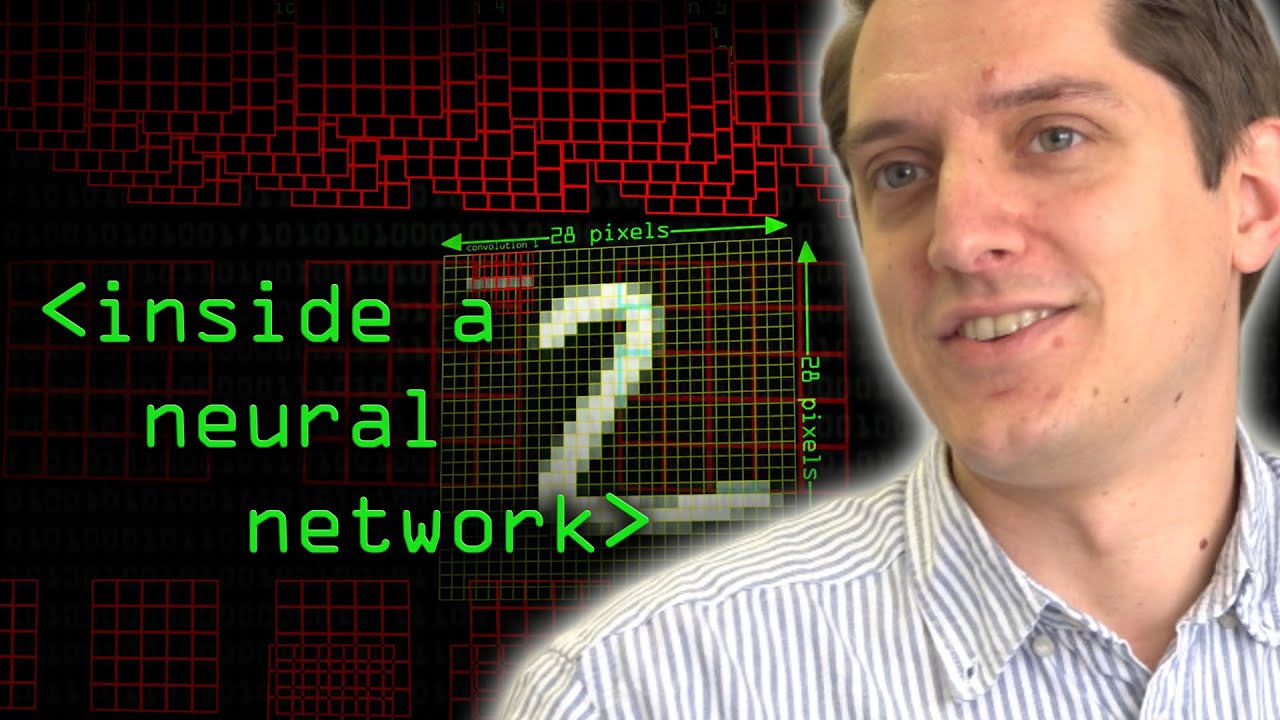
Just what is happening inside a Convolutional Neural Network? Dr Mike Pound shows us the images in between the input and the result.
How Blurs & Filters Work (Kernel Convolutions): https://youtu.be/C_zFhWdM4ic
Cookie Stealing: https://youtu.be/T1QEs3mdJoc
Rob Miles on Game Playing AI: https://youtu.be/5oXyibEgJr0
Secure Web Browsing: https://www.youtube.com/watch?v=E_wX40fQwEA
Deep Learning: https://youtu.be/l42lr8AlrHk
http://www.facebook.com/computerphile
https://twitter.com/computer_phile
This video was filmed and edited by Sean Riley.
Computer Science at the University of Nottingham: http://bit.ly/nottscomputer
Computerphile is a sister project to Brady Haran's Numberphile. More at http://www.bradyharan.com

In this project I built a neural network and trained it to play Snake using a genetic algorithm.
Thanks for watching! Subscribe if you enjoyed and Share if you know anyone who would be interested!
GitHub Repo: https://github.com/greerviau/SnakeAI
Twitter: https://twitter.com/greerviau
Support me on Patreon: https://www.patreon.com/greerviau
Thanks to Josh Cominelli for the music!
Soundcloud: https://soundcloud.com/josh-cominelli
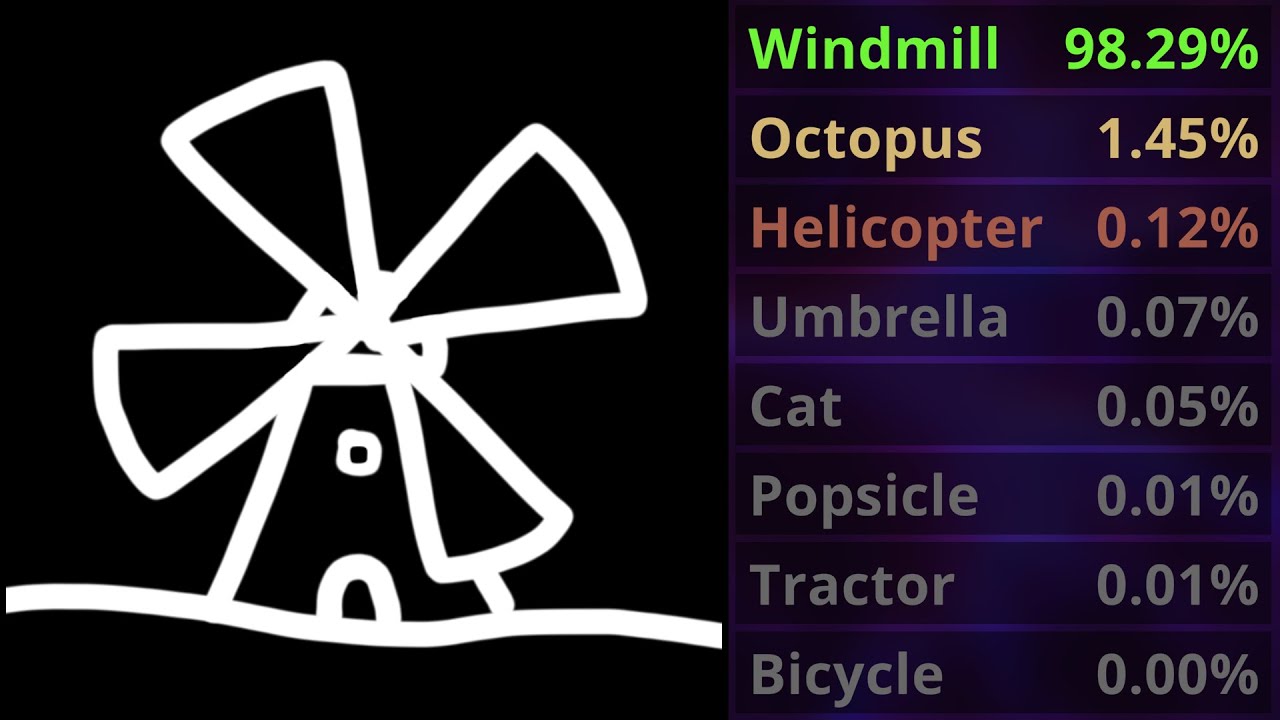
Exploring how neural networks learn by programming one from scratch in C#, and then attempting to teach it to recognize various doodles and images.
Source code: https://github.com/SebLague/Ne....ural-Network-Experim
Demo: https://sebastian.itch.io/neur....al-network-experimen
If you'd like to support me in creating more videos (and get early access to new stuff), you can join my patreon here: https://www.patreon.com/SebastianLague
The data is from:
Digits http://yann.lecun.com/exdb/mnist/
Fashion https://github.com/zalandoresearch/fashion-mnist
Doodles https://github.com/googlecreat....ivelab/quickdraw-dat
Cifar10 https://www.cs.toronto.edu/~kriz/cifar.html
Chapters
0:00 Introduction
2:39 The decision boundary
3:49 Weights
5:42 Biases
6:45 Hidden layers
7:45 Programming the network
9:57 Activation functions
12:42 Cost
15:07 Gradient descent example
18:22 The cost landscape
19:55 Programming gradient descent
21:10 It's learning! (slowly)
23:21 Calculus example
27:34 The chain rule
29:50 Some partial derivatives
33:14 Backpropagation
39:25 Digit recognition
43:56 Drawing our own digits
47:37 Fashion
48:25 Doodles
52:00 The final challenge
Music:
Cosmic Waves - Michael FK
Amber - The Stolen Orchestra
Beyond the Horizon - Sounds Like Sander
Air - Assaf Ayalon
Purest Form - Sounds Like Sander
Hear Wide Open - Sounds Like Sander
Universal Wonder - Moments
Roman P - Moments
All In Good Time - Shimmer
It Will Come Back - The Stolen Orchestra
Frontier - Shimmer
New Moon - Cloud Wave
Sunflower - Cody Martin
Inner Peace - Moments
Enchanted - Cody Martin
Just Around The Corner - Shimmer
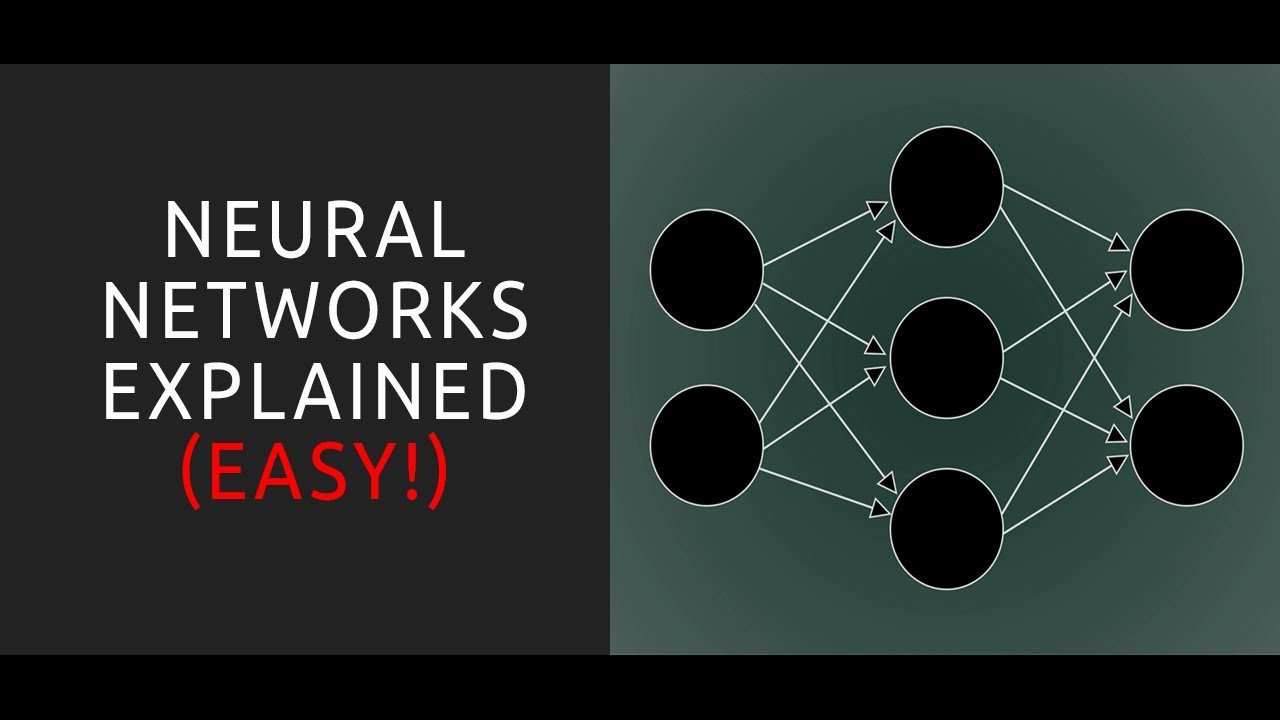
If you know nothing about how a neural network works, this is the video for you! I've worked for weeks to find ways to explain this in a way that is easy to understand for beginners.
Past Videos:
Intro to Machine Learning with Javascript:
https://www.youtube.com/watch?v=9Hz3P1VgLz4&list=PLoYCgNOIyGABWLy_XoLSxTVRe2bltV8GM&index=2&t=0s
Machine Learning 2 - Building a Recommendation Engine:
https://www.youtube.com/watch?v=lvzekeBQsSo&list=PLoYCgNOIyGABWLy_XoLSxTVRe2bltV8GM&index=3&t=0s
Machine learning and neural networks are awesome. This video provides beginners with an easy tutorial explaining how a neural network works - what math is involved, and a step by step explanation of how the data moves through the network.
The example used will be a feed forward neural network with back propagation. It explains the difference between linear and non linear data, the importance of the activation function, learning rate, and momentum configurations.
-~-~~-~~~-~~-~-
Also watch: "Tailwind CSS - why CSS utility classes save so much time"
https://www.youtube.com/watch?v=oU5ar0dmQEY
-~-~~-~~~-~~-~-

A video about neural networks, how they work, and why they're useful.
My twitter: https://twitter.com/max_romana
SOURCES
Neural network playground: https://playground.tensorflow.org/
Universal Function Approximation:
Proof: https://cognitivemedium.com/ma....gic_paper/assets/Hor
Covering ReLUs: https://proceedings.neurips.cc..../paper/2017/hash/32c
Covering discontinuous functions: https://arxiv.org/pdf/2012.03016.pdf
Turing Completeness:
Networks of infinite size are turing complete: Neural Computability I & II (behind a paywall unfourtunately, but is cited in following paper)
RNNs are turing complete: https://binds.cs.umass.edu/pap....ers/1992_Siegelmann_
Transformers are turing complete: https://arxiv.org/abs/2103.05247
More on backpropagation:
https://www.youtube.com/watch?v=Ilg3gGewQ5U
More on the mandelbrot set:
https://www.youtube.com/watch?v=NGMRB4O922I
Additional Sources:
Neat explanation of universal function approximation proof: https://www.youtube.com/watch?v=Ijqkc7OLenI
Where I got the hard coded parameters: https://towardsdatascience.com..../can-neural-networks
Reviewers:
Andrew Carr https://twitter.com/andrew_n_carr
Connor Christopherson
TIMESTAMPS
(0:00) Intro
(0:27) Functions
(2:31) Neurons
(4:25) Activation Functions
(6:36) NNs can learn anything
(8:31) NNs can't learn anything
(9:35) ...but they can learn a lot
MUSIC
https://www.youtube.com/watch?v=SmkUY_B9fGg
Neural Networks → https://ibm.biz/Neural_Networks_Now
Let's Create Data Fabric Instead of Data Silos → https://ibm.biz/Your_data_fabric
Neural networks reflect the behavior of the human brain, allowing computer programs to recognize patterns and solve common problems in the fields of AI, machine learning, and deep learning. Master Inventor, Martin Keen, makes some important points about neural networks and does it all in 5 minutes.
Download a free AI ebook → https://ibm.biz/Free_AI_Ebook_Today
Get started for free on IBM Cloud → https://ibm.biz/Get_my_free_cloud_account
Subscribe to see more videos like this in the future → http://ibm.biz/subscribe-now
#Software #ITModernization #NeuralNetworks #DataFabric #lightboard #IBM
👩🏻💻 CourseraPlus subscription 👉 https://imp.i384100.net/zaoxPx
Learn SQL Basics for Data Science 👉 https://imp.i384100.net/AovPnJ
Google Data Analytics Certificate 👉 https://imp.i384100.net/15v9y6
Applied Data Science with Python 👉 https://imp.i384100.net/gbxOqv
Mathematics for Machine Learning 👉 https://imp.i384100.net/BX91NB
Data Visualization with Tableau 👉 https://imp.i384100.net/n15XWR
Hi data nerds! Today I’m sharing with you my recommended learning roadmap and the courses to help you learn the core data science skills quickly. Resources are abundant online, but it is hard sometimes to select what is right for you, and what you really need. I hope with this learning roadmap, you can learn the most in-demand skills in the most effective way. Hope you enjoy it!
Thank you for watching and have a great day! 🤗
🔑 TIMESTAMPS
================================
0:00 - Intro
0:17 - My data science journey 🤓
2:12 - Google Data Analytics Professional cert
4:14 - Learn SQL Basic for DS Specialization
6:37 - Applied Data Science with Python Specialization
8:34 - Mathematics for Machine Learning Specialisation
10:50 - Data Visualisation with Tableau Specialisation
13:45 - Tips for saving $$
🙋🏻♀️ LET'S CONNECT!
================================
🤓 Join my Discord server:
https://discord.gg/SK7ZC5XhcS
📩 SUBSCRIBE to my Substack to get future newsletters from me:
https://substack.com/profile/87689887-thu-vu
✍ FOLLOW me on Medium:
https://medium.com/@vuthihienthu.ueb
(I sometimes make both video and article versions of my content, by following me on Medium you will have access to the content in writing too).
🔗 Other Links:
https://linktr.ee/thuvuanalytics
🔔 SUBSCRIBE to my channel (It's FREE):
https://www.youtube.com/c/Thuvu5?sub_...
COURSES & RESOURCES
================================
💯 SQL Courses:
Select Star SQL 👉 https://selectstarsql.com/
Bipp.io SQL tutorials 👉 https://bipp.io/sql-tutorial/
📑 Excel Courses:
Excel Skills for Business 👉 https://coursera.pxf.io/doPaoy
📊 Data Visualisation:
📚 Books I recommend: https://kit.co/thuvu/books-on-data-vi...
How to create effective charts and diagrams 👉 https://education.microsoft.com/nb-no...
Data Viz Catalog 👉 https://datavizproject.com/
As a member of the Amazon and Coursera Affiliate Programs, I earn a commission from qualifying purchases on the links above. By using the links you help support this channel at no cost for you.
#datascience #machinelearning #DataAnalysis #Datanerd #ThuVu #dataanalytics

In this video I will give you the resources you need to learn data science from zero knowledge. We will discuss several programming books and math books that are perfect for beginners who want to acquire the skills to become a data scientist. In particular we will look at books on R, Python, Calculus, Linear Algebra, and Statistics. Several more advanced books are also presented in this video. Do you have any other book recommendations for learning Data Science? If so, please leave a comment below.
Programming Books
The Art of R Programming https://amzn.to/3GqxS59
Larning Python https://amzn.to/3EGRGjd
Python Crash Course https://amzn.to/3tDlR4z
Doing Math With Python https://amzn.to/3TGdAra
Calculus Books
Calculus by Stewart https://amzn.to/3V3rCnQ
Calculus by Larson https://amzn.to/3XgjHp1
Calculus Early Transcendentals by Briggs https://amzn.to/3V1qfGa
Vector Calculus https://amzn.to/3UEUhjj
Linear Algebra Books
Elementary Linear Algebra by Anton https://amzn.to/3tDbrBQ
Elementary Linear Algebra by Larson https://amzn.to/3GsjtoW
Introduction to Linear Algebra by Strang https://amzn.to/3TMHU3v
Linear Algebra by Wilde https://amzn.to/3THlmkt
Elementary Linear Algebra by Grossman https://amzn.to/3hSLAn5
Schaum's Outline of Linear Algebra https://amzn.to/3TMzwAQ
Linear Algebra Theory and Applications by Cheney and Kincaid https://amzn.to/3gcRfnA
Linear Algebra by Friedber, Insel, and Spence https://amzn.to/3V1s6L8
Statistics Books for Beginners
Understanding Statistics by Mendenhall https://amzn.to/3EJ2SMu
Probability and Statistics for Engineers and Scientists by Ross https://amzn.to/3XekCqc
Statistics by McClave https://amzn.to/3GskLjM or https://amzn.to/3UTLoCM
Schaum's Outline of Probability and Statistics https://amzn.to/3XeJTQO
Mathematical Statistics Books
Mathematical Statistics with Applications by Wackerly, et al. https://amzn.to/3EaX5xq
John Freund's Mathematical Statistics with Applications https://amzn.to/3UX0bvY
Advanced/Specialty Statistics Books
The Statistical Analysis of Experimental Data https://amzn.to/3ANaaMT
Design and Analysis of Experiments https://amzn.to/3TGiCE4
Applied Regression Analysis https://amzn.to/3ElFCT0
Methods of Multivariate Analysis https://amzn.to/3UN4QRs
Nonparametric Statistical Methods https://amzn.to/3OiArrz
Applied Linear Statistical Models https://amzn.to/3EHpIE5
Introduction to Linear Regression Analysis https://amzn.to/3UX1Vp0
Probability and Statistical Inference https://amzn.to/3Oon5Kz
Statistical Methods https://amzn.to/3EGxaPK
Applied Multivariate Statistical Analysis https://amzn.to/3tDrOhV
These are my affiliate links. As an Amazon Associate I earn from qualifying purchases.
If you enjoyed this video please consider liking, sharing, and subscribing.
Udemy Courses Via My Website: https://mathsorcerer.com
Free Homework Help : https://mathsorcererforums.com/
My FaceBook Page: https://www.facebook.com/themathsorcerer
There are several ways that you can help support my channel:)
Consider becoming a member of the channel: https://www.youtube.com/channe....l/UCr7lmzIk63PZnBw3b
My GoFundMe Page: https://www.gofundme.com/f/sup....port-math-education-
My Patreon Page: https://www.patreon.com/themathsorcerer
Donate via PayPal: https://paypal.com/donate/?cmd=_s-xclick&hosted_button_id=7XNKUGJUENSYU

🔥Java Placement Course : https://www.youtube.com/watch?v=yRpLlJmRo2w&list=PLfqMhTWNBTe3LtFWcvwpqTkUSlB32kJop
🔥Complete C++ Placement Course (Data Structures+Algorithm) :https://www.youtube.com/playli....st?list=PLfqMhTWNBTe
🔥Telegram: https://t.me/apnikakshaofficial
🔥Instagram: https://www.instagram.com/dhattarwalaman/
My YouTube Gear 😉: https://docs.google.com/docume....nt/d/1pyTJVmed-rHFXN
Notes of this Lecture:

Since Big Data, Data Science, and Data Analytics are emerging technologies (they’re still evolving), we often use Data Science and Data Analytics interchangeably. Let's clear this famous misunderstanding and clarify the difference between data science vs data analytics.
Recommended Videos,
9 Top Data Science Certifications to Boost Your Career in 2021
https://www.youtube.com/watch?v=eAaYbiBRTxQ
Difference Between AI vs ML vs DL vs Data Science Explained
https://www.youtube.com/watch?v=vtoKf-aJSs8
How to Learn Data Science Step by Step for FREE
https://www.youtube.com/watch?v=mJxGLvirQQI
11 Best Python Packages for Data Science
https://www.youtube.com/watch?v=cS0TaZV3gmU
5 Top Skills Needed for Machine Learning Engineer
https://www.youtube.com/watch?v=NdqVOHDJGD8
When NOT to use Machine Learning (ML) or Artificial Intelligence (AI)
https://www.youtube.com/watch?v=BZUHsuE2Rns
10+ ML & AI Career Path with Salaries | How to Start Career in AI and ML
https://www.youtube.com/watch?v=oQBUH0fB1mA
Got feedback on this video of data analytics vs data science? Feel free to share your views in the comment section below.
Let's get social!
https://twitter.com/brandlitic
https://www.instagram.com/brandlitic
https://www.facebook.com/brandlitic
Official Medium.com Publication: https://medium.com/brandlitic
#Shorts #YouTubeShorts #DataScience #DataAnalytics #60SecondsWhiteboard #DataAnalyst #DataScientist
Learn the basic components of Data Science in this crash course for beginners.
If you want to learn more about data science after completing this course, check out Max's Free Getting Started with Data Science Workshop: https://codingwithmax.com/webinar/data-scientist/
In this course for beginners, you will learn about:
1. Statistics: we talk about the types of data you'll encounter, types of averages, variance, standard deviation, correlation, and more.
2. Data visualization: we talk about why we need to visualize our data, and the different ways of doing it (1 variable graphs, 2 variable graphs and 3 variable graphs.)
3. Programming: we talk about why programming helps us with data science including the ease of automation and recommended Python libraries for you to get started with data science.
⭐️ Contents ⭐️
⌨️ (0:00:00) Introduction
⌨️ (0:10:52) Statistical Data Types
⌨️ (0:25:10) Types of Averages
⌨️ (0:38:55) Spread of Data
⌨️ (0:50:54) Quantiles and Percentiles
⌨️ (0:55:52) Importance of Data Visualization
⌨️ (1:05:14) One Variable Graphs
⌨️ (1:12:04) Two Variable Graphs
⌨️ (1:25:08) Three and Higher Variable Graphs
⌨️ (1:31:20) Programming
Course from Coding With Max. Check out the Coding With Max blog: https://www.codingwithmax.com/blog
Full data science course: https://codingwithmax.teachabl....e.com/p/data-scienti
--
Learn to code for free and get a developer job: https://www.freecodecamp.org
Read hundreds of articles on programming: https://medium.freecodecamp.org
And subscribe for new videos on technology: https://youtube.com/subscripti....on_center?add_user=f

👉🏻 Sign up for Our Complete Data Science Training with 57% OFF: https://bit.ly/3v4Y4tf
👉🏻 Download Our Free Data Science Career Guide: https://bit.ly/3bD0pnx
You want to learn what Data Science is? And you like brief explanations? Then this is the perfect video for you!
Video Timestamps:
0:00-0:23 Video intro
0:23-0:50 Why the data science notion is still confusing to people
0:50-1:09 Data science is an interdisciplinary field
1:09-1:35 Data science and AI
1:35-1:46 Data science, ML, Deep Learning
1:46-2:09 Channel promo
2:09-2:19 What you will see next
2:19-2:51 Types of data used
2:51-3:36 Activities performed by data scientists
3:36-3:54 Time allocation
3:54-4:06 Key skills needed by data scientists
4:06-4:24 Frequently used data science methods
4:24-5:21 How data scientists create value
We will try to provide a dynamic overview of the data science profession along with some key aspects such as:
✔️ Type of data used:
✔️ Activities performed on the job
✔️ Time allocation
✔️ Key skills
✔️ And frequently used data science methods
We’ll focus on how data scientists create value for companies and will explain how data science relates to AI, Machine Learning, and Deep Learning.
► Consider hitting the SUBSCRIBE button if you LIKE the content: https://www.youtube.com/c/365D....ataScience?sub_confi
►VISIT our website: https://bit.ly/365ds
🤝 Connect with us on LinkedIn: https://www.linkedin.com/company/365datascience/
At 365 Data Science we make #DataScience accessible to all by providing the highest quality online data science education. Our courses are designed to build up your skill set from beginner to job-ready, regardless of your current level, background education, and experience.
Our data science program helps students and young professionals embark on a career as a data scientist. Demand for qualified data scientists is at an all-time high and traditional degrees are simply too expensive, time-consuming or rigid to meet the majority of needs.
Our mission is to close that gap. We provide high quality, affordable training to open new opportunities for students and professionals all over the world. We are committed to hiring top talent and helping everyone in the company reach their full potential. We care about our students, colleagues and the industry and are committed to their advancement.
We are committed to excellence in every lesson, every course and every interaction with our students.
We constantly improve our program offering and the customer experience.
We’ve Helped More than 1 million Student differentiate themselves by providing them with:
150+ Hours of video
1,980+ Lessons
35+ Courses
1.5M+ Students
Ready to Start Your Career?
Check out our Data Science Career guides: https://www.youtube.com/playli....st?list=PLaFfQroTgZn
#DataScience #Explained #In5Minutes
Data Science touches almost every operation of a business. See how → https://ibm.biz/BdPEfu
To learn more about Data Science → https://ibm.biz/BdPEfJ
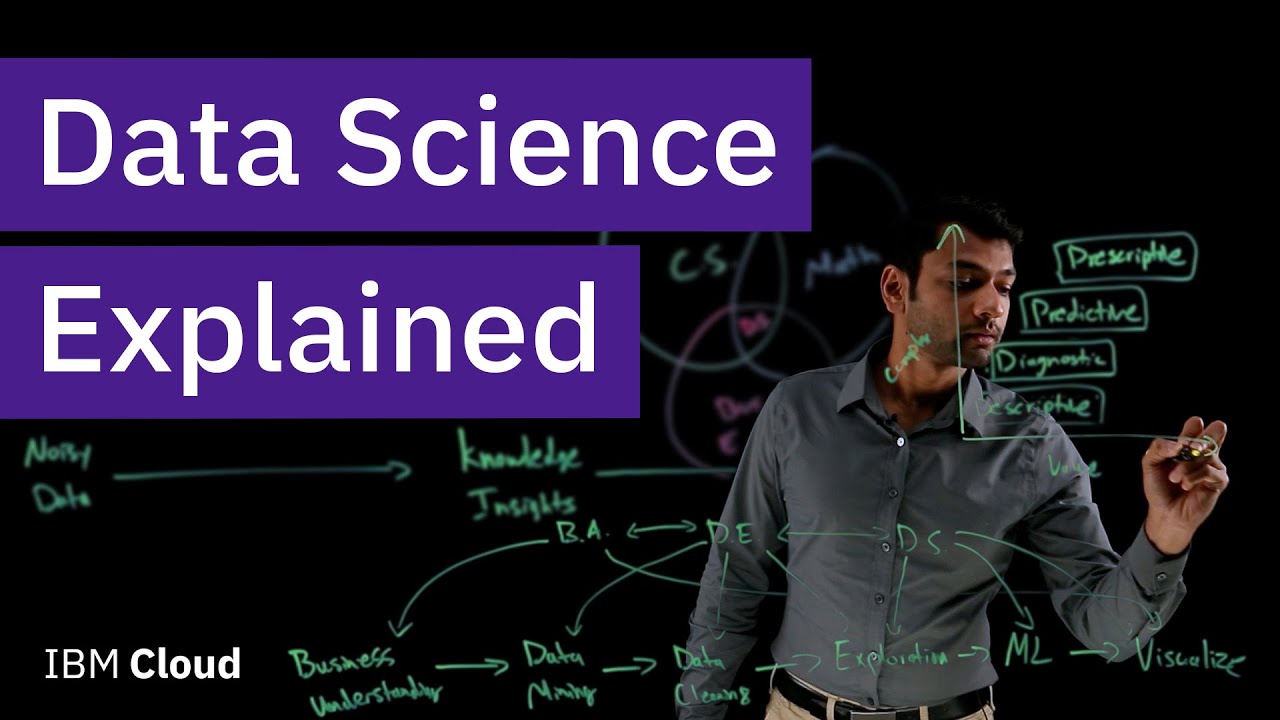
Data Science is the convergence of computer science, mathematics, and business expertise and helps entrepreneurs predict, diagnose, and solve their problems. Luv Aggarwal, a Data Solution Engineer at IBM, goes through the basics and explains how the discipline deploys data mining, data cleaning, machine learning and a variety of advanced analytics to yield actionable insights that will provide a roadmap for growth.
Get started for free on IBM Cloud → https://ibm.biz/BdPEfu
Subscribe to see more videos like this in the future → http://ibm.biz/subscribe-now
#DataScience #BusinessSolutions #Lightboard #IBM #ComputerScience #Data #MachineLearning

🔥𝐄𝐝𝐮𝐫𝐞𝐤𝐚 𝐀𝐖𝐒 𝐒𝐨𝐥𝐮𝐭𝐢𝐨𝐧 𝐀𝐫𝐜𝐡𝐢𝐭𝐞𝐜𝐭 𝐂𝐞𝐫𝐭𝐢𝐟𝐢𝐜𝐚𝐭𝐢𝐨𝐧 𝐓𝐫𝐚𝐢𝐧𝐢𝐧𝐠 𝐂𝐨𝐮𝐫𝐬𝐞: https://www.edureka.co/aws-certification-training (Use code "𝐘𝐎𝐔𝐓𝐔𝐁𝐄𝟐𝟎")
This AWS CloudFormation video tutorial shall teach you how to use AWS CloudFormation and why it is used. Towards the end, we will be learning how to create a template using a JSON script and also create a stack using the sample templates. This video tutorial is ideal for those want to become an AWS Certified Solutions Architect!
00:00:00 Agenda
00:00:53 Why AWS CloudFormation
00:06:08 AWS CloudFormation Components
00:27:48 Templates in CloudFormation
00:29:37 Stacks in CloudFormation
00:30:19 Direct Update
00:30:40 Update
🔴 Subscribe to our channel to get video updates. Hit the subscribe button above: https://goo.gl/6ohpTV
🔴 𝐄𝐝𝐮𝐫𝐞𝐤𝐚 𝐎𝐧𝐥𝐢𝐧𝐞 𝐓𝐫𝐚𝐢𝐧𝐢𝐧𝐠 𝐚𝐧𝐝 𝐂𝐞𝐫𝐭𝐢𝐟𝐢𝐜𝐚𝐭𝐢𝐨𝐧𝐬
🌕 AWS Online Training: http://bit.ly/3ADYwDY
🌕 Azure Online Training: http://bit.ly/3i4P85F
🔴 𝐄𝐝𝐮𝐫𝐞𝐤𝐚 𝐑𝐨𝐥𝐞-𝐁𝐚𝐬𝐞𝐝 𝐂𝐨𝐮𝐫𝐬𝐞𝐬
🔵 DevOps Engineer Masters Program: http://bit.ly/3Oud9PC
🌕 Cloud Architect Masters Program: http://bit.ly/3OvueZy
🔵 Data Scientist Masters Program: http://bit.ly/3tUAOiT
🌕 Big Data Architect Masters Program: http://bit.ly/3tTWT0V
🔵 Machine Learning Engineer Masters Program: http://bit.ly/3AEq4c4
🌕 Business Intelligence Masters Program: http://bit.ly/3UZPqJz
🔵 Cyber Security Masters Program: http://bit.ly/3U25rNR
🌕 Full Stack Developer Masters Program : http://bit.ly/3tWCE2S
🔵 Automation Testing Engineer Masters Program : http://bit.ly/3AGXg2J
🌕 Python Developer Masters Program : https://bit.ly/3EV6kDv
🔵 Azure Cloud Engineer Masters Program: http://bit.ly/3AEBHzH
🔴 𝐄𝐝𝐮𝐫𝐞𝐤𝐚 𝐔𝐧𝐢𝐯𝐞𝐫𝐬𝐢𝐭𝐲 𝐏𝐫𝐨𝐠𝐫𝐚𝐦𝐬
🌕 Professional Certificate Program in DevOps with Purdue University: https://bit.ly/3Ov52lT
📢📢 𝐓𝐨𝐩 𝟏𝟎 𝐓𝐫𝐞𝐧𝐝𝐢𝐧𝐠 𝐓𝐞𝐜𝐡𝐧𝐨𝐥𝐨𝐠𝐢𝐞𝐬 𝐭𝐨 𝐋𝐞𝐚𝐫𝐧 𝐢𝐧 2023 𝐒𝐞𝐫𝐢𝐞𝐬 📢📢
⏩ NEW Top 10 Technologies To Learn In 2023 - https://youtu.be/udD_GQVDt5g
📌𝐓𝐞𝐥𝐞𝐠𝐫𝐚𝐦: https://t.me/edurekaupdates
📌𝐓𝐰𝐢𝐭𝐭𝐞𝐫: https://twitter.com/edurekain
📌𝐋𝐢𝐧𝐤𝐞𝐝𝐈𝐧: https://www.linkedin.com/company/edureka
📌𝐈𝐧𝐬𝐭𝐚𝐠𝐫𝐚𝐦: https://www.instagram.com/edureka_learning/
📌𝐅𝐚𝐜𝐞𝐛𝐨𝐨𝐤: https://www.facebook.com/edurekaIN/
📌𝐒𝐥𝐢𝐝𝐞𝐒𝐡𝐚𝐫𝐞: https://www.slideshare.net/EdurekaIN
📌𝐂𝐚𝐬𝐭𝐛𝐨𝐱: https://castbox.fm/networks/505?country=IN
📌𝐌𝐞𝐞𝐭𝐮𝐩: https://www.meetup.com/edureka/
📌𝐂𝐨𝐦𝐦𝐮𝐧𝐢𝐭𝐲: https://www.edureka.co/community/
What is the AWS certification?
AWS is a top cloud service provider and the AWS certification is one of the leading IT certifications today. It consists of a wide range of expert insights, resources that help validate your technical skills and cloud expertise to improve your career and business.
Why learn AWS?
As AWS is one of the rapidly growing cloud services, it has over 1 million customers from 190 countries. Cloud skills have become critical to large enterprises, and thus the AWS certification provides enormous job opportunities with competitive salaries.
Got a question on the topic? Please share it in the comment section below and our experts will answer it for you.
Please write back to us at [email protected] or call us at IND: 9606058406 / US: 18338555775 (toll-free) for more information.