Top videos




An updated deep learning introduction using Python, TensorFlow, and Keras.
Text-tutorial and notes: https://pythonprogramming.net/....introduction-deep-le
TensorFlow Docs: https://www.tensorflow.org/api_docs/python/
Keras Docs: https://keras.io/layers/about-keras-layers/
Discord: https://discord.gg/sentdex

I am happy to have read, "Deep Learning with Python" by Francois Chollet. The book is a 5/5 stars! He lays a easy to understand base foundation for the reader while providing and explaining simple code. I really liked the way he started with a simple model and then added more details to it for a better fit while providing testing and logic as to why it was better. The code also follows the same progression where it is short and simple at the beginning and then becomes longer and more detailed as the models become more complicated.
Traditional neural networks, CNN (convolution neural networks), and RNN (recurrent neural networks) are all covered in great detail with real examples. There are many cool topics covered such as generative adversarial networks. The book also does a great job at pointing out how deep learning can be used and what has been over hyped in the media and online.
Buy the book here (my affiliate link):
https://amzn.to/2w3LDUY
Quant t-shirts, mugs, and hoodies:
https://teespring.com/stores/fancy-quant
Connect with me:
https://www.linkedin.com/in/dimitri-bianco
https://twitter.com/DimitriBianco
☕ Show Your Support and Buy Me a Coffee ☕
https://ko-fi.com/fancyquant



Le deep learning, une technique qui révolutionne l'intelligence artificielle...et bientôt notre quotidien !
Écrit et réalisé par David Louapre © Science étonnante
Le billet qui accompagne la vidéo : http://wp.me/p11Vwl-23E
* MES LIVRES :
- "Mais qui a attrapé le bison de Higgs ?"
https://www.amazon.fr/gp/product/B07R7BZZ5J/
- "Insoluble, mais vrai !"
https://www.amazon.fr/gp/product/2081486776/
* ME SOUTENIR :
http://www.tipeee.com/science-etonnante
* SUR LES RESEAUX SOCIAUX :
Facebook : https://www.facebook.com/sciencetonnante
Twitter : https://www.twitter.com/dlouapre
* LE BLOG :
http://scienceetonnante.com
La vidéo de Fei Fei Li à TED : https://www.ted.com/talks/fei_....fei_li_how_we_re_tea
La leçon inaugurale de Yann Le Cun au Collège de France : http://www.college-de-france.f....r/site/yann-lecun/in
Références :
==========
Russakovsky, Olga, et al. « Imagenet large scale visual recognition challenge. » International Journal of Computer Vision 115.3 (2015): 211-252. http://arxiv.org/pdf/1409.0575
Radford, Alec, Luke Metz, and Soumith Chintala. « Unsupervised Representation Learning with Deep Convolutional Generative Adversarial Networks. » arXiv preprint arXiv:1511.06434 (2015). http://arxiv.org/pdf/1511.06434
Zeiler, Matthew D., and Rob Fergus. « Visualizing and understanding convolutional networks. » Computer vision–ECCV 2014. Springer International Publishing, 2014. 818-833. http://arxiv.org/pdf/1311.2901
Vinyals, Oriol, et al. "Show and tell: A neural image caption generator." Proceedings of the IEEE Conference on Computer Vision and Pattern Recognition. 2015. http://arxiv.org/pdf/1411.4555.pdf


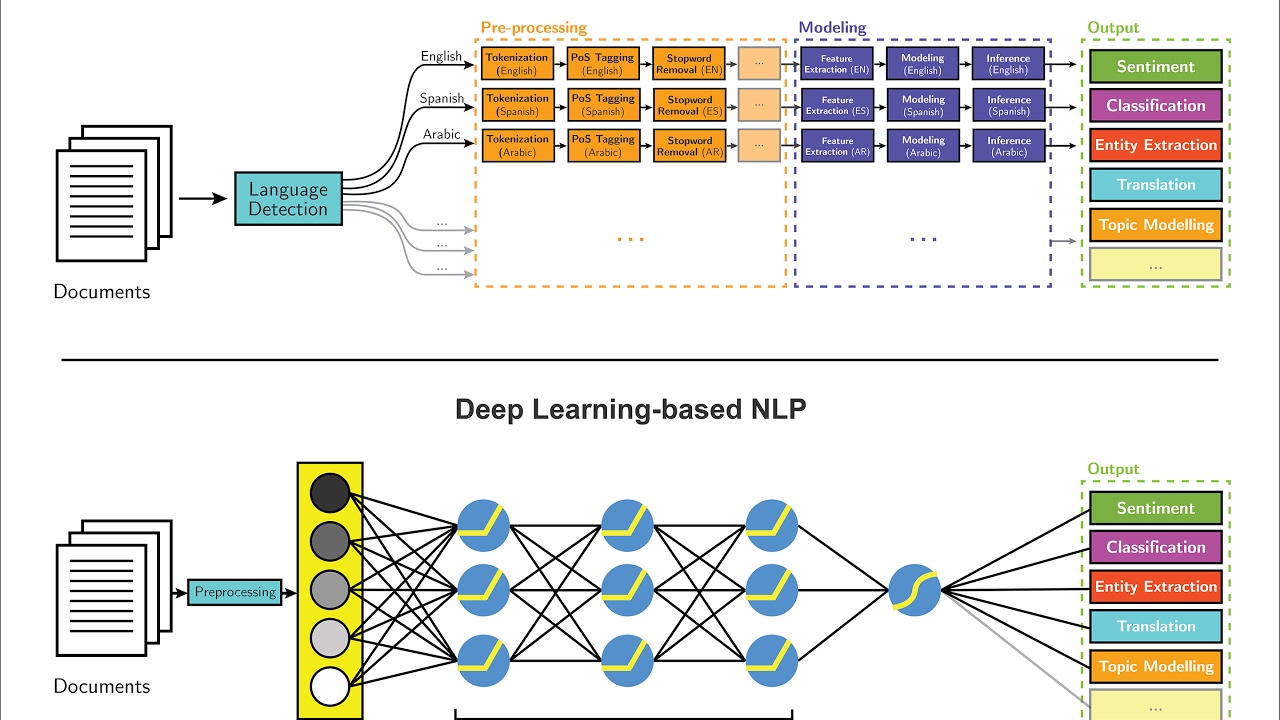
Despite its popularity, machine vision is not the only Deep Learning application. Deep nets have started to take over text processing as well, beating every traditional method in terms of accuracy. They also are used extensively for cancer detection and medical imaging. When a data set has highly complex patterns, deep nets tend to be the optimal choice of model.
Demo URLs
Clarifai - http://www.clarifai.com
Metamind - https://www.metamind.io/language/twitter
As we have previously discussed, Deep Learning is used in many areas of machine vision. Facebook uses deep nets to detect faces from different angles, and the startup Clarifai uses these nets for object recognition. Other applications include scene parsing and vehicular vision for driverless cars.
Deep Learning TV on
Facebook: https://www.facebook.com/DeepLearningTV/
Twitter: https://twitter.com/deeplearningtv
Deep Nets are also starting to beat out other models in certain Natural Language Processing tasks like sentiment analysis, which can be seen with new tools like MetaMind. Recurrent nets can be used effectively in document classification and character-level text processing.
Deep Nets are even being used in the medical space. A Stanford team was able to use deep nets to identify 6,642 factors that help doctors better predict the chances of cancer survival. Researchers from IDSIA in Switzerland used a deep net to identify invasive breast cancer cells. In drug discovery, Merck hosted a deep learning challenge to predict the biological activity of molecules based on chemical structure.
In finance, deep nets are trained to make predictions based on market data streams, portfolio allocations, and risk profiles. In digital advertising, these nets are used to optimize the use of screen space, and to cluster users in order to offer personal ads. They are even used to detect fraud in real time, and to segment customers for upselling/cross-selling in a sales environment.
What is your favorite deep learning application? Please comment and share your thoughts.
Credits
Nickey Pickorita (YouTube art) -
https://www.upwork.com/freelan....cers/~0147b8991909b2
Isabel Descutner (Voice) -
https://www.youtube.com/user/IsabelDescutner
Dan Partynski (Copy Editing) -
https://www.linkedin.com/in/danielpartynski
Marek Scibior (Prezi creator, Illustrator) -
http://brawuroweprezentacje.pl/
Jagannath Rajagopal (Creator, Producer and Director) -
https://ca.linkedin.com/in/jagannathrajagopal