Top videos






At Mirakl, we empower marketplaces with Artificial Intelligence solutions. Catalogs data is an extremely rich source of e-commerce sellers and marketplaces products which include images, descriptions, brands, prices and attributes (for example, size, gender, material or color). Such big volumes of data are suitable for training multimodal deep learning models and present several technical Machine Learning and MLOps challenges to tackle.
We will dive deep into two key use cases: deduplication and categorization of products. For categorization the creation of quality multimodal embeddings plays a crucial role and is achieved through experimentation of transfer learning techniques on state-of-the-art models. Finding very similar or almost identical products among millions and millions can be a very difficult problem and that is where our deduplication algorithm comes to bring a fast and computationally efficient solution.
Furthermore we will show how we deal with big volumes of products using robust and efficient pipelines, Spark for distributed and parallel computing, TFRecords to stream and ingest data optimally on multiple machines avoiding memory issues, and MLflow for tracking experiments and metrics of our models.
Connect with us:
Website: https://databricks.com
Facebook: https://www.facebook.com/databricksinc
Twitter: https://twitter.com/databricks
LinkedIn: https://www.linkedin.com/company/data...
Instagram: https://www.instagram.com/databricksinc/



With so many alternatives available, why are neural nets used for Deep Learning? Neural nets excel at complex pattern recognition and they can be trained quickly with GPUs.
Deep Learning TV on
Facebook: https://www.facebook.com/DeepLearningTV/
Twitter: https://twitter.com/deeplearningtv
Historically, computers have only been useful for tasks that we can explain with a detailed list of instructions. As such, they tend to fail in applications where the task at hand is fuzzy, such as recognizing patterns. Neural Networks fill this gap in our computational abilities by advancing machine perception – that is, they allow computers to start to making complex judgements about environmental inputs. Most of the recent hype in the field of AI has been due to progress in the application of deep neural networks.
Neural nets tend to be too computationally expensive for data with simple patterns; in such cases you should use a model like Logistic Regression or an SVM. As the pattern complexity increases, neural nets start to outperform other machine learning methods. At the highest levels of pattern complexity – high-resolution images for example – neural nets with a small number of layers will require a number of nodes that grows exponentially with the number of unique patterns. Even then, the net would likely take excessive time to train, or simply would fail to produce accurate results.
Have you ever had this problem in your own machine learning projects? Please comment.
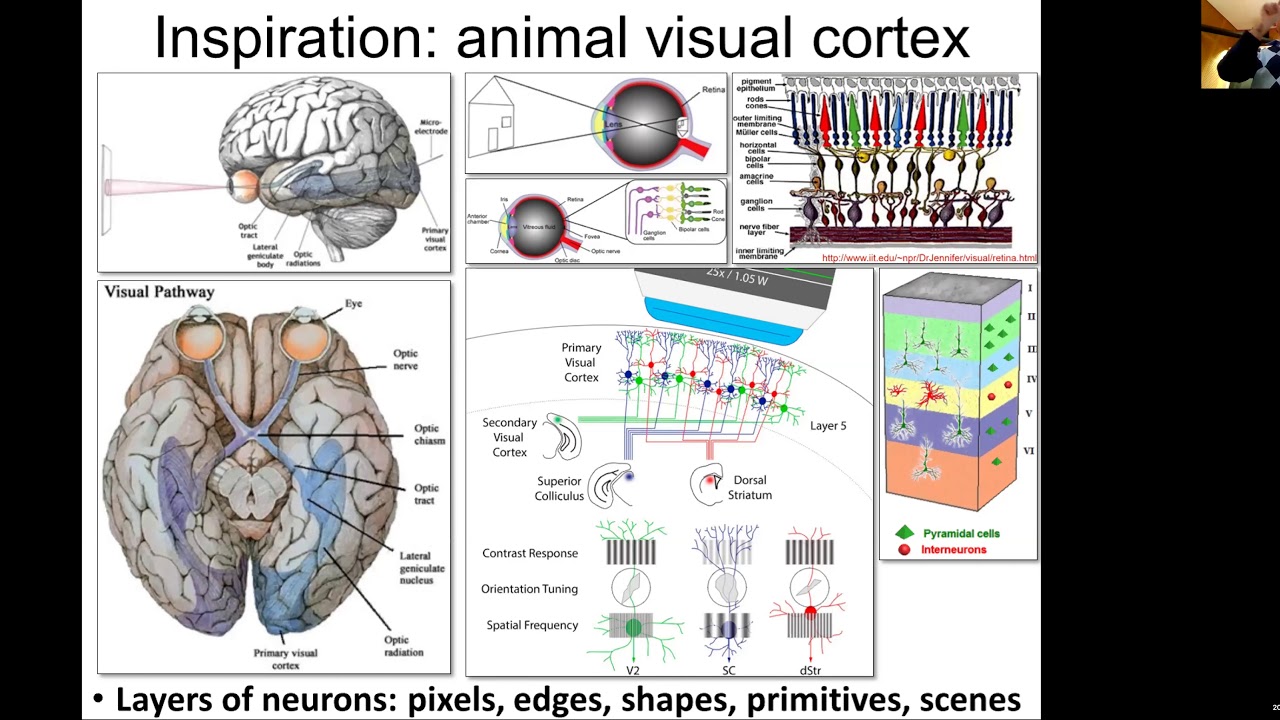
As a result, deep nets are essentially the only practical choice for highly complex patterns such as the human face. The reason is that different parts of the net can detect simpler patterns and then combine them together to detect a more complex pattern. For example, a convolutional net can detect simple features like edges, which can be combined to form facial features like the nose and eyes, which are then combined to form a face (Credit: Andrew Ng). Deep nets can do this accurately – in fact, a deep net from Google beat a human for the first time at pattern recognition.
However, the strength of deep nets is coupled with an important cost – computational power. The resources required to effectively train a deep net were prohibitive in the early years of neural networks. However, thanks to advances in high-performance GPUs of the last decade, this is no longer an issue. Complex nets that once would have taken months to train, now only take days.
Credits:
Nickey Pickorita (YouTube art)
https://www.upwork.com/freelan....cers/~0147b8991909b2
Isabel Descutner (Voice) -
https://www.youtube.com/user/IsabelDescutner
Dan Partynski (Copy Editing) -
https://www.linkedin.com/in/danielpartynski
Jagannath Rajagopal (Creator, Producer and Director) -
https://ca.linkedin.com/in/jagannathrajagopal
DATA is available on the Trimble Learn platform: https://learn.trimble.com/lear....n/course/external/vi
This course is intended to introduce the Deep Learning (Convolutional Neural Network (CNN)) functionalities within the Trimble eCognition Developer Software and consists of 4 videos.
+ Introduction to Deep Learning 1 of 4: Introduction and Set-up
+ Introduction to Deep Learning 2 of 4: Creating Samples
+ Introduction to Deep Learning 3 of 4: Create / Train / Save CNN
+ Introduction to Deep Learning 4 of 4: Apply CNN with OBIA
This course is for free and can be conducted also with the Developer Trial version: https://geospatial.trimble.com/ecognition-trial.
Accessing this course from the Trimble Learn platform, you will have to create an account (also for free) and enroll to this course. Additionally to the DATA you will also receive a CERTIFICATE if you finish the course on the Trimble Learn platform.
Enjoy diving into eCognitions Deep Learning world!
______________Video Content_________________
00:00 - Introduction
00:29 - Create a model - Theory
01:46 - Train a model - Theory
02:59 - Create Convolutional Neural Network (alg.)
04:33 - Shuffle labeled sample patches (alg.)
05:27 - Train Convolutional Neural Network (alg.)
06:52 - Save Convolutional Neural Network (alg.)
(⊙_☉)
👉 Find out more and enroll in the Deep Learning Fundamentals course:
🔗 https://deeplizard.com/course/dlcpailzrd
💥🦎 DEEPLIZARD COMMUNITY RESOURCES 🦎💥
👋 Hey, we're Chris and Mandy, the creators of deeplizard!
👉 Check out the website for more learning material:
🔗 https://deeplizard.com
💻 ENROLL TO GET DOWNLOAD ACCESS TO CODE FILES
🔗 https://deeplizard.com/resources
🧠 Support collective intelligence, join the deeplizard hivemind:
🔗 https://deeplizard.com/hivemind
🧠 Use code DEEPLIZARD at checkout to receive 15% off your first Neurohacker order
👉 Use your receipt from Neurohacker to get a discount on deeplizard courses
🔗 https://neurohacker.com/shop?rfsn=6488344.d171c6
👀 CHECK OUT OUR VLOG:
🔗 https://youtube.com/deeplizardvlog
❤️🦎 Special thanks to the following polymaths of the deeplizard hivemind:
Tammy
Mano Prime
Ling Li
🚀 Boost collective intelligence by sharing this video on social media!
👀 Follow deeplizard:
Our vlog: https://youtube.com/deeplizardvlog
Facebook: https://facebook.com/deeplizard
Instagram: https://instagram.com/deeplizard
Twitter: https://twitter.com/deeplizard
Patreon: https://patreon.com/deeplizard
YouTube: https://youtube.com/deeplizard
🎓 Deep Learning with deeplizard:
Deep Learning Dictionary - https://deeplizard.com/course/ddcpailzrd
Deep Learning Fundamentals - https://deeplizard.com/course/dlcpailzrd
Learn TensorFlow - https://deeplizard.com/course/tfcpailzrd
Learn PyTorch - https://deeplizard.com/course/ptcpailzrd
Natural Language Processing - https://deeplizard.com/course/txtcpailzrd
Reinforcement Learning - https://deeplizard.com/course/rlcpailzrd
Generative Adversarial Networks - https://deeplizard.com/course/gacpailzrd
🎓 Other Courses:
DL Fundamentals Classic - https://deeplizard.com/learn/video/gZmobeGL0Yg
Deep Learning Deployment - https://deeplizard.com/learn/video/SI1hVGvbbZ4
Data Science - https://deeplizard.com/learn/video/d11chG7Z-xk
Trading - https://deeplizard.com/learn/video/ZpfCK_uHL9Y
🛒 Check out products deeplizard recommends on Amazon:
🔗 https://amazon.com/shop/deeplizard
🎵 deeplizard uses music by Kevin MacLeod
🔗 https://youtube.com/channel/UC....SZXFhRIx6b0dFX3xS8L1
❤️ Please use the knowledge gained from deeplizard content for good, not evil.