Top videos

🚀 Small Language Models (SLMs): The Future of AI? 🤖
Most people think AI—like ChatGPT—needs huge servers and an internet connection. While that’s true for Large Language Models (LLMs), AI doesn’t have to be massive!
Introducing Small Language Models (SLMs)—AI that’s lightweight, efficient, and runs entirely offline. 📱💡
🔍 What You’ll Learn in This Video:
✅ SLMs vs. LLMs – What’s the difference?
✅ How SLMs work – Train them on your data for specific tasks.
✅ Real-world examples – AI for customer support, healthcare, and education.
✅ Why SLMs are the future – Privacy-friendly, low-energy, and cost-effective!
🌎 Why This Matters:
Unlike LLMs that require cloud computing, SLMs can run directly on your phone, laptop, or even a Raspberry Pi! No internet needed, no privacy concerns, and perfect for businesses, remote areas, and industries with strict data security requirements.
💡 SLMs Are Changing AI Forever!
• Instant AI-powered customer support 🏢
• Medical assistance in remote areas 🏥
• Personalized education tools for students 📚
• Energy-efficient AI for sustainability 🌱

The Qwen3 family of thinking large language models has just been released and the smallest model in the family is just 523MB! But what can such a small model do? Is it just an academic exercise or is it actually useful? Let's find out.
---
Twitter: https://twitter.com/garyexplains
Instagram: https://www.instagram.com/garyexplains/
#garyexplains

Hi my name is Chris and I build productivity apps 👋 and this is EVERYTHING I learned building an AI agent using the Anthropic Agent SDK :)
---
Check out Convex (database I'm using): https://convex.link/chrisraroque
(please tell them I sent you 🙏)
---
My apps and socials: https://chrisraroque.com
My agency (work with me): https://aloa.co/
Timestamps:
0:00 – Intro / What we are covering
1:03 - What I built with the Agent SDK
2:28 - How Agents Work & Agent SDK Bascs
4:50 - What makes the Agent SDK special
7:55 - Using Convex as the database for my agent
9:19 - Building tools for the agent
10:28 - Agent Skills
12:32 - Agent memory
14:24 - Why I could not release my agent
17:07 - Practical use cases for agents
18:26 - Deploying agents
19:47 - Final thoughts and thank you :)
#appdevelopment #dayinthelife #softwareengineer #startup #softwaredev #indieappdeveloper #dayinthelifecoding #codewithme #buildinpublic #vlog

🧪AI Agents Labs for Free: https://kode.wiki/3Wh4DZ6
Learn everything about AI agents from scratch in this comprehensive tutorial. No prior knowledge required. We'll take you from zero to building production-ready AI systems with hands-on labs.
🎯 What You'll Learn:
• AI Fundamentals - LLMs, tokens, embeddings, and context windows
• LangChain - Simplify AI development with pre-built components
• Prompt Engineering - Zero-shot, few-shot, and chain-of-thought techniques
• Vector Databases - Semantic search with ChromaDB and Pinecone
• RAG (Retrieval Augmented Generation) - Build intelligent document search
• LangGraph - Create multi-step AI workflows and agents
• MCP (Model Context Protocol) - Connect AI to external tools
🔧 Hands-On Labs Include:
✓ Making your first OpenAI API calls
✓ Building semantic search engines
✓ Creating RAG systems for document retrieval
✓ Developing multi-agent workflows
✓ Integrating external tools with MCP
Perfect for developers, data scientists, and anyone wanting to understand modern AI development. Follow along with free labs and build a real-world AI assistant that searches 500GB of documents in under 30 seconds.
🚨Start Your AI Journey with KodeKloud: https://kode.wiki/4qsrspX
⏰ TIMESTAMPS:
00:00 - Introduction to AI Agents
00:40 - How LLMs work in real time?
04:56 - Embeddings & Vector Representations
05:56 - How LangChain works?
10:12 - Practice Labs - Your First AI API Call
14:57 - Practice Labs - LangChain
17:57 - Prompt Engineering Techniques
21:21 - Practice Labs - Master Prompt Engineering
24:46 - Vector Databases Deep Dive
31:27 - Practice Labs - Build Semantic Search Engine
35:15 - RAG (Retrieval Augmented Generation)
38:14 - Practice Labs - RAG Implementation
42:14 - LangGraph for AI Workflows
45:51 - Practice Labs - Build Stateful AI Workflow
48:51 - Model Context Protocol (MCP)
51:56 - Practice Labs - Advanced MCP Concepts
55:21 - Conclusion
🔔 Subscribe to KodeKloud for more AI development tools and tutorials!
#AiAgents #AI #Aifundamentals #LangChain #MCP #LLMs #RAG #Langgraph #vectordb #promptengineering #VectorDatabases #Tutorial #kodekloud

Ready to become a certified watsonx Data Scientist? Register now and use code IBMTechYT20 for 20% off of your exam → https://ibm.biz/BdbvCi
Learn more about AI Agents here → https://ibm.biz/BdbvCj
AI agents are transforming how intelligent systems work 🤖. Deanna Berger explains how Agentic AI, workflow automation, and AI infrastructure enable smarter, autonomous solutions. See how connected agents drive innovation and real‑world impact.
AI news moves fast. Sign up for a monthly newsletter for AI updates from IBM → https://ibm.biz/BdbvCZ
#ai #agenticai #aiagents #automation

Ready to become a certified Architect on Cloud Pak for Data? Register now and use code IBMTechYT20 for 20% off of your exam → https://www.ibm.com/training/c....ertification/ibm-cer
Learn more about Agentic AI here → [Topic Page on .com]
Agentic AI is transforming technology—but autonomy brings big risks 🤖. Phaedra Boinodiris & Matt Bellio explore risks like misinformation, security gaps, and decision-making errors, and share strategies for AI governance and responsible deployment 🚀. Learn how to navigate the future of autonomous AI!
AI news moves fast. Sign up for a monthly newsletter for AI updates from IBM → https://www.ibm.com/account/re....g/us-en/signup?formi
#agenticai #autonomousai #airisks #technologyinnovation

For more information about Stanford's Artificial Intelligence programs visit: https://stanford.io/ai
In this webinar, you will gain an introduction to the concept of agentic language models (LMs) and their usage. You will learn about common limitations of LMs and agentic LM usage patterns, such as reflection, planning, tool usage, and iterative LM usage.
This online session will cover:
Overview of LMs
LM Usage and limitations
Retrieval Augmented Generation (RAG)
Tool usage
Agentic LMs
Agentic design patterns
About the speaker: Insop Song
Insop is a Principal Machine Learning Researcher at GitHub Next. Previously he worked at Microsoft, where he focused on leveraging machine learning and large language models to boost engineering productivity. His projects included fine-tuning open-source large language models with internal code and text, developing document assistance tools, and applying AI to various engineering tasks. He is currently a course developer as well as a course facilitator for Stanford Online’s professional AI program.
Chapters:
00:00 - Introduction
00:10 - Overview of the Talk
01:50 - Training Language Models
02:30 - Modeling Objectives
04:00 - Examples of Training Data Formatting
05:40 - Applications of Language Models
06:50 - Using API for Language Models
09:00 - Best Practices for Prompt Preparation
11:10 - Importance of Clear Instructions
13:40 - Reflection and Improvement Techniques
16:30 - Tool Usage and Function Calling
20:30 - Definition of Agentic Language Models
21:50 - Reasoning and Action in Agentic Models
24:00 - Example of a Customer Support AI Agent
29:20 - Summary of Applications
36:00 - Key Design Patterns in Agentic Models
44:00 - Summary of Agentic Language Model Usage
47:40 - Audience Q&A
50:00 - Addressing Ethical Considerations
54:50 - Getting Started with Language Models
57:00 - Resources for Staying Updated
58:20 - Closing Remarks

We're launching Claude Code, our agentic coding tool, in a limited research preview. Claude Code lets developers delegate substantial engineering tasks to Claude directly from their terminal.
Claude Code has already become indispensable for our team. In early testing, Claude completed tasks in one pass that would normally take 45+ minutes of manual work.
With Claude Code, our goal is to better understand how developers use Claude to help improve our models for all.
In this demo, Claude Code completes complex coding tasks that would ordinarily take a significant amount of manual work. It explains an unfamiliar Next.js project, adds new functionality, creates tests, fixes build errors, and explains its changes.
Read more and join the preview: http://www.anthropic.com/news/claude-3-7-sonnet
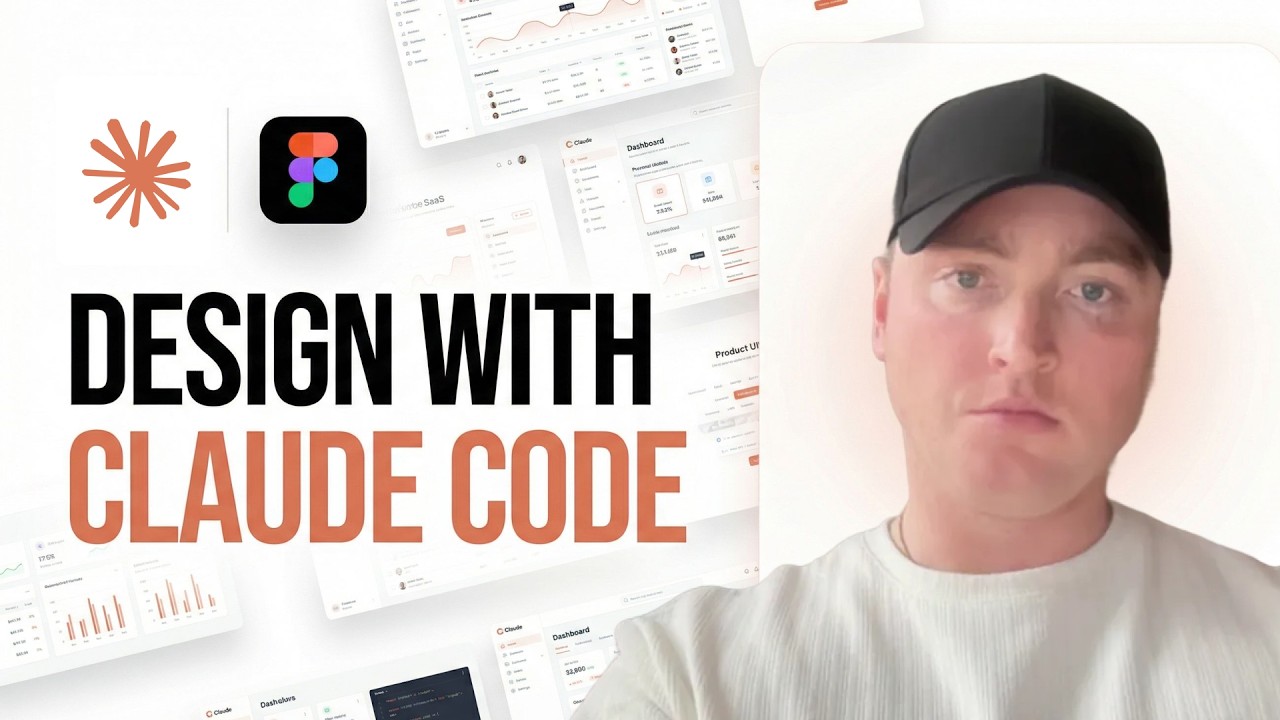
Learn how to design with Claude Code from Anthropic in real product workflows with Figma MCP.
I cover what Claude Code is, how designers can use it, and how to turn it into a serious productivity multiplier for UX exploration, documentation, prototyping, and shipping faster.
If you’re a UI, UX, or Product Designer looking to build better products, work smarter with AI, and stay competitive in a rapidly changing industry, this guide is for you.
🔗 KEY LINKS
📣 JOIN THE COMMUNITY: https://uicollective.co/
❎ Follow me on X: https://x.com/KirkMDesign
Why Join UI Collective Academy? Get access to premium courses, premium downloads, and so much more on the way (I am largely building this solo...trying to make design education available for all, support goes a long way!)
↪️ Need a design system? (also included in the academy): https://collectivekit.co/
🔗 VIDEOS TO WATCH
Build a Design System: https://youtu.be/opTANvl9G1g
Complex Design System Setup: https://youtu.be/L-tpK7Eeuow
AI & Design Systems: https://youtu.be/XfezMs8B-O8
🔗 MORE LINKS
Let us build or fix your design system: https://designsystemlabs.co/
📣 Save 20% on the Annual Mobbin plan: http://mobbin.com/uicollective
[email protected]
VIDEO LINKS & MORE:
Installation: https://code.claude.com/docs/en/overview#terminal
For installation: /plugin install figma@claude-plugins-official
MCP documentation: https://code.claude.com/docs/en/mcp
https://www.pencil.dev/
0:00 An Introduction
0:53 Introduction to Claude Code
3:23 Claude Code & Opus 4.6
4:26 Setting Up Claude Code
6:07 Connecting Figma MCP
7:35 Building a Figma Design with Claude Code
11:59 Claude Code Desktop App
13:32 Pencil App Demo
14:31 Building a Design with Claude Code & Pencil
MIT 6.006 Introduction to Algorithms, Spring 2020
Instructor: Jason Ku
View the complete course: https://ocw.mit.edu/6-006S20
YouTube Playlist: https://www.youtube.com/playli....st?list=PLUl4u3cNGP6
The goal of this introductions to algorithms class is to teach you to solve computation problems and communication that your solutions are correct and efficient. Models of computation, data structures, and algorithms are introduced.
License: Creative Commons BY-NC-SA
More information at https://ocw.mit.edu/terms
More courses at https://ocw.mit.edu
Support OCW at http://ow.ly/a1If50zVRlQ
We encourage constructive comments and discussion on OCW’s YouTube and other social media channels. Personal attacks, hate speech, trolling, and inappropriate comments are not allowed and may be removed. More details at https://ocw.mit.edu/comments.

MIT 15.773 Hands-On Deep Learning Spring 2024
Instructor: Rama Ramakrishnan
View the complete course: https://ocw.mit.edu/courses/15....-773-hands-on-deep-l
YouTube Playlist: https://www.youtube.com/playli....st?list=PLUl4u3cNGP6
Introduction and overview of the course covering the history and background of the field.
License: Creative Commons BY-NC-SAMore information at https://ocw.mit.edu/termsMore courses at https://ocw.mit.eduSupport OCW at http://ow.ly/a1If50zVRlQ
We encourage constructive comments and discussion on OCW’s YouTube and other social media channels. Personal attacks, hate speech, trolling, and inappropriate comments are not allowed and may be removed. More details at https://ocw.mit.edu/comments.

MIT 14.01 Principles of Microeconomics, Fall 2023
Instructor: Prof. Jonathan Gruber
View the complete course: https://ocw.mit.edu/14-01F23
YouTube Playlist: https://www.youtube.com/playli....st?list=PLUl4u3cNGP6
In this lecture, Prof. Gruber talks about where consumer decisions come from, beginning with consumer preferences. He then builds on these concepts to explain the utility function, which is a mathematical expression of consumer preference. Keywords: micoreconomics, consumer demand, preferences, utility function
License: Creative Commons BY-NC-SA
More information at https://ocw.mit.edu/terms
More courses at https://ocw.mit.edu
Support OCW at http://ow.ly/a1If50zVRlQ
We encourage constructive comments and discussion on OCW’s YouTube and other social media channels. Personal attacks, hate speech, trolling, and inappropriate comments are not allowed and may be removed. More details at https://ocw.mit.edu/comments.

MIT 18.642 Topics in Mathematics with Applications in Finance, Fall 2024
Instructor: Peter Kempthorne
View the complete course: https://ocw.mit.edu/courses/18....-642-topics-in-mathe
YouTube Playlist: https://www.youtube.com/playli....st?list=PLUl4u3cNGP6
The lecture introduces linear algebra with a focus on its applications in quantitative finance, covering vector and matrix fundamentals, portfolio valuation, and concepts like short selling, arbitrage, and contingent claims. It further explores stochastic matrices and Markov chains, eigenvalues and eigenvectors, and their roles in modeling financial markets, culminating in discussions on no-arbitrage conditions, market completeness, and pricing measures essential for option pricing theory.
License: Creative Commons BY-NC-SA
More information at https://ocw.mit.edu/terms
More courses at https://ocw.mit.edu
Support OCW at http://ow.ly/a1If50zVRlQ
We encourage constructive comments and discussion on OCW’s YouTube and other social media channels. Personal attacks, hate speech, trolling, and inappropriate comments are not allowed and may be removed. More details at https://ocw.mit.edu/comments.

Course details: https://stanford.io/4qjWTCk
Think back to the first time you had to tell a direct report their work wasn’t good enough, or persuade your supervisor to change course. For most new managers, those difficult conversations might not have gone as planned. But research shows these early moments can shape the trajectory of your entire career. The good news is you don’t have to wait for the next high-stakes conversation to get it right.
In this course, Stanford faculty combine decades of research with the emergent superpowers of generative AI to give you a “practice field” for leadership. You will rehearse critical conversations in a low-stakes environment and gain the skills and confidence to lead with authority and empathy.
You will learn to:
- Craft clear, respectful communication strategies that shift outcomes
- Give and receive constructive feedback that accelerates growth
Using generative AI, you will role-play high-pressure situations such as confronting difficult team members, motivating diverse talent, or disagreeing with your manager. Each practice round gives you structured, real-time feedback on tone, presence, and empathy so you can iterate and improve.
The course begins with three preset scenarios drawn from the experiences of Stanford alumni.
For each, you will:
- Observe: Hear how young leaders confronted real challenges
- Practice: Role-play with an AI partner as your conversational counterpart
- Get Feedback: Receive personalized feedback from our tough conversation AI coach
-Reflect and Repeat: Apply insights, refine your approach, and try again
Finally, you will design your own AI conversation partner for a current workplace challenge, building a personalized tool you can use beyond the course. Along the way, Stanford faculty share research, alumni share lived experiences, and you gain the playbook to shift your career trajectory.
Please note: This course requires a free ChatGPT account to participate in practice activities.

In this lecture, we highlight the course logistics and give a brief overview of the course.

In this video, we'll go through data preprocessing steps for 3 different datasets. We'll also go in depth on a dimensionality reduction technique called Principal Component Analysis.
Coding challenge for this video:
https://github.com/llSourcell/....How_to_Make_Data_Ama
Charles-David's Winning Code:
https://github.com/alkaya/earthquake-cotw
Siby Jack Grove's Runner-up code:
https://github.com/sibyjackgro....ve/Earthquake_predic
Please subscribe. And like. And comment. That's what keeps me going.
More Learning Resources:
http://www.cs.ccsu.edu/~markov..../ccsu_courses/datami
http://www.slideshare.net/jaso....nrodrigues/data-prep
http://iasri.res.in/ebook/win_....school_aa/notes/Data
http://staffwww.itn.liu.se/~ai....dvi/courses/06/dm/le
http://ufldl.stanford.edu/wiki..../index.php/Data_Prep
http://machinelearningmastery.....com/how-to-prepare-d
https://plot.ly/ipython-notebo....oks/principal-compon
Public datasets:
https://github.com/caesar0301/....awesome-public-datas
https://aws.amazon.com/public-datasets/
http://archive.ics.uci.edu/ml/index.html
https://dreamtolearn.com/ryan/1001_datasets
Join us in our Slack channel:
http://wizards.herokuapp.com/
And please support me on Patreon:
https://www.patreon.com/user?u=3191693
Follow me:
Twitter: https://twitter.com/sirajraval
Facebook: https://www.facebook.com/sirajology Instagram: https://www.instagram.com/sirajraval/ Instagram: https://www.instagram.com/sirajraval/
Signup for my newsletter for exciting updates in the field of AI:
https://goo.gl/FZzJ5w
Hit the Join button above to sign up to become a member of my channel for access to exclusive content! Join my AI community: http://chatgptschool.io/ Sign up for my AI Sports betting Bot, WagerGPT! (500 spots available): https://www.wagergpt.xyz
