Latest videos

For more information about Stanford's Artificial Intelligence professional and graduate programs visit: https://stanford.io/ai
Associate Professor Percy Liang
Associate Professor of Computer Science and Statistics (courtesy)
https://profiles.stanford.edu/percy-liang
Assistant Professor Dorsa Sadigh
Assistant Professor in the Computer Science Department & Electrical Engineering Department
https://profiles.stanford.edu/dorsa-sadigh
To follow along with the course schedule and syllabus, visit:
https://stanford-cs221.github.....io/autumn2021/#sched
0:00 Introduction
0:06 Machine learning: differentiable programming
0:47 Deep learning models
1:24 Feedforward neural networks
4:23 Representing images
5:18 Convolutional neural networks
10:29 Representing natural language
11:51 Embedding tokens
13:01 Representing sequences
14:17 Recurrent neural networks
17:38 Collapsing to a single vector
19:33 Long-range dependencies
19:59 Attention mechanism
26:17 Layer normalization and residual connections
28:38 Transformer
31:30 Generating tokens
32:36 Generating sequences
33:46 Sequence-to-sequence models
35:22 Summary FeedForward Conv MaxPool
#artificialintelligence #machinelearning
For more information about Stanford’s Artificial Intelligence professional and graduate programs, visit: https://stanford.io/3Dev1Yj
Professor Christopher Manning
Thomas M. Siebel Professor in Machine Learning, Professor of Linguistics and of Computer Science
Director, Stanford Artificial Intelligence Laboratory (SAIL)
To follow along with the course schedule and syllabus, visit: http://web.stanford.edu/class/....cs224n/index.html#sc

Lecture by Professor Andrew Ng for Machine Learning (CS 229) in the Stanford Computer Science department. Professor Ng lectures on expectation-maximization in the context of the mixture of Gaussian and naive Bayes models, as well as factor analysis and digression.
This course provides a broad introduction to machine learning and statistical pattern recognition. Topics include supervised learning, unsupervised learning, learning theory, reinforcement learning and adaptive control. Recent applications of machine learning, such as to robotic control, data mining, autonomous navigation, bioinformatics, speech recognition, and text and web data processing are also discussed.
Complete Playlist for the Course:
http://www.youtube.com/view_pl....ay_list?p=A89DCFA6AD
CS 229 Course Website:
http://www.stanford.edu/class/cs229/
Stanford University:
http://www.stanford.edu/
Stanford University Channel on YouTube:
http://www.youtube.com/stanford
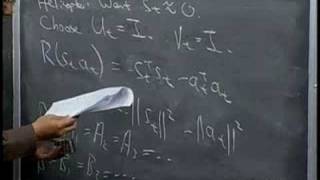
Lecture by Professor Andrew Ng for Machine Learning (CS 229) in the Stanford Computer Science department. Professor Ng discusses state action rewards, linear dynamical systems in the context of linear quadratic regulation, models, and the Riccati equation, and finite horizon MDPs.
This course provides a broad introduction to machine learning and statistical pattern recognition. Topics include supervised learning, unsupervised learning, learning theory, reinforcement learning and adaptive control. Recent applications of machine learning, such as to robotic control, data mining, autonomous navigation, bioinformatics, speech recognition, and text and web data processing are also discussed.
Complete Playlist for the Course:
http://www.youtube.com/view_pl....ay_list?p=A89DCFA6AD
CS 229 Course Website:
http://www.stanford.edu/class/cs229/
Stanford University:
http://www.stanford.edu/
Stanford University Channel on YouTube:
http://www.youtube.com/stanford
For more information about Stanford’s Artificial Intelligence professional and graduate programs, visit: https://stanford.io/30l2Kkw
Professor Christopher Manning, Stanford University
http://onlinehub.stanford.edu/
Professor Christopher Manning
Thomas M. Siebel Professor in Machine Learning, Professor of Linguistics and of Computer Science
Director, Stanford Artificial Intelligence Laboratory (SAIL)
To follow along with the course schedule and syllabus, visit: http://web.stanford.edu/class/....cs224n/index.html#sc
0:00 Introduction
0:23 Announcements
2:00 What is Coreference Resolution?
12:04 Applications
16:40 Coreference Resolution in Two Steps
19:39 Mention Detection: Not so Simple
22:19 Can we avoid a pipelined system?
23:39 4. On to Coreference! First, some linguistics
26:11 Anaphora vs Coreference
27:59 Anaphora vs. Coreference
29:24 Anaphora vs. Cataphora
32:33 Four kinds of Coreference Models
34:43 Hobbs Algorithm Example
40:07 Knowledge-based Pronominal Coreference
45:01 Hobbs' algorithm: commentary
46:06 Coreference Models: Mention Pair
47:33 Mention Pair Training
48:05 Mention Pair Test Time
52:01 7. Coreference Models: Mention Ranking
54:57 Coreference Models: Training
56:05 Mention Ranking Models: Test Time
56:49 A. Non-Neural Coref Model: Features
For more information about Stanford’s Artificial Intelligence professional and graduate programs, visit: https://stanford.io/3Cfhyya
Professor Christopher Manning & PhD Candidate Abigail See, Stanford University
http://onlinehub.stanford.edu/
Professor Christopher Manning
Thomas M. Siebel Professor in Machine Learning, Professor of Linguistics and of Computer Science
Director, Stanford Artificial Intelligence Laboratory (SAIL)
To follow along with the course schedule and syllabus, visit: http://web.stanford.edu/class/....cs224n/index.html#sc
0:00 Introduction
0:27 Announcements
1:09 Overview
2:47 Natural Language Generation (NLG)
5:00 Recap: training a (conditional) RNN-LM
6:21 Recap: decoding algorithms
6:47 Recap: greedy decoding
7:32 Recap: beam search decoding
8:57 Aside: Do the hosts in Westworld use beam search?
10:07 What's the effect of changing beam size k?
13:16 Effect of beam size in chitchat dialogue
15:58 Sampling-based decoding
18:22 Softmax temperature
21:03 Decoding algorithms: in summary
22:55 Summarization: task definition
27:04 Summarization: two main strategies
28:20 Pre-neural summarization
31:00 Summarization evaluation: ROUGE
35:20 Neural summarization (2015-present)
38:53 Neural summarization: copy mechanisms
42:58 Neural summarization: better content selection
43:47 Bottom-up summarization
45:46 Neural summarization via Reinforcement Learning
49:36 Pre- and post-neural dialogue
50:56 Seq2seq-based dialogue
52:36 Irrelevant response problem
54:19 Genericness / boring response problem
56:38 Repetition problem
59:12 Storytelling
59:35 Generating a story from an image

Precision Health is a fundamental shift to more proactive and personalized health care that empowers people to lead healthy lives. It is in this spirit of possibility and promise that Stanford Medicine hosted the sixth year of this conference in 2018, bringing together international researchers and leaders from academia, health care, government, and industry to develop actionable steps for improving human health.
Panelists on a panel about meaningful use of deep/machine learning in medicine included:
* Katherine Chou, Google
* Kevin Lyman, Enlitic
* Jenna Wiens, University of Michigan
* Natalie Pageler, Stanford
Moderator: Serena Yeung, Stanford
For more information, visit: https://bigdata.stanford.edu/

Watch the original Lecture here: https://www.youtube.com/watch?v=UzxYlbK2c7E
Lecture by Professor Andrew Ng for Machine Learning (CS 229) in the Stanford Computer Science department. Professor Ng provides an overview of the course in this introductory meeting.
This course provides a broad introduction to machine learning and statistical pattern recognition. Topics include supervised learning, unsupervised learning, learning theory, reinforcement learning and adaptive control. Recent applications of machine learning, such as to robotic control, data mining, autonomous navigation, bioinformatics, speech recognition, and text and web data processing are also discussed.
Complete Playlist for the Course:
http://www.youtube.com/view_play_list...
CS 229 Course Website:
http://www.stanford.edu/class/cs229/
Stanford University:
http://www.stanford.edu/
Stanford University Channel on YouTube:
http://www.youtube.com/stanford
For more information about Stanford’s Artificial Intelligence professional and graduate programs, visit: https://stanford.io/3Cbr1GI
Professor Christopher Manning & Guest Speaker Kevin Clark, Stanford University
http://onlinehub.stanford.edu/
Professor Christopher Manning
Thomas M. Siebel Professor in Machine Learning, Professor of Linguistics and of Computer Science
Director, Stanford Artificial Intelligence Laboratory (SAIL)
To follow along with the course schedule and syllabus, visit: http://web.stanford.edu/class/....cs224n/index.html#sc
0:00 Introduction
0:56 Deep Learning for NLP 5 years ago
1:34 Future of Deep Learning + NLP
3:32 Why has deep learning been so successful recently?
5:03 Big deep learning successes
6:20 NLP Datasets
8:12 Machine Translation Data
9:54 Pre-Training
12:10 Self-Training
18:27 Large-Scale Back-Translation
20:03 Unsupervised Word Translation
27:43 Unsupervised Neural Machine Translation
31:14 Why Does This Work?
33:46 Unsupervised Machine Translation
34:49 Attribute Transfer
38:10 Cross-Lingual BERT
43:03 Huge Models in Computer Vision
44:29 Training Huge Models
47:41 So What Can GPT-2 Do?
50:04 GPT-2 Results
51:16 How can GPT-2 be doing translation?
52:12 GPT-2 Question Answering
53:31 What happens as models get even bigger?
54:24 GPT-2 Reaction
59:26 High-Impact Decisions
Dr. Matthew Lungren presents labeling work using deep learning at the NIH AI Radiology workshop 2018

For more information about Stanford’s Artificial Intelligence professional and graduate programs, visit: https://stanford.io/3qAoAeO
Professor Christopher Manning
Thomas M. Siebel Professor in Machine Learning, Professor of Linguistics and of Computer Science
Director, Stanford Artificial Intelligence Laboratory (SAIL)
To follow along with the course schedule and syllabus, visit: http://web.stanford.edu/class/....cs224n/index.html#sc

For more information about Stanford’s Artificial Intelligence professional and graduate programs, visit: https://stanford.io/3BcmeEA
Jure Leskovec
Computer Science, PhD
Having defined a GNN layer, the next design step is how to stack GNN layers together. To motivate different ways of stacking GNN layers, we first introduce the issue of over-smoothing that prevents GNNs learning meaningful node embeddings. We learn 2 lessons from the problem of over-smoothing: (1) We should be cautious when adding GNN layers; (2) we can add skip connections in GNNs to alleviate the over-smoothing problem. When the number of GNN layers is small, we can enhance the expressiveness of GNN by creating multi-layer message / aggregation computation, or adding pre-processing / post-processing layers in the GNN.
To follow along with the course schedule and syllabus, visit:
http://web.stanford.edu/class/cs224w/
For more information about Stanford's Artificial Intelligence professional and graduate programs visit: https://stanford.io/2ZB72nu
Lecture 2: Word Vectors, Word Senses, and Neural Network Classifiers
1. Course organization (2 mins)
2. Finish looking at word vectors and word2vec (13 mins)
3. Can we capture the essence of word meaning more effectively by counting? (8m)
4. The GloVe model of word vectors (8 min)
5. Evaluating word vectors (14 mins)
6. Word senses (8 mins)
7. Review of classification and how neural nets differ (8 mins)
8. Introducing neural networks (14 mins)
To learn more about this course visit: https://online.stanford.edu/co....urses/cs224n-natural
To follow along with the course schedule and syllabus visit: http://web.stanford.edu/class/cs224n/
Professor Christopher Manning
Thomas M. Siebel Professor in Machine Learning, Professor of Linguistics and of Computer Science
Director, Stanford Artificial Intelligence Laboratory (SAIL)
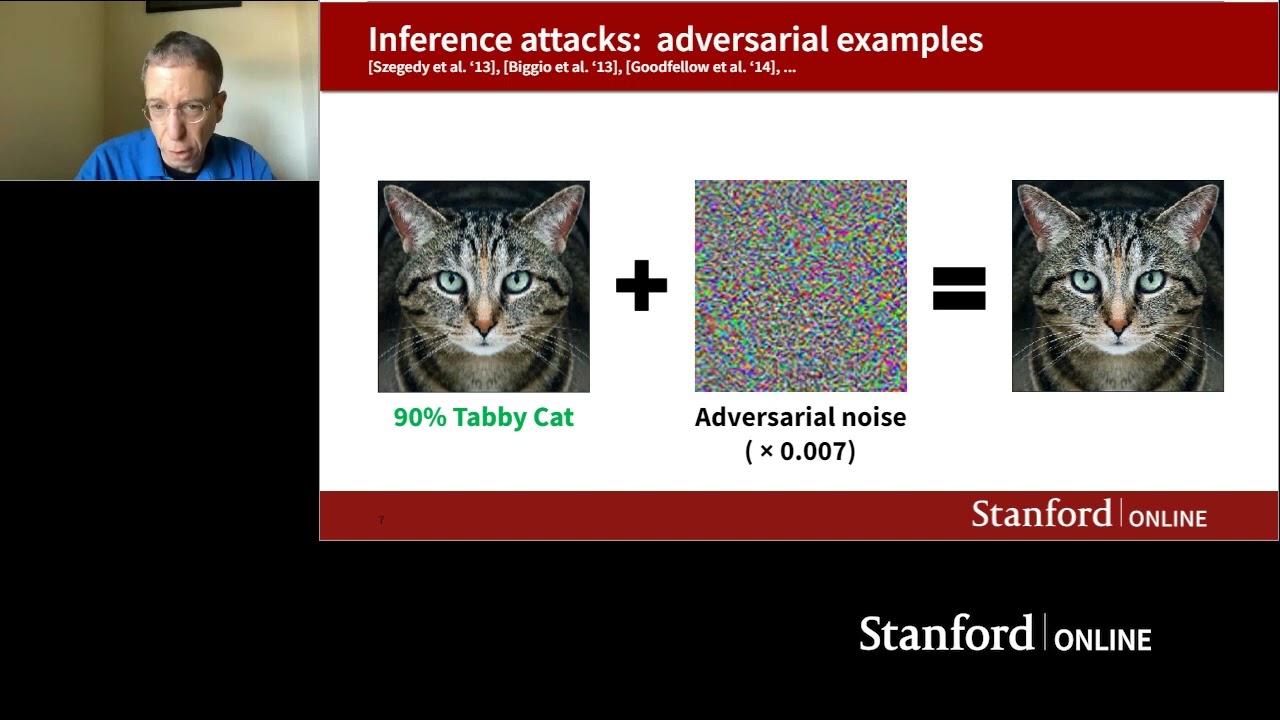
In this webinar, Professor Dan Boneh discusses recent work at the intersection of cybersecurity and machine learning. Specifically, he explores an area known as “adversarial machine learning” which looks at the stability of machine learning models in the presence of adversarial behavior.
For more information about Stanford’s Artificial Intelligence professional and graduate programs, visit: https://stanford.io/2Z3aQ0f
#artificialintelligence #machinelearning
Lecture by Professor Andrew Ng for Machine Learning (CS 229) in the Stanford Computer Science department. Professor Ng lectures on the debugging process, linear quadratic regulation, Kalmer filters, and linear quadratic Gaussian in the context of reinforcement learning.
This course provides a broad introduction to machine learning and statistical pattern recognition. Topics include supervised learning, unsupervised learning, learning theory, reinforcement learning and adaptive control. Recent applications of machine learning, such as to robotic control, data mining, autonomous navigation, bioinformatics, speech recognition, and text and web data processing are also discussed.
Complete Playlist for the Course:
http://www.youtube.com/view_pl....ay_list?p=A89DCFA6AD
CS 229 Course Website:
http://www.stanford.edu/class/cs229/
Stanford University:
http://www.stanford.edu/
Stanford University Channel on YouTube:
http://www.youtube.com/stanford
Lecture by Professor Andrew Ng for Machine Learning (CS 229) in the Stanford Computer Science department. Professor Ng continues his lecture about support vector machines, including soft margin optimization and kernels.
This course provides a broad introduction to machine learning and statistical pattern recognition. Topics include supervised learning, unsupervised learning, learning theory, reinforcement learning and adaptive control. Recent applications of machine learning, such as to robotic control, data mining, autonomous navigation, bioinformatics, speech recognition, and text and web data processing are also discussed.
Complete Playlist for the Course:
http://www.youtube.com/view_pl....ay_list?p=A89DCFA6AD
CS 229 Course Website:
http://www.stanford.edu/class/cs229/
Stanford University:
http://www.stanford.edu/
Stanford University Channel on YouTube:
http://www.youtube.com/stanford