Latest videos
Rebecca Fiebrink
Goldsmiths College
Dynamic professionals sharing their industry experience and cutting edge research within the human-computer interaction (HCI) field will be presented in this seminar. Each week, a unique collection of technologists, artists, designers, and activists will discuss a wide range of current and evolving topics pertaining to HCI.
Learn more about Stanford's Human-Computer Interaction Group: https://hci.stanford.edu
Learn about Stanford's Graduate Certificate in HCI: https://online.stanford.edu/pr....ograms/human-compute
View the full playlist: https://www.youtube.com/playlist?list=PLoROMvodv4rMyupDF2O00r19JsmolyXdD&disable_polymer=true
Lecture by Professor Andrew Ng for Machine Learning (CS 229) in the Stanford Computer Science department. Professor Ng lectures on principal component analysis (PCA) and independent component analysis (ICA) in relation to unsupervised machine learning.
This course provides a broad introduction to machine learning and statistical pattern recognition. Topics include supervised learning, unsupervised learning, learning theory, reinforcement learning and adaptive control. Recent applications of machine learning, such as to robotic control, data mining, autonomous navigation, bioinformatics, speech recognition, and text and web data processing are also discussed.
Complete Playlist for the Course:
http://www.youtube.com/view_pl....ay_list?p=A89DCFA6AD
CS 229 Course Website:
http://www.stanford.edu/class/cs229/
Stanford University:
http://www.stanford.edu/
Stanford University Channel on YouTube:
http://www.youtube.com/stanford
Lecture by Professor Andrew Ng for Machine Learning (CS 229) in the Stanford Computer Science department. Professor Ng continues his lecture on learning theory by discussing VC dimension and model selection.
This course provides a broad introduction to machine learning and statistical pattern recognition. Topics include supervised learning, unsupervised learning, learning theory, reinforcement learning and adaptive control. Recent applications of machine learning, such as to robotic control, data mining, autonomous navigation, bioinformatics, speech recognition, and text and web data processing are also discussed.
Complete Playlist for the Course:
http://www.youtube.com/view_pl....ay_list?p=A89DCFA6AD
CS 229 Course Website:
http://www.stanford.edu/class/cs229/
Stanford University:
http://www.stanford.edu/
Stanford University Channel on YouTube:
http://www.youtube.com/stanford
Lecture by Professor Andrew Ng for Machine Learning (CS 229) in the Stanford Computer Science department. Professor Ng discusses the topic of reinforcement learning, focusing particularly on continuous state MDPs, discretization, and policy and value iterations.
This course provides a broad introduction to machine learning and statistical pattern recognition. Topics include supervised learning, unsupervised learning, learning theory, reinforcement learning and adaptive control. Recent applications of machine learning, such as to robotic control, data mining, autonomous navigation, bioinformatics, speech recognition, and text and web data processing are also discussed.
Complete Playlist for the Course:
http://www.youtube.com/view_pl....ay_list?p=A89DCFA6AD
CS 229 Course Website:
http://www.stanford.edu/class/cs229/
Stanford University:
http://www.stanford.edu/
Stanford University Channel on YouTube:
http://www.youtube.com/stanford

Professor Sanjay Lall
Electrical Engineering
To follow along with the course schedule and syllabus, visit:
http://ee104.stanford.edu
To view all online courses and programs offered by Stanford, visit: https://online.stanford.edu/

Learn more about Stanford's online artificial intelligence professional and graduate programs:
https://stanford.io/3CDAIOV
Stanford Online Artificial Intelligence courses let you virtually step into the classrooms of Stanford professors who are leading the AI revolution. Learn from anywhere in the world, wherever you are in your life’s journey. Take courses in Machine Learning, Robotics, Deep Language, Natural Language, Computer Vision, and more!

EE380: Computer Systems Colloquium Seminar
Computer Architecture : Deep Learning in the Age of Zen, Vega, and Beyond
Speaker: Allen Rush, Advanced Micro Devices, Inc.
Deep Learning and Machine Intelligence is maturing to the point where is it is being deployed to many applications, particularly large data, imaging classification and detection. This talk addresses the challenges of deep learning from a computational challenge perspective and discusses the ways in which new compute platforms of Zen (x86) and Vega (GPU) provide high performance solutions to different training and inference applications. The ROCm software stack completes the support with libraries and framework support for a variety of environments.
About the Speaker:
Allen Rush is a fellow at AMD, focusing on imaging and machine learning architecture development. He has been active in imaging and computer vision projects for over 25 years, including several startups. He is the domain architect for ISP and current machine learning development activities in HW, SW and application support.
For more information about this seminar and its speaker, you can visit http://web.stanford.edu/class/....ee380/Abstracts/1701
Support for the Stanford Colloquium on Computer Systems Seminar Series provided by the Stanford Computer Forum.
Colloquium on Computer Systems Seminar Series (EE380) presents the current research in design, implementation, analysis, and use of computer systems. Topics range from integrated circuits to operating systems and programming languages. It is free and open to the public, with new lectures each week.
Learn more: http://bit.ly/WinYX5

TensorFlow Meets Chip Huyen (@chipro), author and instructor of the TensorFlow for Deep Learning class at Stanford University: https://goo.gl/rNb6PW. They discuss the class, her journey from writing travel stories, to studying computer science, to now teaching students about deep learning at Stanford University! Remember this show is about YOU! We'd love to learn about your TensorFlow journey so leave us a comment below or find us on Twitter!
TensorFlow for Deep Learning Research Course→ https://goo.gl/rNb6PW
Code on GitHub → https://goo.gl/LJS74Y
TensorFlow Meets Playlist → https://goo.gl/DTNXjd
Subscribe to the TensorFlow channel here → https://goo.gl/ht3WGe

Lecture by Professor Andrew Ng for Machine Learning (CS 229) in the Stanford Computer Science department. Professor Ng lectures on Bayesian statistics, regularization, digression-online learning, and the applications of machine learning algorithms.
This course provides a broad introduction to machine learning and statistical pattern recognition. Topics include supervised learning, unsupervised learning, learning theory, reinforcement learning and adaptive control. Recent applications of machine learning, such as to robotic control, data mining, autonomous navigation, bioinformatics, speech recognition, and text and web data processing are also discussed.
Complete Playlist for the Course:
http://www.youtube.com/view_pl....ay_list?p=A89DCFA6AD
CS 229 Course Website:
http://www.stanford.edu/class/cs229/
Stanford University:
http://www.stanford.edu/
Stanford University Channel on YouTube:
http://www.youtube.com/stanford
Lecture by Professor Andrew Ng for Machine Learning (CS 229) in the Stanford Computer Science department. Professor Ng discusses POMDPs, policy search, and Pegasus in the context of reinforcement learning.
This course provides a broad introduction to machine learning and statistical pattern recognition. Topics include supervised learning, unsupervised learning, learning theory, reinforcement learning and adaptive control. Recent applications of machine learning, such as to robotic control, data mining, autonomous navigation, bioinformatics, speech recognition, and text and web data processing are also discussed.
Complete Playlist for the Course:
http://www.youtube.com/view_pl....ay_list?p=A89DCFA6AD
CS 229 Course Website:
http://www.stanford.edu/class/cs229/
Stanford University:
http://www.stanford.edu/
Stanford University Channel on YouTube:
http://www.youtube.com/stanford

Andrew Ng, Adjunct Professor & Kian Katanforoosh, Lecturer - Stanford University
http://onlinehub.stanford.edu/
Andrew Ng
Adjunct Professor, Computer Science
Kian Katanforoosh
Lecturer, Computer Science
To follow along with the course schedule and syllabus, visit:
http://cs230.stanford.edu/
To get the latest news on Stanford’s upcoming professional programs in Artificial Intelligence, visit: http://learn.stanford.edu/AI.html
To view all online courses and programs offered by Stanford, visit: http://online.stanford.edu
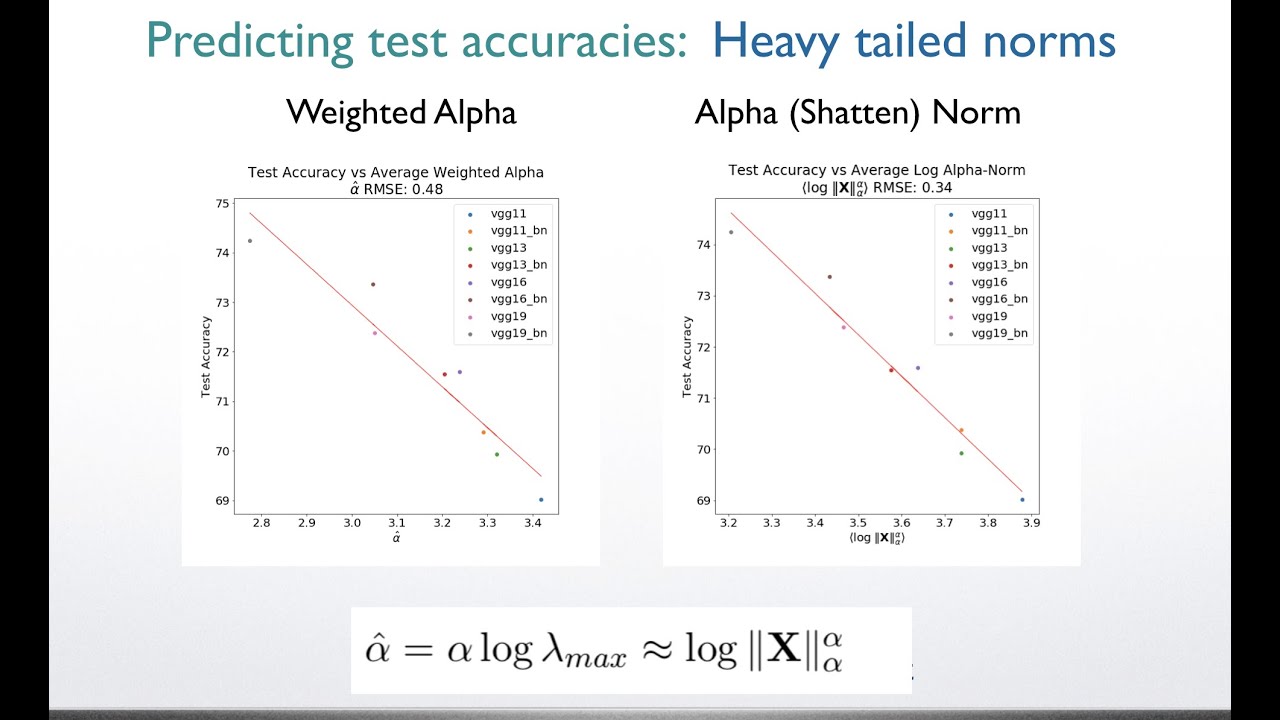
Random Matrix Theory (RMT) is applied to analyze the weight matrices of
Deep Neural Networks (DNNs), including production quality, pre-trained
models and smaller models trained from scratch. Empirical and theoretical
results indicate that the DNN training process itself implements a
form of self-regularization, evident in the empirical spectral density (ESD)
of DNN layer matrices. To understand this, we provide a phenomenology
to identify 5+1 Phases of Training, corresponding to increasing amounts of
implicit self-regularization. For smaller and/or older DNNs, this implicit self-regularization
is like traditional Tikhonov regularization, with a "size scale" separating signal from
noise. For state-of-the-art DNNs, however, we identify a novel form of
heavy-tailed self-regularization, similar to the self-organization seen
in the statistical physics of disordered systems.
To that end, building on the statistical mechanics of generalization,
and applying recent results from RMT, we derive a new VC-like
complexity metric that resembles the familiar product norms, but
is suitable to study average case generalization behavior in real systems.
We then demonstrate its effectiveness by testing how well this new
metric correlates with trends in the reported test accuracies across models
for over 450 pretrained DNNs covering a range of data sets and architectures.

Andrew Ng, Adjunct Professor & Kian Katanforoosh, Lecturer - Stanford University
http://onlinehub.stanford.edu/
Andrew Ng
Adjunct Professor, Computer Science
Kian Katanforoosh
Lecturer, Computer Science
To follow along with the course schedule and syllabus, visit:
http://cs230.stanford.edu/
To get the latest news on Stanford’s upcoming professional programs in Artificial Intelligence, visit: http://learn.stanford.edu/AI.html
To view all online courses and programs offered by Stanford, visit: http://online.stanford.edu

Andrew Ng, Adjunct Professor & Kian Katanforoosh, Lecturer - Stanford University
http://onlinehub.stanford.edu/
Andrew Ng
Adjunct Professor, Computer Science
Kian Katanforoosh
Lecturer, Computer Science
To follow along with the course schedule and syllabus, visit:
http://cs230.stanford.edu/
To get the latest news on Stanford’s upcoming professional programs in Artificial Intelligence, visit: http://learn.stanford.edu/AI.html
To view all online courses and programs offered by Stanford, visit: http://online.stanford.edu

For more information about Stanford’s Artificial Intelligence professional and graduate programs, visit: https://stanford.io/3meRgaI
Topics: Overview of course, Optimization
Percy Liang, Associate Professor & Dorsa Sadigh, Assistant Professor - Stanford University
http://onlinehub.stanford.edu/
Associate Professor Percy Liang
Associate Professor of Computer Science and Statistics (courtesy)
https://profiles.stanford.edu/percy-liang
Assistant Professor Dorsa Sadigh
Assistant Professor in the Computer Science Department & Electrical Engineering Department
https://profiles.stanford.edu/dorsa-sadigh
To follow along with the course schedule and syllabus, visit:
https://stanford-cs221.github.....io/autumn2019/#sched
#artificialintelligencecourse
0:00 Introduction
3:30 Why AI?
15:10 AI as Agents
18:20 AI Tools
20:39 Biases
23:28 Summary
34:08 PacMan
43:11 Perquisites, Homework, Exams