Latest videos

Bayesian Deep Learning and a Probabilistic Perspective of Model Construction
ICML 2020 Tutorial
Bayesian inference is especially compelling for deep neural networks. The key distinguishing property of a Bayesian approach is marginalization instead of optimization. Neural networks are typically underspecified by the data, and can represent many different but high performing models corresponding to different settings of parameters, which is exactly when marginalization will make the biggest difference for accuracy and calibration.
The tutorial has four parts:
Part 1: Introduction to Bayesian modelling and overview (Foundations, overview, Bayesian model averaging in deep learning, epistemic uncertainty, examples)
Part 2: The function-space view (Gaussian processes, infinite neural networks, training a neural network is kernel learning, Bayesian non-parametric deep learning)
Part 3: Practical methods for Bayesian deep learning (Loss landscapes, functional diversity in mode connectivity, SWAG, epistemic uncertainty, calibration, subspace inference, K-FAC Laplace, MC Dropout, stochastic MCMC, Bayes by Backprop, deep ensembles)
Part 4: Bayesian model construction and generalization (Deep ensembles, MultiSWAG, tempering, prior-specification, posterior contraction, re-thinking generalization, double descent, width-depth trade-offs, more!)
Slides: https://cims.nyu.edu/~andrewgw/bayesdlicml2020.pdf
Associated Paper: "Bayesian Deep Learning and a Probabilistic Perspective of Generalization" (NeurIPS 2020)
https://arxiv.org/pdf/2002.08791.pdf
Thanks to Kevin Xia (Columbia) for help in preparing the video.
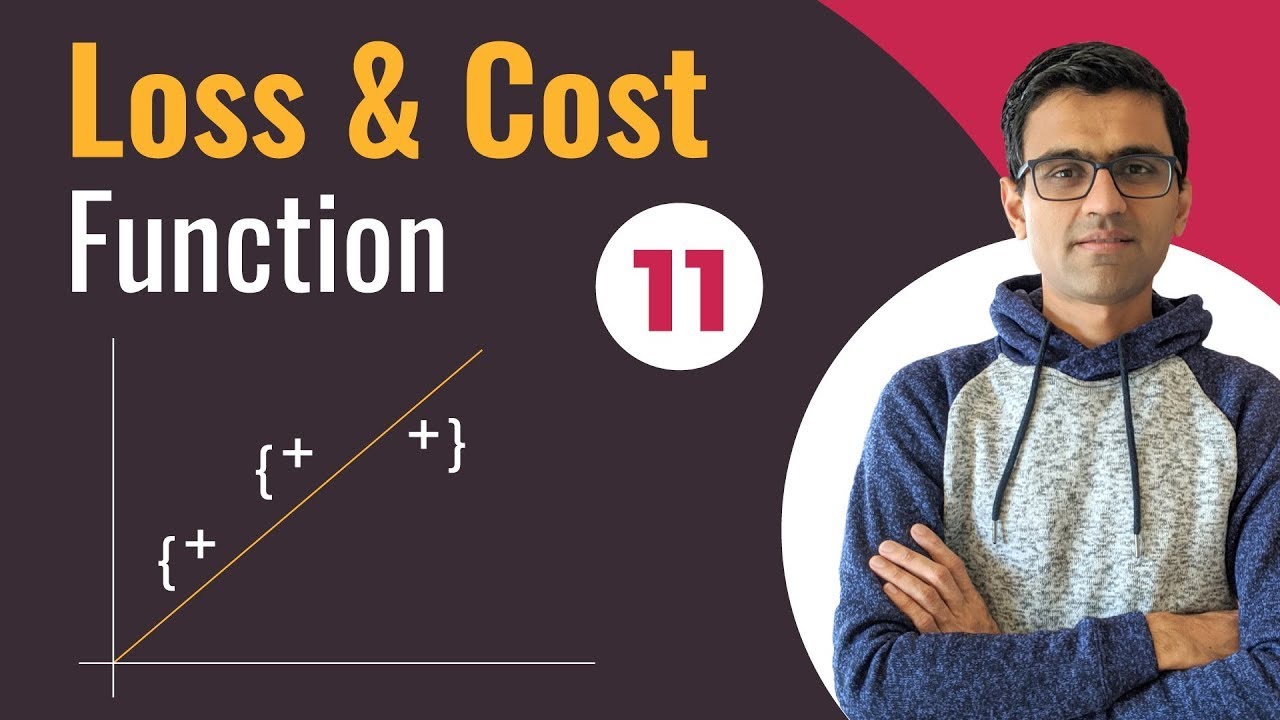
Loss or a cost function is an important concept we need to understand if you want to grasp how a neural network trains itself. We will go over various loss functions in this video such as mean absolute error (a.k.a MAE), mean squared error (a.k.a MSE), log loss or binary cross entropy. After going through theory we will implement these loss functions in python. It is important to go through this implementation as it might be useful during your interviews (if you are targeting a role of a data scientist or a machine learning engineer)
Code: https://github.com/codebasics/....deep-learning-keras-
Exercise: Go at the end of the above notebook to see the exercise
Do you want to learn technology from me? Check https://codebasics.io/ for my affordable video courses.
🔖 Hashtags 🔖
#lossfunction #costfunction #costfunctionneuralnetwork #lossfunctionneuralnetwork #costfunctiondeeplearning #lossfunctiondeeplearning
Why not MSE for logistic regression:
https://towardsdatascience.com..../why-not-mse-as-a-lo
Next video: https://www.youtube.com/watch?v=pXGBHV3y8rs&list=PLeo1K3hjS3uu7CxAacxVndI4bE_o3BDtO&index=12
Previous video: https://www.youtube.com/watch?v=Wibxjrxf5ko&list=PLeo1K3hjS3uu7CxAacxVndI4bE_o3BDtO&index=10
Deep learning playlist: https://www.youtube.com/playli....st?list=PLeo1K3hjS3u
Machine learning playlist : https://www.youtube.com/playli....st?list=PLeo1K3hjS3u
Prerequisites for this series:
1: Python tutorials (first 16 videos): https://www.youtube.com/playli....st?list=PLeo1K3hjS3u
2: Pandas tutorials(first 8 videos): https://www.youtube.com/playli....st?list=PLeo1K3hjS3u
3: Machine learning playlist (first 16 videos): https://www.youtube.com/playli....st?list=PLeo1K3hjS3u
Website: https://codebasics.io/
Facebook: https://www.facebook.com/codebasicshub
Twitter: https://twitter.com/codebasicshub

Deep Learning using Matlab - In this lesson, we will learn how to train a deep neural network using Matlab. It is divided into three sections -
1) Challenges of Deep Learning (continuation of previous lecture)
2) Designing the Architecture - https://youtu.be/HSDyiCuViWg?t=371
3) Writing the code in Matlab (Implementation) - https://youtu.be/HSDyiCuViWg?t=678
You can copy the code from here - https://www.nzfaruqui.com/deep....-learning-using-matl
In the first section, the challenges of Deep Learning have been explained briefly. In the second section, the architecture of neural network has been explained. It also covered selection criteria of input nodes and output nodes, weight matrices and training data. In the third section, the implementation has been demonstrated.
In the previous lecture, we have learned details about Neural Network. That is why I didn't recap those things and directly started with the challenges of deep neural network.
Almost every new learners find it difficult to understand few things such as - how to select number of input nodes, number of output nodes, weight matrices, who data are passed into the network, how to calculate error and so on. I have explained these concept using animations and graphics.
Third section, the final section is the implementation part. Here I have implemented the concept I explained in the lecture. First I coded 'DeepLearning' function. The necessary functions - ReLU and Softmax function have been implemented as well. Then I have shown how to train a deep neural network by calling the 'DeepLearning' function. Finally I have tested the deep neural network. All of these has been shown in Matlab code.
I hope this lesson will help you to understand how to train a deep neural network in Matlab. And after completing this lecture, you will be able to train your own deep neural network to accomplish what ever you want.
This is a clip from a conversation with Gary Marcus from Oct 2019. New full episodes every Mon & Thu and 1-2 new clips or a new non-podcast video on all other days. You can watch the full conversation here: https://www.youtube.com/watch?v=vNOTDn3D_RI
(more links below)
Podcast full episodes playlist:
https://www.youtube.com/playli....st?list=PLrAXtmErZgO
Podcasts clips playlist:
https://www.youtube.com/playli....st?list=PLrAXtmErZgO
Podcast website:
https://lexfridman.com/ai
Podcast on iTunes:
https://apple.co/2lwqZIr
Podcast on Spotify:
https://spoti.fi/2nEwCF8
Podcast RSS:
https://lexfridman.com/category/ai/feed/
Note: I select clips with insights from these much longer conversation with the hope of helping make these ideas more accessible and discoverable. Ultimately, this podcast is a small side hobby for me with the goal of sharing and discussing ideas. For now, I post a few clips every Tue & Fri. I did a poll and 92% of people either liked or loved the posting of daily clips, 2% were indifferent, and 6% hated it, some suggesting that I post them on a separate YouTube channel. I hear the 6% and partially agree, so am torn about the whole thing. I tried creating a separate clips channel but the YouTube algorithm makes it very difficult for that channel to grow unless the main channel is already very popular. So for a little while, I'll keep posting clips on the main channel. I ask for your patience and to see these clips as supporting the dissemination of knowledge contained in nuanced discussion. If you enjoy it, consider subscribing, sharing, and commenting.
Gary Marcus is a professor emeritus at NYU, founder of Robust.AI and Geometric Intelligence, the latter is a machine learning company acquired by Uber in 2016. He is the author of several books on natural and artificial intelligence, including his new book Rebooting AI: Building Machines We Can Trust. Gary has been a critical voice highlighting the limits of deep learning and discussing the challenges before the AI community that must be solved in order to achieve artificial general intelligence.
Subscribe to this YouTube channel or connect on:
- Twitter: https://twitter.com/lexfridman
- LinkedIn: https://www.linkedin.com/in/lexfridman
- Facebook: https://www.facebook.com/lexfridman
- Instagram: https://www.instagram.com/lexfridman
- Medium: https://medium.com/@lexfridman
- Support on Patreon: https://www.patreon.com/lexfridman

👉 Find out more and enroll in the Deep Learning Fundamentals course:
🔗 https://deeplizard.com/course/dlcpailzrd
💥🦎 DEEPLIZARD COMMUNITY RESOURCES 🦎💥
👋 Hey, we're Chris and Mandy, the creators of deeplizard!
👉 Check out the website for more learning material:
🔗 https://deeplizard.com
💻 ENROLL TO GET DOWNLOAD ACCESS TO CODE FILES
🔗 https://deeplizard.com/resources
🧠 Support collective intelligence, join the deeplizard hivemind:
🔗 https://deeplizard.com/hivemind
🧠 Use code DEEPLIZARD at checkout to receive 15% off your first Neurohacker order
👉 Use your receipt from Neurohacker to get a discount on deeplizard courses
🔗 https://neurohacker.com/shop?rfsn=6488344.d171c6
👀 CHECK OUT OUR VLOG:
🔗 https://youtube.com/deeplizardvlog
❤️🦎 Special thanks to the following polymaths of the deeplizard hivemind:
Tammy
Mano Prime
Ling Li
🚀 Boost collective intelligence by sharing this video on social media!
👀 Follow deeplizard:
Our vlog: https://youtube.com/deeplizardvlog
Facebook: https://facebook.com/deeplizard
Instagram: https://instagram.com/deeplizard
Twitter: https://twitter.com/deeplizard
Patreon: https://patreon.com/deeplizard
YouTube: https://youtube.com/deeplizard
🎓 Deep Learning with deeplizard:
Deep Learning Dictionary - https://deeplizard.com/course/ddcpailzrd
Deep Learning Fundamentals - https://deeplizard.com/course/dlcpailzrd
Learn TensorFlow - https://deeplizard.com/course/tfcpailzrd
Learn PyTorch - https://deeplizard.com/course/ptcpailzrd
Natural Language Processing - https://deeplizard.com/course/txtcpailzrd
Reinforcement Learning - https://deeplizard.com/course/rlcpailzrd
Generative Adversarial Networks - https://deeplizard.com/course/gacpailzrd
🎓 Other Courses:
DL Fundamentals Classic - https://deeplizard.com/learn/video/gZmobeGL0Yg
Deep Learning Deployment - https://deeplizard.com/learn/video/SI1hVGvbbZ4
Data Science - https://deeplizard.com/learn/video/d11chG7Z-xk
Trading - https://deeplizard.com/learn/video/ZpfCK_uHL9Y
🛒 Check out products deeplizard recommends on Amazon:
🔗 https://amazon.com/shop/deeplizard
🎵 deeplizard uses music by Kevin MacLeod
🔗 https://youtube.com/channel/UC....SZXFhRIx6b0dFX3xS8L1
❤️ Please use the knowledge gained from deeplizard content for good, not evil.

Checking out a fully custom water-cooled build with 4 A100 40GB cards. An insane powerhouse in a tiny form factor.
Comino Website: https://grando.ai/choose-a-gpu-machine-for-ai-deep-learning/?utm_source=youtube&utm_medium=video&utm_campaign=sentdex#grando-rm
Neural Networks from Scratch book: https://nnfs.io
Channel membership: https://www.youtube.com/channe....l/UCfzlCWGWYyIQ0aLC5
Discord: https://discord.gg/sentdex
Reddit: https://www.reddit.com/r/sentdex/
Support the content: https://pythonprogramming.net/support-donate/
Twitter: https://twitter.com/sentdex
Instagram: https://instagram.com/sentdex
Facebook: https://www.facebook.com/pythonprogramming.net/
Twitch: https://www.twitch.tv/sentdex
#comino #watercooling #deeplearning

In this video I am going to discuss about the complete road map to prepare for deep learning which will be definitely helpful for preparing for interviews
Complete DL Playlist :https://www.youtube.com/playli....st?list=PLZoTAELRMXV
⭐ Kite is a free AI-powered coding assistant that will help you code faster and smarter. The Kite plugin integrates with all the top editors and IDEs to give you smart completions and documentation while you’re typing. I've been using Kite for a few months and I love it! https://www.kite.com/get-kite/?utm_medium=referral&utm_source=youtube&utm_campaign=krishnaik&utm_content=description-only
All Playlist In My channel
Complete ML Playlist :https://www.youtube.com/playli....st?list=PLZoTAELRMXV
Complete NLP Playlist:https://www.youtube.com/playli....st?list=PLZoTAELRMXV
Docker End To End Implementation: https://www.youtube.com/playli....st?list=PLZoTAELRMXV
Live stream Playlist: https://www.youtube.com/playli....st?list=PLZoTAELRMXV
Machine Learning Pipelines: https://www.youtube.com/playli....st?list=PLZoTAELRMXV
Pytorch Playlist: https://www.youtube.com/playli....st?list=PLZoTAELRMXV
Feature Engineering :https://www.youtube.com/playli....st?list=PLZoTAELRMXV
Live Projects :https://www.youtube.com/playli....st?list=PLZoTAELRMXV
Kaggle competition :https://www.youtube.com/playli....st?list=PLZoTAELRMXV
Mongodb with Python :https://www.youtube.com/playli....st?list=PLZoTAELRMXV
MySQL With Python :https://www.youtube.com/playli....st?list=PLZoTAELRMXV
Deployment Architectures:https://www.youtube.com/playli....st?list=PLZoTAELRMXV
Amazon sagemaker :https://www.youtube.com/playli....st?list=PLZoTAELRMXV
Please donate if you want to support the channel through GPay UPID,
Gpay: krishnaik06@okicici
Discord Server Link: https://discord.gg/tvAJuuy
Telegram link: https://t.me/joinchat/N77M7xRvYUd403DgfE4TWw
Please join as a member in my channel to get additional benefits like materials in Data Science, live streaming for Members and many more
https://www.youtube.com/channe....l/UCNU_lfiiWBdtULKOw
Please do subscribe my other channel too
https://www.youtube.com/channe....l/UCjWY5hREA6FFYrthD
Connect with me here:
Twitter: https://twitter.com/Krishnaik06
Facebook: https://www.facebook.com/krishnaik06
instagram: https://www.instagram.com/krishnaik06
#deeplearning
#dl
#deeplearninginterviews

▬▬▬▬▬▬▬▬▬▬▬▬ CONNECT ▬▬▬▬▬▬▬▬▬▬▬▬
🖥️ Website: https://www.assemblyai.com
🐦 Twitter: https://twitter.com/AssemblyAI
🦾 Discord: https://discord.gg/Cd8MyVJAXd
▶️ Subscribe: https://www.youtube.com/c/Asse....mblyAI?sub_confirmat
🔥 We're hiring! Check our open roles: https://www.assemblyai.com/careers
▬▬▬▬▬▬▬▬▬▬▬▬▬▬▬▬▬▬▬▬▬▬▬▬▬▬▬▬▬▬▬▬▬
#MachineLearning #DeepLearning

Visit https://brilliant.org/PythonProgrammer/ to get started for free and get 20% off your annual subscription.
Thanks to Brilliant for sponsoring this video :-)
Grokking Deep Learning is a great introduction to Deep Learning.
You can buy the book here:
Amazon affiliate link https://amzn.to/353S5gG
📚 My favourite python books for beginners (affiliate links)
📗 Python Crash Course 2nd Edition https://amzn.to/33tATAE
📘 Automate the Boring Stuff with Python https://amzn.to/3qM1DFl
📙 Python Basics - A Practical Introduction to Python 3 https://amzn.to/3fHRMdb
📕 Python Programming An Introduction to Computer Science https://amzn.to/33VeQCr
📗 Invent Your Own Computer Games with Python https://amzn.to/3FM3H4b
🆓 Free Python Resource
https://python-programming.qua....ntecon.org/intro.htm
(This is a great introduction to python)
⚙ My Gear
💡 BenQ Screen Bar Desk Light - https://amzn.to/3tH6ysL
🎧 Sony Noise Cancelling Headphones - https://amzn.to/3tLl82G
📱 Social Media
https://www.instagram.com/gilesmcmullen/
https://twitter.com/GilesMcMullen
👌 SUBSCRIBE to ME!👌
https://www.youtube.com/channe....l/UC68KSmHePPePCjW4v
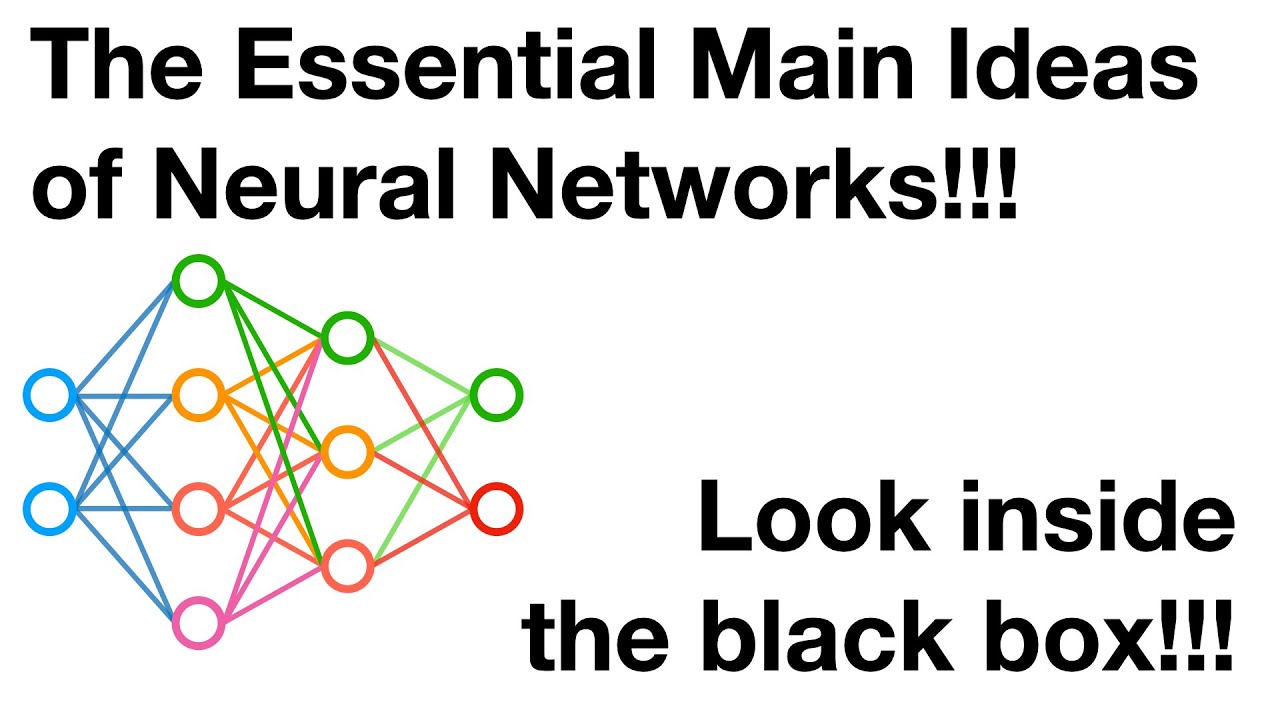
Neural Networks are one of the most popular Machine Learning algorithms, but they are also one of the most poorly understood. Everyone says Neural Networks are "black boxes", but that's not true at all. In this video I break each piece down and show how it works, step-by-step, using simple mathematics that is still true to the algorithm. By the end of this video you will have a deep understanding of what Neural Networks do.
For a complete index of all the StatQuest videos, check out:
https://statquest.org/video-index/
If you'd like to support StatQuest, please consider...
Buying my book, The StatQuest Illustrated Guide to Machine Learning:
PDF - https://statquest.gumroad.com/l/wvtmc
Paperback - https://www.amazon.com/dp/B09ZCKR4H6
Kindle eBook - https://www.amazon.com/dp/B09ZG79HXC
Patreon: https://www.patreon.com/statquest
...or...
YouTube Membership: https://www.youtube.com/channe....l/UCtYLUTtgS3k1Fg4y5
...a cool StatQuest t-shirt or sweatshirt:
https://shop.spreadshirt.com/s....tatquest-with-josh-s
...buying one or two of my songs (or go large and get a whole album!)
https://joshuastarmer.bandcamp.com/
...or just donating to StatQuest!
https://www.paypal.me/statquest
Lastly, if you want to keep up with me as I research and create new StatQuests, follow me on twitter:
https://twitter.com/joshuastarmer
0:00 Awesome song and introduction
2:01 A simple dataset and problem
3:37 Description of Neural Networks
7:54 Creating a squiggle from curved lines
15:25 Using the Neural Network to make a prediction
16:38 Some more Neural Network terminology
#StatQuest #NeuralNetworks

The TensorFlow: Data and Deployment Specialization is now available on Coursera! Enroll now: http://bit.ly/3aeQS41
Check out all our courses: www.deeplearning.ai
Subscribe to The Batch, our weekly newsletter: www.deeplearning.ai/thebatch
Follow us:
Twitter: https://twitter.com/deeplearningai_
Facebook: https://www.facebook.com/deeplearningHQ/
Linkedin: https://www.linkedin.com/company/deeplearningai/"

Dato GraphLab is a good software platform for Deep Learning projects that require graph analytics and other important algorithms. It provides two deep nets, sophisticated data munging, an intuitive UI, and built-in enhancements for handling big data.
Deep Learning TV on
Facebook: https://www.facebook.com/DeepLearningTV/
Twitter: https://twitter.com/deeplearningtv
Dato GraphLab currently offers a vanilla MLP and a convolutional net. An important feature of the platform is the Graph Analytics toolset, which can be run alongside the deep learning models. Other provided tools include text analytics, a recommender, classification, regression, and clustering. You can also point GraphLab at multiple data sources in order to train data loads.
The platform has an intuitive UI along with an extension called the GraphLab Canvas. This extension offers highly sophisticated visualizations of your models.
Even though GraphLab needs to be deployed and maintained on your own hardware, the platform comes with many performance enhancements that speed up training on big data sets.
GraphLab offers three different types of built-in storage – tabular, columnar, and graph. In addition, the platform provides built-in GPU support which is extremely beneficial for training. You can also set up each type of model as a service that can be accessed programmatically through an API.
Under what circumstances would you use a graph in your deep learning projects? Please comment and share your thoughts.
Credits
Nickey Pickorita (YouTube art) -
https://www.upwork.com/freelan....cers/~0147b8991909b2
Isabel Descutner (Voice) -
https://www.youtube.com/user/IsabelDescutner
Dan Partynski (Copy Editing) -
https://www.linkedin.com/in/danielpartynski
Marek Scibior (Prezi creator, Illustrator) -
http://brawuroweprezentacje.pl/
Jagannath Rajagopal (Creator, Producer and Director) -
https://ca.linkedin.com/in/jagannathrajagopal

🔥Intellipaat AI Deep Learning course: https://intellipaat.com/artifi....cial-intelligence-ma
In this deep learning interview questions and answers you will learn the latest and top questions asked by companies for deep learning interview. This deep learning interview questions & answers video covers all kinds of questions starting from basic to advanced questions so that you can get benefited.
#DeepLearningInterviewQuestionsAndAnswers #AIandDeepLearningInterviewQuestions #DeepLearningInterviewQuestions #DeepLearningInterview #DeepLearning #MachineLearning #AIInterviewQuestions
📌 Do subscribe to Intellipaat channel & get regular updates on videos: http://bit.ly/Intellipaat
🔗 Watch AI video tutorials here: http://bit.ly/2F1Bhqt
📕 Read complete AI tutorial here: https://intellipaat.com/blog/t....utorial/artificial-i
📝Following questions are covered in this deep learning video:
00:00 - Deep Learning Interview Questions And Answers
00:59 - What is the Difference between Machine Learning and Deep Learning?
02:16 - What is Perceptron?
03:26 - How is Deep Learning better than Machine Learning?
04:29 - What are some of the most used applications of Deep Learning?
05:27 - What is the meaning of Over fitting?
06:47 - What are Activation functions?
08:00 - Why is Fourier transform used in Deep Learning?
08:55 - What are the steps involved in training a perceptron in Deep learning?
09:47 - What is the use of the loss function?
10:30 - What are some of the Deep Learning Frameworks or tools that you have used?
11:49 - What is the use of the swish function?
12:38 - What are auto encoders?
13:41 - What are the steps to be followed to use the gradient descent algorithm?
14:57 - Differentiate between a single layer perceptron and a multi-layer perceptron
16:00 - What is data normalization in Deep Learning?
16:54 - What is forward propagation?
17:44 - What is back propagation?
18:40 - What are Hyper parameters in Deep Learning?
19:19 - How can hyper parameters be trained in neural networks?
21:38 - What is the meaning of dropout in Deep Learning?
22:42 - What are Tensors?
23:44 - What is the meaning of model capacity in Deep Learning?
24:33 - What is Boltzmann Machine?
25:25 - What are some of the advantages of using TensorFlow?
26:27 - What is the computational graph in Deep Learning?
27:40 - What is a CNN?
28:25 - What are the various layers present in a CNN?
30:19 - What is an RNN in Deep Learning?
31:15 - What is a Vanishing gradient when using RNNs?
32:11 - What is exploding gradient descent in Deep Learning?
33:10 - What is the use of LSTM?
34:04 - Where are autoencoders used?
35:05 - What are the types of auto encoders?
35:35 - What is a restricted Boltzmann Machine?
36:30 - What are some of the limitations of Deep Learning?
38:04 - What are the variants of gradient descent?
39:33 - Why is mini-batch gradient descent so popular?
40:35 - What are deep autoencoders?
41:47 - Why is the leaky ReLu function used in Deep Learning?
42:35 - What are some of the examples if the supervised learning algorithms in Deep Learning?
43:25 - What are some of the examples of unsupervised learning algorithms in Deep Learning?
43:56 - Can we initialize the weights of a network to start from zero?
45:00 - What is the meaning of valid padding and same padding in CNN?
46:16 - What are some of the applications of transfer learning in Deep Learning?
47:25 - How is the transformer architecture better than RNNs in Deep Learning?
48:41 - What are the steps involved in the working of an LSTM network?
50:07 - What are the elements in TensorFlow that are programmable?
50:43 - What is the meaning of bagging and boosting in Deep Learning?
51:52 - What are generative adversarial networks (GANs)?
53:00 - Have you earned any sort of Certification to improve your learning and implementation process?
----------------------------
Intellipaat Edge
1. 24*7 Life time Access & Support
2. Flexible Class Schedule
3. Job Assistance
4. Mentors with +14 yrs
5. Industry Oriented Course ware
6. Life time free Course Upgrade
------------------------------
Why should you opt for an Artificial Intelligence career?
If you want to fast-track your career then you should strongly consider Artificial Intelligence. The reason for this is that it is one of the fastest growing technology. There is a huge demand for professionals in Artificial Intelligence. The salaries for A.I. Professionals is fantastic.There is a huge growth opportunity in this domain as well.
------------------------------
For more Information:
Please write us to [email protected], or call us at: +91- 7847955955, US : 1-800-216-8930(Toll Free)
Website: https://intellipaat.com/artifi....cial-intelligence-ma
Facebook: https://www.facebook.com/intellipaatonline
LinkedIn: https://www.linkedin.com/compa....ny/intellipaat-softw
Twitter: https://twitter.com/Intellipaat

We talk about how you can train your models on the cloud with a p2.xlarge instance, leveraging GPU computation power. If you like the video, like and SUBSCRIBE to the channel for more amazing content!
LINKS
Create an account: https://aws.amazon.com
Instances & AMI: https://docs.aws.amazon.com/AW....SEC2/latest/UserGuid

Google's TensorFlow is currently the most popular Deep Learning library on GitHub. This video will provide an overview of the library's strengths, weaknesses, and numerous features.
Deep Learning TV on
Facebook: https://www.facebook.com/DeepLearningTV/
Twitter: https://twitter.com/deeplearningtv
TensorFlow grew out of a proprietary deep net library called DistBelief, which was built by Google as part of the Google Brain project. The goal of this project is to build a system for large scale machine learning models so that they can be deployed on a variety of platforms – from smart phones to clusters consisting of 100s of nodes and 1000s of GPUs. Another goal is to increase the portability of machine learning and to simplify the process of transferring research models to commercial-grade applications.
Like Theano, TensorFlow is based on a computational graph – a directed graph where nodes represent mathematical operations and edges represent the flow of data between nodes. The data set carried by an edge from one node to another is called a tensor, a type of multi-dimensional array. The library's name stems from the way these tensors flow across the network. Due to its structure, TensorFlow is not limited to neural net applications. Any domain where computation can be modelled as a data flow graph can benefit from the TensorFlow library. TensorFlow also shares several important features with Theano such as auto differentiation, shared and symbolic variables, and common sub-expression elimination.
Different types of deep nets can be built using TensorFlow, although TensorFlow does not allow for hyper-parameter configuration of deep nets. The TensorFlow Roadmap suggests a possible layer configuration feature, but there is currently no mention of when this would be implemented. For now, the library Keras provides TensorFlow with a layer configuration option. TensorFlow also provides a “no-nonsense” interface for C++. In addition, TensorFlow has comprehensive and informative documentation, including the March 2016 release of a free Massive Open Online Course (MOOC) on Udacity.
TensorFlow and Theano are very similar, but TensorFlow was several orders of magnitude slower than Theano from its release until March 2016. The TensorFlow community has since worked to combat performance and other issues. An April 2016 update from Soumith Chintala of Facebook shows that TensorFlow performed well in the ImageNet category, with no Theano-based libraries in the rankings.
An important feature of TensorFlow v0.8 is the implementation of data parallelism, which is similar to the Iterative Map-Reduce from Deeplearning4j. This version of TensorFlow also implements model parallelism, where different portions of the graph can be trained on multiple devices in parallel. The TensorBoard feature allows users to visualize both performance and the different levels of the network architecture. Due to community requests, TensorFlow's Roadmap also includes support for OpenCL, a fast-rising standard for GPU computing.
URLs
Soumith Chintala benchmarks - https://github.com/soumith/convnet-benchmarks
TensorFlow road map - https://www.tensorflow.org/ver....sions/r0.8/resources
Github ML Showcase - https://github.com/showcases/machine-learning
Somatic Ruby post - http://www.somatic.io/blog/ten....sorflow-is-coming-to
TensorFlow MOOC - https://www.udacity.com/course..../deep-learning--ud73
Credits
Nickey Pickorita (YouTube art) -
https://www.upwork.com/freelan....cers/~0147b8991909b2
Isabel Descutner (Voice) -
https://www.youtube.com/user/IsabelDescutner
Dan Partynski (Copy Editing) -
https://www.linkedin.com/in/danielpartynski
Marek Scibior (Prezi creator, Illustrator) -
http://brawuroweprezentacje.pl/
Jagannath Rajagopal (Creator, Producer and Director) -
https://ca.linkedin.com/in/jagannathrajagopal