Latest videos

Data scientists use a variety of metrics in order to objectively determine the performance of a model. This clip will provide an overview of some of the most common metrics such as error, precision, and recall.
Deep Learning TV on
Facebook: https://www.facebook.com/DeepLearningTV/
Twitter: https://twitter.com/deeplearningtv
URL for article on metrics (this Wikipedia article is actually very informative) -
https://en.wikipedia.org/wiki/Precision_and_recall
Credits
Nickey Pickorita (YouTube art) -
https://www.upwork.com/freelan....cers/~0147b8991909b2
Isabel Descutner (Voice) -
https://www.youtube.com/user/IsabelDescutner
Dan Partynski (Copy Editing) -
https://www.linkedin.com/in/danielpartynski
Marek Scibior (Prezi creator, Illustrator) -
http://brawuroweprezentacje.pl/
Jagannath Rajagopal (Creator, Producer and Director) -
https://ca.linkedin.com/in/jagannathrajagopal

Introducing the new Lambda Tensorbook – the world’s most powerful laptop for deep learning: https://rzr.to/lambda-tensorbook
Co-created with Lambda, this sleek laptop is powered by the latest NVIDIA GeForce RTX 3080 Max-Q 16GB GPU and machine learning tools including PyTorch to give engineers everything needed to create, train and test anytime, anywhere.
--
SUBSCRIBE and get hooked up with exclusive content, codes, and giveaways.
http://www.youtube.com/subscription_c...
Keep with the Cult:
http://www.facebook.com/razer
http://www.twitter.com/razer
http://www.instagram.com/razer
https://www.tiktok.com/@razer
razer.com
#Razer #Gaming

Enroll today at https://www.coursera.org/speci....alizations/deep-lear to get access to the specialization!
About this Specialization:
If you want to break into AI, this Specialization will help you do so. Deep Learning is one of the most highly sought after skills in tech. We will help you become good at Deep Learning.
In five courses, you will learn the foundations of Deep Learning, understand how to build neural networks, and learn how to lead successful machine learning projects. You will learn about Convolutional networks, RNNs, LSTM, Adam, Dropout, BatchNorm, Xavier/He initialization, and more. You will work on case studies from healthcare, autonomous driving, sign language reading, music generation, and natural language processing. You will master not only the theory, but also see how it is applied in industry. You will practice all these ideas in Python and in TensorFlow, which we will teach.
You will also hear from many top leaders in Deep Learning, who will share with you their personal stories and give you career advice.
AI is transforming multiple industries. After finishing this specialization, you will likely find creative ways to apply it to your work.
We will help you master Deep Learning, understand how to apply it, and build a career in AI.

Dr. B.S. Manjunath, distinguished professor in the Department of Electrical & Computer Engineering at UC Santa Barbara, discusses the use of computer video technology to assist with visual analysis of issues like human stress and disease, methane gas release, and underwater mapping. He also discusses what we know about human vision, how it works compared to how computer vision works. Recorded on 10/21/2021. [4/2022] [Show ID: 37871]
More from: GRIT Talks
(https://www.uctv.tv/grit)
Explore More Science & Technology on UCTV
(https://www.uctv.tv/science)
Science and technology continue to change our lives. University of California scientists are tackling the important questions like climate change, evolution, oceanography, neuroscience and the potential of stem cells.
UCTV is the broadcast and online media platform of the University of California, featuring programming from its ten campuses, three national labs and affiliated research institutions. UCTV explores a broad spectrum of subjects for a general audience, including science, health and medicine, public affairs, humanities, arts and music, business, education, and agriculture. Launched in January 2000, UCTV embraces the core missions of the University of California -- teaching, research, and public service – by providing quality, in-depth television far beyond the campus borders to inquisitive viewers around the world.
(https://www.uctv.tv)
In this deep learning with Python and Pytorch tutorial, we'll be actually training this neural network by learning how to iterate over our data, pass to the model, calculate loss from the result, and then do backpropagation to slowly fit our model to the data.
Text-based tutorials and sample code: https://pythonprogramming.net/....training-deep-learni
Linode Cloud GPUs $20 credit: https://linode.com/sentdex
Channel membership: https://www.youtube.com/channe....l/UCfzlCWGWYyIQ0aLC5
Discord: https://discord.gg/sentdex
Support the content: https://pythonprogramming.net/support-donate/
Twitter: https://twitter.com/sentdex
Instagram: https://instagram.com/sentdex
Facebook: https://www.facebook.com/pythonprogramming.net/
Twitch: https://www.twitch.tv/sentdex
#pytorch #deeplearning #machinelearning
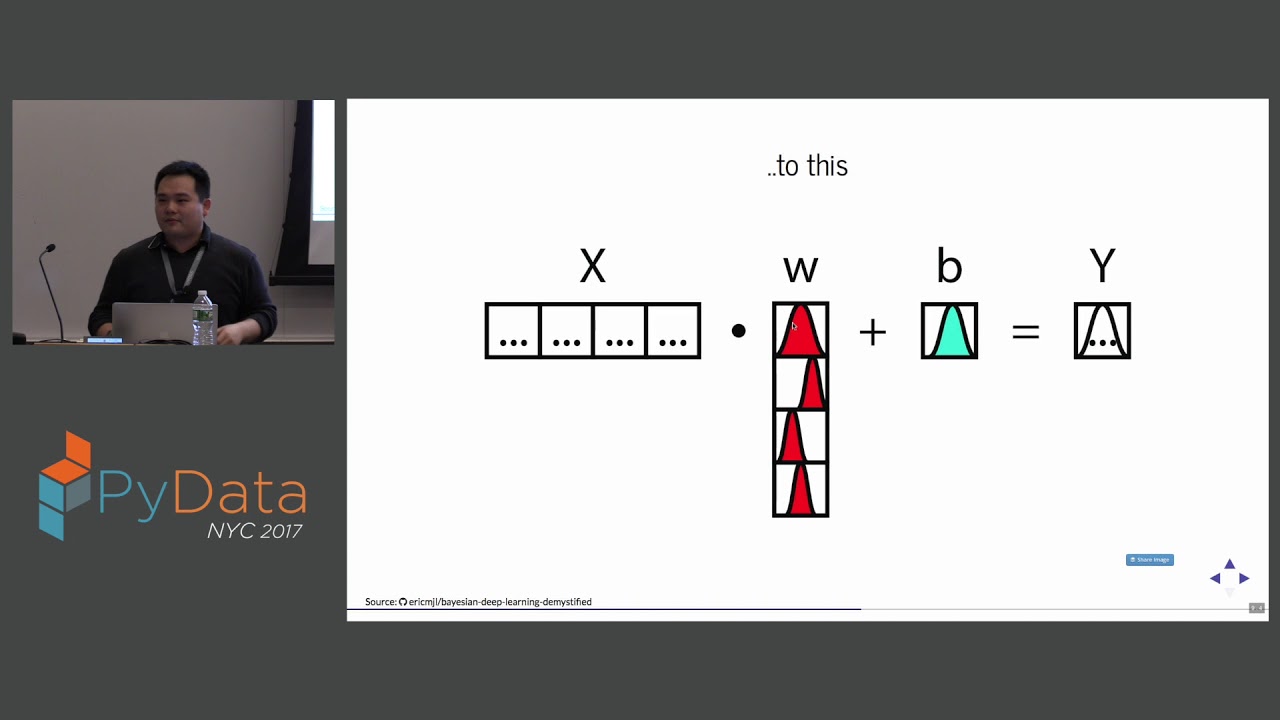
PyData New York City 2017
Slides: https://ericmjl.github.io/baye....sian-deep-learning-d
In this talk, I aim to do two things: demystify deep learning as essentially matrix multiplications with weights learned by gradient descent, and demystify Bayesian deep learning as placing priors on weights. I will then provide PyMC3 and Theano code to illustrate how to construct Bayesian deep nets and visualize uncertainty in their results. 00:00 Welcome!
00:10 Help us add time stamps or captions to this video! See the description for details.
Want to help add timestamps to our YouTube videos to help with discoverability? Find out more here: https://github.com/numfocus/YouTubeVideoTimestamps

This interview is published from deeplearning.ai’s Deep Learning Specialization (https://www.coursera.org/speci....alizations/deep-lear on Coursera.
It is part of the course on “Convolutional Neural Networks” (https://www.coursera.org/learn..../convolutional-neura

We at iNeuron are happy to announce multiple series of courses. Finally we are covering Big Data,
Cloud,AWS,AIops and MLops. Check out the syllabus below.
30 Days Data Science Interview preparation - https://rb.gy/q1c58g
Big Data Master-https://rb.gy/xg1ob7
Business analytics-https://rb.gy/herdd8
Aws Cloud Masters- https://rb.gy/x5poyj
AI OPS- https://rb.gy/kionj6
Incase of any queries you can contact the below number. Happy Learning!!
8788503778
6260726925
9538303385
8660034247
9880055539

Deep Learning NVR DVA3219 is an AI-powered video analytics server perfect for those who are concerned about privacy and security.
Powered by NVIDIA GeForce® graphic card, advanced deep learning-based algorithms are built into DVA3219 to transform a vast amount of unstructured video data into situational awareness and business intelligence. The video analytics process is done entirely on-premises, meaning no footage is uploaded to the cloud for analysis purposes.
With Deep Learning NVR DVA3219, you'll be able to enjoy the benefits of AI-powered video analytics without sweating over sensitive information and regulatory requirements.
Learn more about DVA3219
https://www.synology.com/products/DVA3219

A visual introduction to the structure of an artificial neural network. More to come!
Support me on Patreon! https://patreon.com/vcubingx
Source Code: https://github.com/vivek3141/dl-visualization
Here's the course I referred to in the video. I am not affiliated with NYU.
https://www.youtube.com/playli....st?list=PLLHTzKZzVU9
Here's 3blue1brown's video on Linear Transformations:
https://youtu.be/kYB8IZa5AuE
Special thanks to Matt Henderson, David Ha, Oliver Ni and Sumedh Shenoy for reviewing the video.
And also thanks to Grant Sanderson himself for giving me some manim tips!
I've been quite active on twitter, follow me here!
https://twitter.com/vcubingx
Join the discord server!
https://discord.gg/Kj8QUZU
These videos were made using 3blue1brown's library, manim:
https://github.com/3b1b/manim
Follow me!
Website: https://vcubingx.com
Twitter: https://twitter.com/vcubingx
Github: https://github.com/vivek3141
Instagram: https://instagram.com/vcubingx
Patreon: https://patreon.com/vcubingx
The Neural Network, A Visual Introduction | Visualizing Deep Learning, Chapter 1
0:00 Intro
1:55 One input Perceptron
3:30 Two input Perceptron
4:40 Three input Perceptron
5:17 Activation Functions
6:58 Neural Network
9:45 Visualizing 2-2-2 Network
10:59 Visualizing 2-3-2 Network
12:33 Classification
13:05 Outro
Please join as a member in my channel to get additional benefits like materials in Data Science, live streaming for Members and many more
https://www.youtube.com/channe....l/UCNU_lfiiWBdtULKOw In this video we will understand about the max pooling layer in CNN
Please do subscribe my other channel too
https://www.youtube.com/channe....l/UCjWY5hREA6FFYrthD
Connect with me here:
Twitter: https://twitter.com/Krishnaik06
facebook: https://www.facebook.com/krishnaik06
Instagram: https://www.instagram.com/krishnaik06
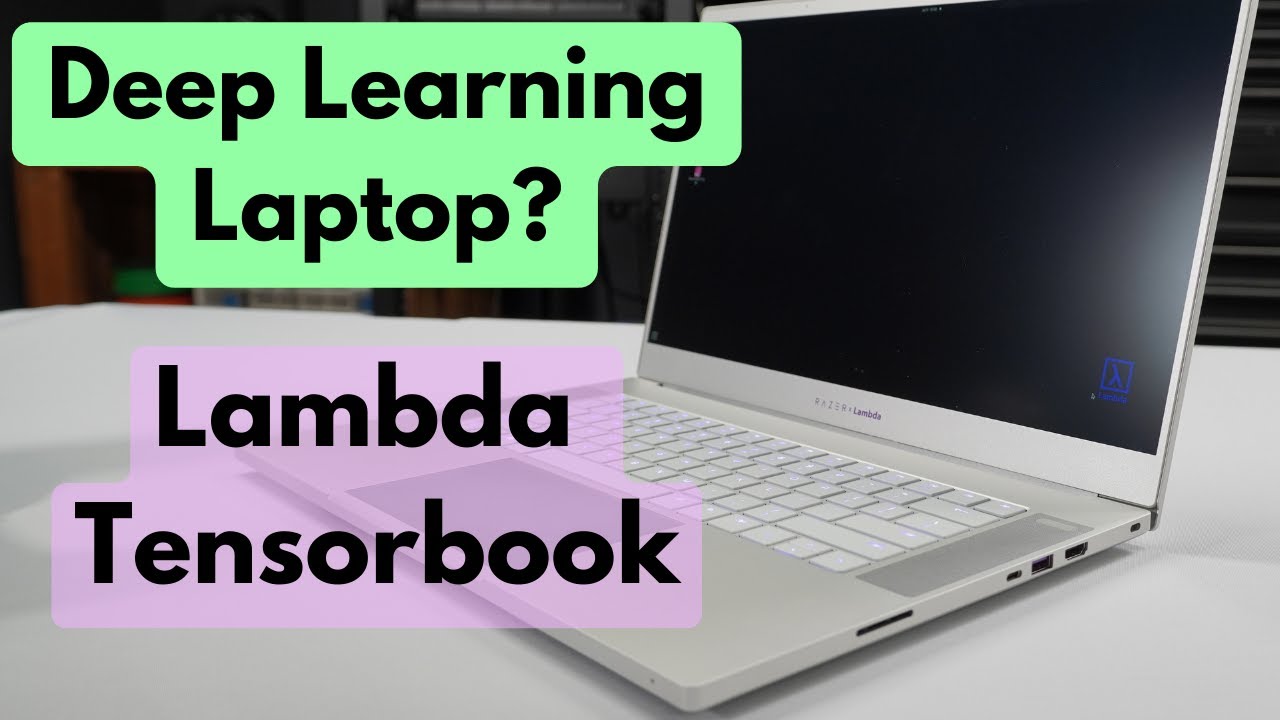
Reviewing Lambda and Razer's Tensorbook, a laptop aimed at deep learning, with 16GB of VRAM (GPU memory), 64GB of RAM, 2TB of NVMe storage and an 8-core intel i7 11800H CPU.
https://lambdalabs.com/deep-le....arning/laptops/tenso
Neural Networks from Scratch book: https://nnfs.io
Channel membership: https://www.youtube.com/channe....l/UCfzlCWGWYyIQ0aLC5
Discord: https://discord.gg/sentdex
Reddit: https://www.reddit.com/r/sentdex/
Support the content: https://pythonprogramming.net/support-donate/
Twitter: https://twitter.com/sentdex
Instagram: https://instagram.com/sentdex
Facebook: https://www.facebook.com/pythonprogramming.net/
Twitch: https://www.twitch.tv/sentdex
Deep learning, a subset of Machine learning, uses neural networks to teach computers the human thinking process. Let ProjectPro assists you on this journey of learning by providing video tutorials as well as hands-on experience of industry-level projects.
With ProjectPro, you can access a curated library of verified, solved end-to-end project solutions in data science, machine learning, and big data. It also offers Tech support and 1-1 sessions.
Check out our end to end solved projects here: https://bit.ly/3FIfIaY
Also, subscribe to our YouTube channel to never miss an update!
#shorts #deeplearning
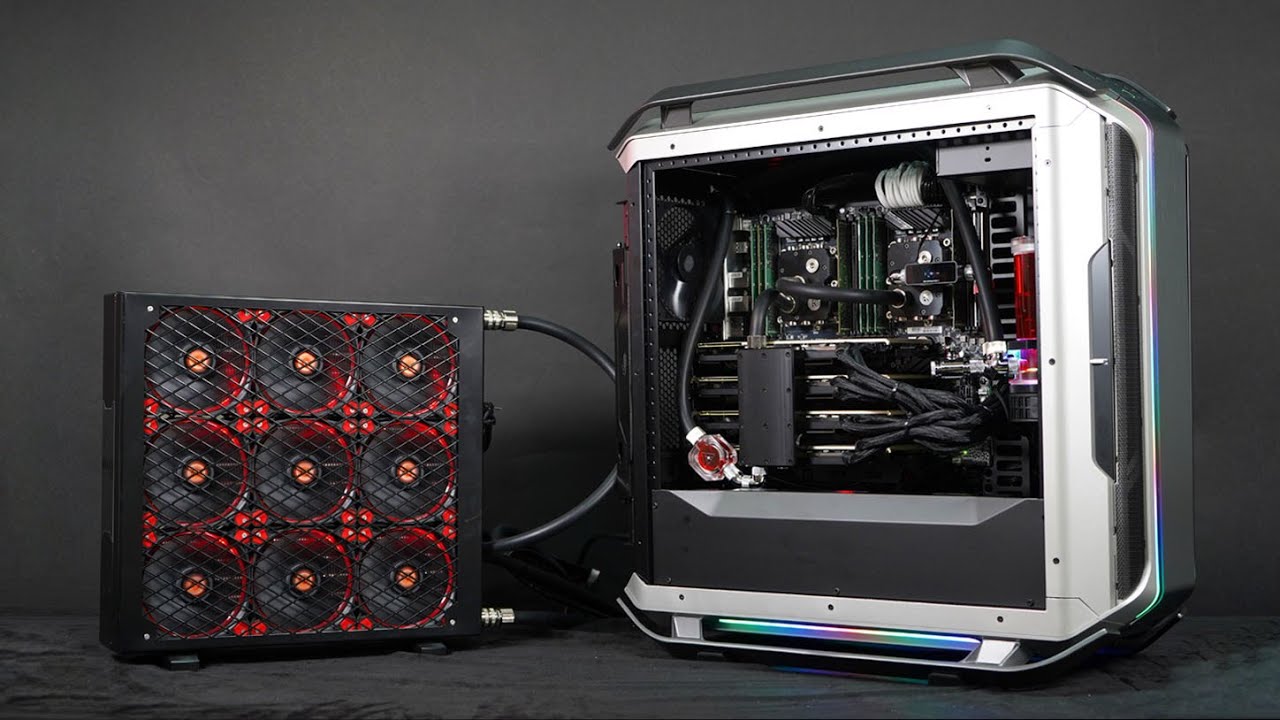
#intel#nvidia#tiranrtx
Yangcom Home Page
https://www.yangcom.co.kr
Yangcom Instagram
https://www.instagram.com/yangcom_official/
Yangcom Facebook
https://mbasic.facebook.com/YangcomPC
Yangcom Blog
https://blog.naver.com/combox0
Unstructured textual data is ubiquitous, but standard Natural Language Processing (NLP) techniques are often insufficient tools to properly analyze this data. Deep learning has the potential to improve these techniques and revolutionize the field of text analytics.
Deep Learning TV on
Facebook: https://www.facebook.com/DeepLearningTV/
Twitter: https://twitter.com/deeplearningtv
Some of the key tools of NLP are lemmatization, named entity recognition, POS tagging, syntactic parsing, fact extraction, sentiment analysis, and machine translation. NLP tools typically model the probability that a language component (such as a word, phrase, or fact) will occur in a specific context. An example is the trigram model, which estimates the likelihood that three words will occur in a corpus. While these models can be useful, they have some limitations. Language is subjective, and the same words can convey completely different meanings. Sometimes even synonyms can differ in their precise connotation. NLP applications require manual curation, and this labor contributes to variable quality and consistency.
Deep Learning can be used to overcome some of the limitations of NLP. Unlike traditional methods, Deep Learning does not use the components of natural language directly. Rather, a deep learning approach starts by intelligently mapping each language component to a vector. One particular way to vectorize a word is the “one-hot” representation. Each slot of the vector is a 0 or 1. However, one-hot vectors are extremely big. For example, the Google 1T corpus has a vocabulary with over 13 million words.
One-hot vectors are often used alongside methods that support dimensionality reduction like the continuous bag of words model (CBOW). The CBOW model attempts to predict some word “w” by examining the set of words that surround it. A shallow neural net of three layers can be used for this task, with the input layer containing one-hot vectors of the surrounding words, and the output layer firing the prediction of the target word.
The skip-gram model performs the reverse task by using the target to predict the surrounding words. In this case, the hidden layer will require fewer nodes since only the target node is used as input. Thus the activations of the hidden layer can be used as a substitute for the target word’s vector.
Two popular tools:
Word2Vec: https://code.google.com/archive/p/word2vec/
Glove: http://nlp.stanford.edu/projects/glove/
Word vectors can be used as inputs to a deep neural network in applications like syntactic parsing, machine translation, and sentiment analysis. Syntactic parsing can be performed with a recursive neural tensor network, or RNTN. An RNTN consists of a root node and two leaf nodes in a tree structure. Two words are placed into the net as input, with each leaf node receiving one word. The leaf nodes pass these to the root, which processes them and forms an intermediate parse. This process is repeated recursively until every word of the sentence has been input into the net. In practice, the recursion tends to be much more complicated since the RNTN will analyze all possible sub-parses, rather than just the next word in the sentence. As a result, the deep net would be able to analyze and score every possible syntactic parse.
Recurrent nets are a powerful tool for machine translation. These nets work by reading in a sequence of inputs along with a time delay, and producing a sequence of outputs. With enough training, these nets can learn the inherent syntactic and semantic relationships of corpora spanning several human languages. As a result, they can properly map a sequence of words in one language to the proper sequence in another language.
Richard Socher’s Ph.D. thesis included work on the sentiment analysis problem using an RNTN. He introduced the notion that sentiment, like syntax, is hierarchical in nature. This makes intuitive sense, since misplacing a single word can sometimes change the meaning of a sentence. Consider the following sentence, which has been adapted from his thesis:
“He turned around a team otherwise known for overall bad temperament”
In the above example, there are many words with negative sentiment, but the term “turned around” changes the entire sentiment of the sentence from negative to positive. A traditional sentiment analyzer would probably label the sentence as negative given the number of negative terms. However, a well-trained RNTN would be able to interpret the deep structure of the sentence and properly label it as positive.
Credits
Nickey Pickorita (YouTube art) -
https://www.upwork.com/freelan....cers/~0147b8991909b2
Isabel Descutner (Voice) -
https://www.youtube.com/user/IsabelDescutner
Dan Partynski (Copy Editing) -
https://www.linkedin.com/in/danielpartynski
Marek Scibior (Prezi creator, Illustrator) -
http://brawuroweprezentacje.pl/
Jagannath Rajagopal (Creator, Producer and Director) -
https://ca.linkedin.com/in/jagannathrajagopal
Geometric Deep Learning is able to draw insights from graph data. That includes social networks, sensor networks, the entire Internet, and even 3D Objects (if we consider point cloud data to be a graph). I'll explain how it works via a demo of me using a graph convolutional network to classify people by their interest in sports teams as well as a 3D object classification demo. At its core, it comes down to being able to learn from non-Euclidean data. Euclid's laws help define certain types of data, so I'll cover some geometry background as well. Enjoy!
Code for this video:
https://github.com/llSourcell/pytorch_geometric
Please Subscribe! And Like. And comment. Thats what keeps me going.
Want more education? Connect with me here:
Twitter: https://twitter.com/sirajraval
instagram: https://www.instagram.com/sirajraval
Facebook: https://www.facebook.com/sirajology
More learning resources:
http://sungsoo.github.io/2018/....02/01/geometric-deep
http://geometricdeeplearning.com/
https://arxiv.org/abs/1611.08097
http://3ddl.stanford.edu/CVPR1....7_Tutorial_Intrinsic
https://github.com/rusty1s/pytorch_geometric
https://pemami4911.github.io/p....aper-summaries/deep-
Join us at the School of AI:
https://theschool.ai/
Join us in the Wizards Slack channel:
http://wizards.herokuapp.com/
Please support me on Patreon:
https://www.patreon.com/user?u=3191693
Signup for my newsletter for exciting updates in the field of AI:
https://goo.gl/FZzJ5w
Hiring? Need a Job? See our job board!:
https://www.theschool.ai/jobs/
Need help on a project? See our consulting group:
https://www.theschool.ai/consulting-group/
Hit the Join button above to sign up to become a member of my channel for access to exclusive content!